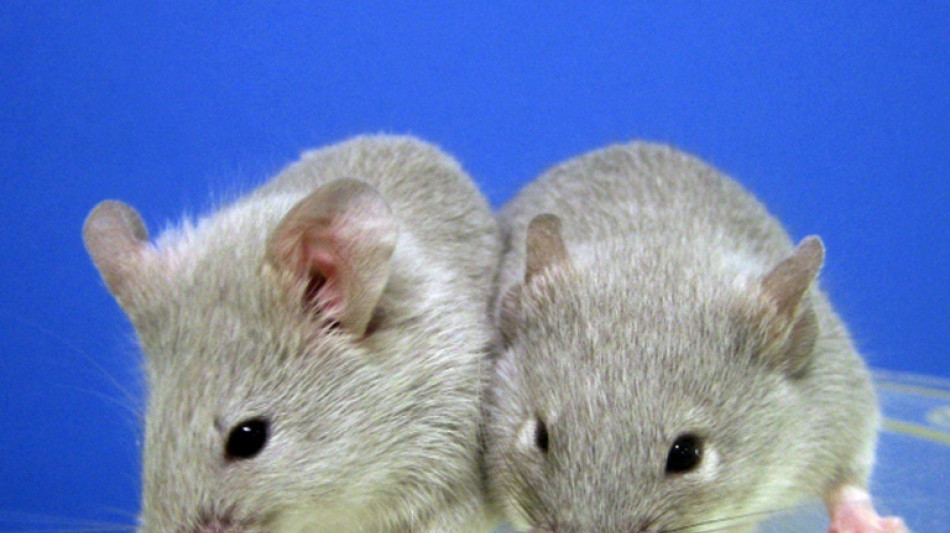
'Revolutionary': Scientists create mice with two fathers / Photo: KYOTO UNIVERSITY - JIJI/AFP/File
Scientists have created eggs using the cells of male mice for the first time, leading to the birth of seven mice with two fathers, according to research Wednesday hailed as "revolutionary".
The technique pioneered in the proof-of-concept experiment is a long way from potentially being used in humans, with obstacles including a low success rate, adaptation concerns and wide-ranging ethical considerations.
But the breakthrough raises the prospect of a raft of new reproductive possibilities, including that gay male couples -- or even a single man -- could have a biological child without needing a female egg.
The research, published in the journal Nature, was carried out by a team of scientists in Japan led by developmental biologist Katsuhiko Hayashi of the Osaka and Kyushu universities.
Hayashi and his team previously found a way to take skin cells from a female mouse and transform them into an egg that could be used to give birth to healthy pups.
For their latest research, the team aimed to do the same for male cells.
Just like humans, male mice have both an X and Y chromosome, while females have two X chromosomes.
The scientists took skin cells from the tail of a male mouse and, in a dish, turned them into what are called induced pluripotent stem cells, which can become any type of cell.
During this process around six percent of the cells lost their Y chromosome, leaving only an X chromosome -- meaning they were what is known as XO.
Using a fluorescent protein and a drug called reversine, the researchers managed to duplicate the existing X chromosome in these cells, creating an XX set.
- One percent success rate -
The cells were then used to create eggs, which were fertilised with the sperm of a different male mouse and implanted into the uteruses of surrogate female mice.
Out of 630 attempts, seven pups were born, representing a success rate of just over one percent.
The pups do not show any sign of abnormalities and are fertile themselves, the study said.
Hayashi, who first presented the findings at the Third International Summit on Human Genome Editing in London last week, warned that many obstacles remained before the technology could be used for humans.
"There is a big difference between a mouse and a human," he told the summit.
Nitzan Gonen, the head of the sex determination laboratory at Israel's Bar-Ilan University, told AFP that it was a "revolutionary paper", while cautioning that there was a long way to go.
Theoretically, the technique could allow two same-sex male partners to have a baby, one providing the sperm and the other the egg, said Gonen, who was not involved in the research.
One man could even provide both the sperm and the egg, which Gonen said could be "a bit more like cloning, like what they did with Dolly the sheep".
- 'Milestone' -
Jonathan Bayerl and Diana Laird, stem cell and reproductive experts at the University of California, San Francisco, said it was not yet known if the process would even work with human stem cells.
Nonetheless, the research marks "a milestone in reproductive biology", they commented in Nature.
One potential future application could be to bring an endangered species with only one surviving male back from the brink, provided there was a suitable female surrogate from another species, they said.
But Gonen warned that the process was currently "extremely inefficient", with 99 percent of the embryos not surviving.
And while pregnancy takes only three weeks in mice, it lasts nine months in humans, creating much more time for something to go wrong, she added.
If she had to guess, Gonen estimated that "scientifically speaking" the technique could be ready for humans in around 10 to 15 years.
But that did include the time it could take to wade through the ethical considerations that may arise, she added.
"The fact that we can do something does not necessarily mean we want to do it -- especially when we are talking about a new human being."
A.El-Ahbaby--DT