Dubai Telegraph - Fly away home: rare Eastern Sarus cranes released in Thailand

EUR -
AED 4.301716
AFN 77.102387
ALL 96.616471
AMD 443.59572
ANG 2.096746
AOA 1074.110656
ARS 1684.073797
AUD 1.758993
AWG 2.108396
AZN 1.969468
BAM 1.957105
BBD 2.345093
BDT 142.274846
BGN 1.956007
BHD 0.441553
BIF 3442.853937
BMD 1.171331
BND 1.509332
BOB 8.045363
BRL 6.406593
BSD 1.164301
BTN 104.676122
BWP 15.509538
BYN 3.38224
BYR 22958.084827
BZD 2.341701
CAD 1.616097
CDF 2613.239193
CHF 0.932854
CLF 0.027423
CLP 1075.808999
CNY 8.274988
CNH 8.264125
COP 4497.758224
CRC 573.294418
CUC 1.171331
CUP 31.040268
CVE 110.338556
CZK 24.254104
DJF 207.332642
DKK 7.469173
DOP 74.991593
DZD 152.193302
EGP 55.679188
ERN 17.569963
ETB 181.362875
FJD 2.661028
FKP 0.878173
GBP 0.875095
GEL 3.150162
GGP 0.878173
GHS 13.36591
GIP 0.878173
GMD 86.093306
GNF 10127.924632
GTQ 8.912942
GYD 243.592389
HKD 9.11565
HNL 30.667099
HRK 7.533972
HTG 152.464242
HUF 384.781097
IDR 19525.616879
ILS 3.760118
IMP 0.878173
INR 105.789742
IQD 1525.229804
IRR 49342.312982
ISK 148.653646
JEP 0.878173
JMD 186.706858
JOD 0.830471
JPY 182.433563
KES 151.043402
KGS 102.432364
KHR 4665.189668
KMF 494.301362
KPW 1054.231935
KRW 1724.076032
KWD 0.359305
KYD 0.970243
KZT 603.629828
LAK 25249.724748
LBP 104262.760889
LKR 359.538149
LRD 205.499626
LSL 19.790509
LTL 3.458635
LVL 0.708527
LYD 6.336359
MAD 10.761174
MDL 19.82213
MGA 5198.532133
MKD 61.550841
MMK 2459.697828
MNT 4154.37601
MOP 9.332201
MRU 46.432945
MUR 53.96325
MVR 18.043867
MWK 2018.971787
MXN 21.296909
MYR 4.814311
MZN 74.859436
NAD 19.790509
NGN 1696.918251
NIO 42.849297
NOK 11.831326
NPR 167.483226
NZD 2.014724
OMR 0.450386
PAB 1.164276
PEN 3.91441
PGK 4.940378
PHP 69.135453
PKR 329.125834
PLN 4.227977
PYG 7933.458103
QAR 4.244229
RON 5.090017
RSD 117.381377
RUB 92.827568
RWF 1694.651428
SAR 4.395478
SBD 9.640746
SCR 16.086003
SDG 704.554117
SEK 10.833077
SGD 1.515035
SHP 0.878802
SLE 28.228883
SLL 24562.220258
SOS 664.251324
SRD 45.233288
STD 24244.183864
STN 24.516763
SVC 10.187748
SYP 12951.233403
SZL 19.783611
THB 37.189173
TJS 10.769872
TMT 4.111371
TND 3.422281
TOP 2.820284
TRY 49.900805
TTD 7.89523
TWD 36.561336
TZS 2881.45984
UAH 49.291291
UGX 4156.771079
USD 1.171331
UYU 45.630419
UZS 13975.25684
VES 301.742191
VND 30838.213177
VUV 143.479984
WST 3.256414
XAF 656.402992
XAG 0.018862
XAU 0.000278
XCD 3.16558
XCG 2.098417
XDR 0.816355
XOF 656.4086
XPF 119.331742
YER 279.391668
ZAR 19.827656
ZMK 10543.376279
ZMW 27.076397
ZWL 377.168059
  • CMSD

    0.0260

    23.306

    +0.11%

  • CMSC

    0.0500

    23.35

    +0.21%

  • SCS

    0.0200

    16.14

    +0.12%

  • BCC

    0.5400

    77.55

    +0.7%

  • NGG

    0.4300

    75.07

    +0.57%

  • RBGPF

    3.1200

    81.17

    +3.84%

  • GSK

    0.4400

    48.85

    +0.9%

  • BCE

    0.5250

    23.715

    +2.21%

  • JRI

    -0.0300

    13.69

    -0.22%

  • RIO

    0.1500

    76.39

    +0.2%

  • RYCEF

    0.2300

    14.85

    +1.55%

  • RELX

    0.3200

    40.4

    +0.79%

  • VOD

    0.0950

    12.655

    +0.75%

  • AZN

    -0.1400

    91.37

    -0.15%

  • BP

    -0.1600

    35.72

    -0.45%

  • BTI

    0.1700

    58.93

    +0.29%

Fly away home: rare Eastern Sarus cranes released in Thailand
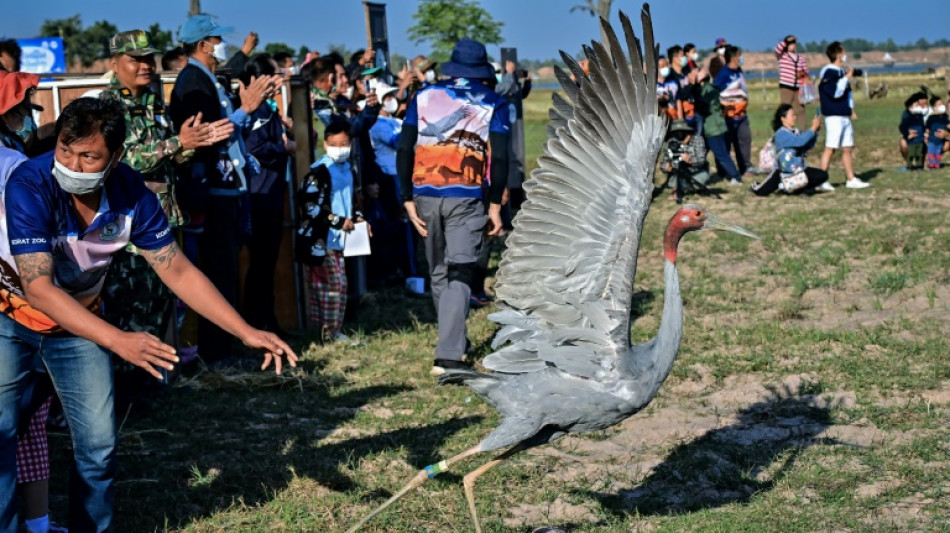
Fly away home: rare Eastern Sarus cranes released in Thailand / Photo: Lillian SUWANRUMPHA - AFP

Fly away home: rare Eastern Sarus cranes released in Thailand

As the sun came up, 13 Thai Eastern Sarus cranes were released over a rippling reservoir in northeast Thailand, the latest effort to revive the almost-extinct species in the kingdom.

Text size:

More commonly known as Thai cranes, the birds nearly disappeared from the country roughly 50 years ago -- they were last spotted in the wild in 1968 -- before a collaboration between the Thai government, Nakhon Ratchasima Zoo and United Nations to save them.

A breeding programme, using fowl donated by Cambodia, began in 1989, with the first reintroduction in 2011.

Sarus cranes are classed by the ICNC as "vulnerable", with an estimated 15,000 remaining in the wild -- with the Thai sub-species having been thought to have disappeared from Thailand's wild wetlands.

But since 2011, more than 150 captively-bred birds -- which can grow to up to six feet (1.8 metres) and weigh almost seven kilograms (15 pounds) -- have been released in Buriram province.

"It is the only place where the Thai cranes are able to live and reproduce on their own," said Governor Chaiwat Chuntirapong.

The birds were transported in large, specially adapted boxes -- their red-feathered heads watching through mesh windows -- from the Wetland and Eastern Sarus Crane Conservation Center where they were bred to the Huai Chorakhe Mak Reservoir.

The latest flock of 13 cranes were released all at once on Christmas Day. The tall birds loudly honked and clumsily flapped as they unsteadily took to the skies accompanied by cheering children and spectators.

It was the final moment in a long journey for the researchers, who carefully nurtured the cranes from hatching, gradually introduced them to the wild and then took them to their final flight to freedom.

"The herdsman wears a suit that hides her body and wears a bird's head puppet on her hands to teach the birds everything from feeding to familiarising them with nature," said Nakhon Ratchasima Zoo researcher Tanat Uttaraviset.

As a result of the long process, roughly 60 to 70 percent of the birds survive in the wild, he said.

Prior to their release, each bird is micro-chipped and tagged, allowing researchers to track them and improve the conservation efforts.

As well as rearing and releasing the cranes, an important part of the programme has been educating people about the species and the environment.

Huai Chorakhe Mak Reservoir was chosen partly thanks to its natural proliferation of water chestnuts -- an important food source for cranes in the dry season.

But their habitat remains threatened by the "widespread invasion of agriculture", said director of Nakhon Ratchasima Zoo Thanachon Kensing.

The zoo has established a learning centre, teaching tourists and locals about how to better care for the environment the birds need to survive.

"Changing villagers' attitudes is difficult," Thanachon admitted.

"But if we can communicate with them... this project will be successful," he said.

Watching his red-headed charges soar off over the sparkling waters, researcher Tanat had just one hope.

"The ultimate goal is to secure the crane population," he said.

R.El-Zarouni--DT