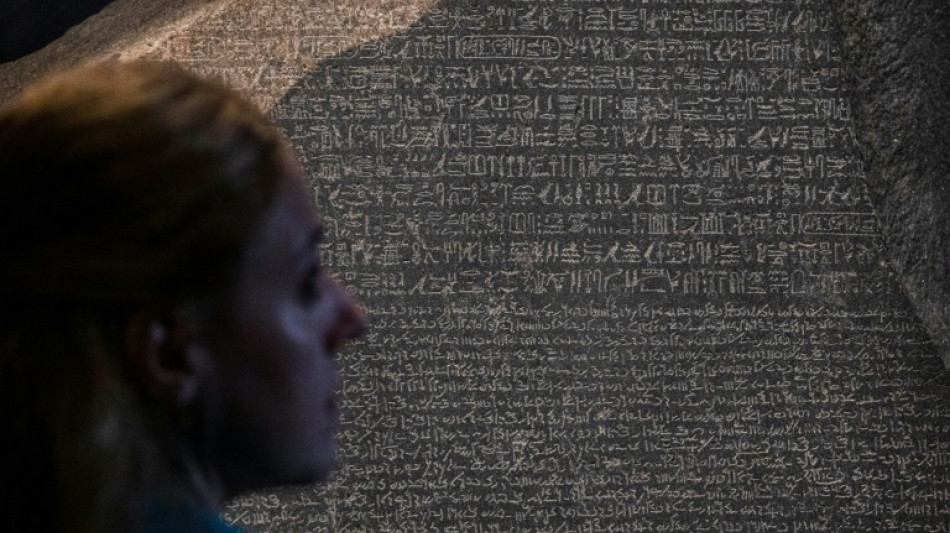
British Museum hails Rosetta Stone's role in cracking hieroglyphs / Photo: CARLOS JASSO - AFP
The Rosetta Stone stars in a new exhibition opening Thursday at the British Museum marking one of the most significant dates in Egyptology -- 200 years after a French scholar finally cracked its code and deciphered hieroglyphs.
The exhibition comes with the British Museum under pressure from some Egyptologists to hand the Rosetta Stone back to Cairo at a time when UK institutions are beginning to return to other countries artefacts looted during the colonial era.
Once seen as magical symbols unrelated to spoken language, Egyptian hieroglyphs were swathed in mystery for centuries until philologist Jean-Francois Champollion cracked their meaning in 1822.
French troops had discovered the stone in the walls of an Egyptian fort in 1799 and gave it to British forces as part of a surrender agreement. The British Museum has displayed it since 1802.
The basalt slab dating from 196 BC was so crucial because it has inscriptions of identical meaning in three languages: hieroglyphs, an ancient Egyptian vernacular script called Demotic and Ancient Greek, which provided the translation key.
"We decided because the Rosetta Stone was such an important key to that decipherment that we will do this properly: with an exhibition that also features our star objects," said Ilona Regulski, curator of Egyptian written culture at the museum.
"It's a wonderful moment to celebrate."
Yet the anniversary exhibition is controversial to some.
Egyptian archaeologist and former antiquities minister Zahi Hawass recently released a petition for the return of the stone and other foreign-held treasures he considers "stolen".
The British Museum told AFP that Egypt has never made a formal request for the Rosetta Stone's return.
- 'Muddied legacy' -
Regulski added that it was a "universal object" and "it doesn't really matter where it is, as long as it's available to people".
Activists from a group called Culture Unstained protested in the museum on Tuesday calling for Cairo to release political prisoners including British activist Alaa Abdel Fattah, and criticising sponsorship by BP oil giant.
The exhibition, "Hieroglyphs: unlocking ancient Egypt" tracks hieroglyphs' fall into obscurity after Egyptians switched to other forms of script.
It explores the rich discoveries about life in ancient Egypt that came from unlocking the symbols.
"For the first time in 3,000 years, Ancient Egyptians spoke directly to us," the museum's director Hartwig Fischer said.
The exhibition does acknowledge attempts by non-Europeans to grasp the symbols but focuses on the race between Western scholars to crack the code.
"Our travellers... went to Egypt and were amazed by all these intriguing picture-like signs on the temple walls," said Regulski.
This led to their "interpretation as magical signs, as secret knowledge, the idea that if you would be able to decipher hieroglyphs, you will understand the meaning of everything."
Champollion was the first to fully grasp the logic of hieroglyphs, outdoing an English rival, Thomas Young, who was in correspondence with him.
The exhibition suggests the French scholar has a "muddied legacy", however, and "often relied on the work of others", including Young.
It also depicts the more bizarre side of Egyptology including special events where enthusiasts unwrapped a mummified body and took lengths of bandages home as souvenirs.
H.El-Hassany--DT