
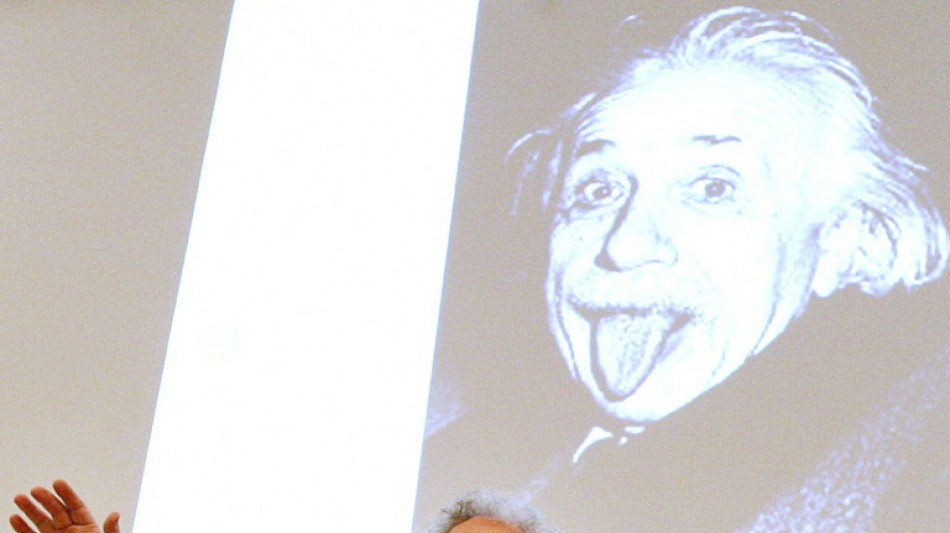
Quantum entanglement: the 'spooky' science behind physics Nobel / Photo: HERBERT PFARRHOFER - APA/AFP/File
This year's physics Nobel prize was awarded Tuesday to three men for their work on a phenomenon called quantum entanglement, which is so bizarre and unlikely that Albert Einstein was sceptical, famously calling it "spooky".
So how exactly does it work?
Even people with degrees in physics struggle to understand it -- and some who do still find parts "hard to swallow," said Chris Phillips, a physicist at Imperial College London.
To explain the phenomenon he used the example of a photon -- "a single unit of light" -- though the theory is believed to hold true for other particles.
If a photon is put through a "special crystal", it can be split into separate photons, he told AFP.
"They're different colours from the one you started with," Phillips said, "but because they started from one photon, they are entangled".
This is where it gets weird. If you measure one photon it instantly affects the other -- no matter how far you separate them.
This is not supposed to happen. Einstein's theory of relativity says nothing can travel faster than the speed of light.
And they are inextricably bound together. When you observe the first photon, there are even odds that it will show itself as "either up or down", Phillips said. But if it is up, then its twin is instantly forced down, or vice versa.
- New way to kill Schroedinger's cat -
He extended the famous quantum thought experiment of Schroedinger's cat, in which a hypothetical animal locked inside a box with a flask of poison remains simultaneously alive and dead -- until the moment the box is opened.
For quantum entanglement, if you have two cats in two boxes, by opening one you would "kill that cat and instantaneously -- on the other side of the universe -- the other cat has been killed," Phillips said.
Phillips has seen this "extremely strange thing" first hand in his laboratory, where he has two beams of photons set up.
"I can put my hand in one beam and something happens to the other beam on the other side of the room instantaneously -- I see a needle flick," he said.
"That would still be true if my laboratory was millions of miles across."
It was the fact that this occurs instantly that bothered Einstein, who dismissed this element of quantum entanglement -- called non-locality -- as "spooky action at a distance" in 1935.
He instead believed that "hidden variables" must somehow be behind what was happening.
In 1964, influential physicist John Stewart Bell found a way to measure whether there were in fact hidden variables inside quantum particles.
Two decades later, French physicist Alain Aspect, who won the Nobel on Tuesday, and his team were among the first able to test Bell's theory in a laboratory.
By testing its limits, they found that "quantum mechanics resists all possible attacks," Aspect said in an interview published by the Nobel Foundation after his win on Tuesday.
- 'Totally crazy' -
In doing so, Aspect proved Einstein wrong. But he was magnanimous to history's greatest physicist.
"I like to say that Einstein's owes a great, great merit in raising the question," Aspect said, adding that "non-locality does not allow you to send a useful message faster than light".
Even Aspect finds it weird to have accepted the idea of something "totally crazy" like non-locality into "my mental images," he said.
The other physics Nobel winners, Austria's Anton Zeilinger and John Clauser of the US, also tested Bell's theory, ruling out loopholes and helping pave the way for what has been called the "second quantum revolution".
Discoveries by Zeilinger, dubbed the "quantum pope", have shown the potential for quantum entanglement to be used in encryption, quantum teleportation and more.
Phillips from Imperial College London has developed a prototype the size of a hi-fi sound system that uses quantum entanglement to diagnose breast cancer.
"We have to be humble in the face of physics," Phillips said, adding that it was the same as any another aspect of nature.
"It just is."
A.Al-Mehrazi--DT



