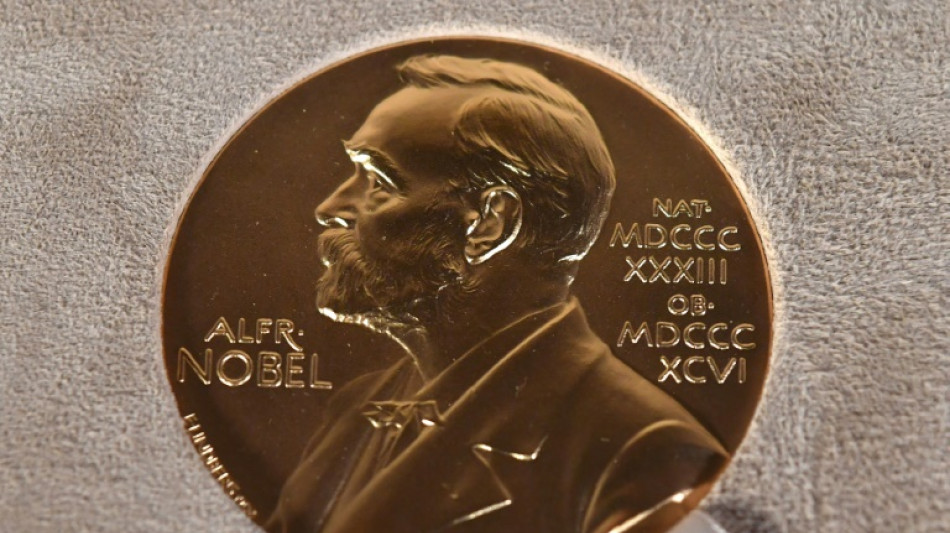
Nobel Physics Prize could focus on light / Photo: Angela Weiss - POOL/AFP/File
Bending and manipulating light to make objects invisible or harnessing it more efficiently to produce electricity are among the discoveries tipped to win the Nobel Physics Prize on Tuesday.
The Royal Swedish Academy of Sciences is due to announce the winner at 11:45 am (0945 GMT).
Last year, the academy honoured Syukuro Manabe, of Japan and the United States, and German Klaus Hasselmann for their research on climate models, while Italian Giorgio Parisi also won for his work on the interplay of disorder and fluctuations in physical systems.
David Pendlebury, head of Clarivate -- an organisation which keeps a close eye on potential laureates in the sciences -- said the committee is likely to stay terrestrial this year.
"There have been so many astrophysics, cosmology prizes, just in the last few years. So I don't think that's on the table this year," he told AFP.
He said a likely pick could be Britain's John B. Pendry, who has become famous for his "invisibility cloak," where he uses materials to bend light to make objects invisible.
Other potential winners are Sajeev John and American Eli Yablonovitch, who in 1987 discovered photonic crystals that can control and manipulate the flow of light.
- Photovoltaics? -
Ulrika Bjorksten, a science commentator for Swedish public radio, said the academy could also focus on photovoltaics: the conversion of light to electricity.
Bjorksten said work on perovskite -- a material discovered by the Russian mineralogist Lev Perovski in the 19th century -- might get recognised.
This could steer the academy towards Britain's Henry Snaith, a physics professor at the University of Oxford, who is developing new materials and structures for hybrid solar cells.
The relatively recent discovery that metal halide perovskites can operate extremely efficiently in thin film solar cells makes him a contender, Bjorksten said.
"He was the origin for why there was so much attention given to perovskite," Bjorksten told AFP.
South Korea's Nam-Gyu Park could also be a candidate for his research into improving the stability of photovoltaic cells.
Specialists in photovoltaics on the other hand could potentially be overlooked since the field is so vast, according to Bjorksten.
"It's really difficult... because there are so many involved," Bjorksten said.
Linus Brohult, editor of the science desk at Swedish public broadcaster SVT, said the microphysics expert Stephen Quake, could be considered for work on microscopic fluid dynamics.
- Women absent -
Only four women -- Marie Curie (1903), Maria Goeppert Mayer (1963), Donna Strickland (2018) and Andrea Ghez (2020) -- have won the Nobel Physics Prize since the award was instituted in 1901.
"It reflects the unfair conditions in society, particularly in years past but still existing," Goran Hansson, secretary general of the Swedish Academy of Sciences, told AFP last year.
Quotas however have been ruled out.
"We want every laureate (to) be accepted... because they made the most important discovery, and not because of gender or ethnicity," Hansson said.
Last year, 12 men and one woman won Nobel Prizes, with all of the science nods going to men.
The physics prize is followed by chemistry on Wednesday, with the highly watched literature and peace prizes announced on Thursday and Friday respectively.
For the literature prize, critics told AFP they thought the Swedish Academy may go for a more mainstream author this year, after selecting lesser-known writers the past two years.
Last year, Tanzanian author Abdulrazak Gurnah won, while US poet Louise Gluck was crowned in 2020.
The peace prize is expected to hold a special significance this year given the Russian invasion of Ukraine.
The International Criminal Court, tasked with investigating war crimes in Ukraine, has been mentioned as a possible laureate this year, along with jailed Russian dissident Alexei Navalny and Belarusian opposition leader Svetlana Tikhanovskaya.
Y.I.Hashem--DT