Dubai Telegraph - Webb telescope spots its first star -- and takes a selfie

EUR -
AED 4.228872
AFN 71.972068
ALL 95.909842
AMD 434.62105
ANG 2.060869
AOA 1055.922261
ARS 1612.664041
AUD 1.626132
AWG 2.075573
AZN 1.962349
BAM 1.950864
BBD 2.321646
BDT 141.447046
BGN 1.897259
BHD 0.434591
BIF 3421.857394
BMD 1.151497
BND 1.469501
BOB 7.96509
BRL 6.015764
BSD 1.152694
BTN 106.183656
BWP 15.53909
BYN 3.398317
BYR 22569.334493
BZD 2.318365
CAD 1.568033
CDF 2507.959919
CHF 0.903603
CLF 0.026455
CLP 1044.636615
CNY 7.906464
CNH 7.925002
COP 4261.550951
CRC 543.330067
CUC 1.151497
CUP 30.514661
CVE 109.985776
CZK 24.434471
DJF 205.274212
DKK 7.472194
DOP 70.41277
DZD 152.14506
EGP 60.26191
ERN 17.27245
ETB 179.932431
FJD 2.545929
FKP 0.859123
GBP 0.862707
GEL 3.126354
GGP 0.859123
GHS 12.489347
GIP 0.859123
GMD 84.64225
GNF 10105.34523
GTQ 8.839097
GYD 241.164032
HKD 9.012851
HNL 30.512273
HRK 7.534821
HTG 150.989955
HUF 389.892131
IDR 19472.95998
ILS 3.606085
IMP 0.859123
INR 106.44101
IQD 1510.053265
IRR 1522019.494717
ISK 144.385837
JEP 0.859123
JMD 180.413545
JOD 0.816388
JPY 183.355687
KES 148.831121
KGS 100.697856
KHR 4626.275212
KMF 490.537296
KPW 1036.385217
KRW 1720.37028
KWD 0.353567
KYD 0.960595
KZT 564.217802
LAK 24695.163427
LBP 103228.165394
LKR 358.385716
LRD 210.95726
LSL 19.043312
LTL 3.40007
LVL 0.696529
LYD 7.357322
MAD 10.802176
MDL 20.016878
MGA 4777.973736
MKD 61.615023
MMK 2418.166226
MNT 4111.007847
MOP 9.292973
MRU 45.808704
MUR 52.864827
MVR 17.790309
MWK 1998.877461
MXN 20.552114
MYR 4.521965
MZN 73.591629
NAD 19.042487
NGN 1603.874006
NIO 42.424139
NOK 11.142746
NPR 169.893849
NZD 1.964862
OMR 0.442747
PAB 1.152724
PEN 3.944657
PGK 4.971379
PHP 68.561306
PKR 322.020359
PLN 4.26854
PYG 7463.1826
QAR 4.202604
RON 5.093645
RSD 117.390523
RUB 91.720314
RWF 1685.280067
SAR 4.320981
SBD 9.264001
SCR 15.257101
SDG 692.049195
SEK 10.754691
SGD 1.472235
SHP 0.863921
SLE 28.314872
SLL 24146.308417
SOS 657.650391
SRD 43.027403
STD 23833.655954
STN 24.438382
SVC 10.086393
SYP 127.674885
SZL 19.048221
THB 37.022348
TJS 11.04889
TMT 4.030238
TND 3.388926
TOP 2.772528
TRY 50.798269
TTD 7.822277
TWD 36.760144
TZS 2993.891239
UAH 51.039225
UGX 4315.120012
USD 1.151497
UYU 46.092982
UZS 13988.486971
VES 503.96085
VND 30255.574683
VUV 137.716839
WST 3.12565
XAF 654.298751
XAG 0.01351
XAU 0.000224
XCD 3.111977
XCG 2.077516
XDR 0.812706
XOF 654.335594
XPF 119.331742
YER 274.741289
ZAR 19.283306
ZMK 10364.857819
ZMW 22.392028
ZWL 370.781454
  • RBGPF

    0.1000

    82.5

    +0.12%

  • CMSC

    -0.1250

    23.115

    -0.54%

  • RYCEF

    -0.5500

    16.95

    -3.24%

  • NGG

    1.6400

    91.33

    +1.8%

  • RELX

    -0.1300

    34.63

    -0.38%

  • GSK

    -1.1100

    54.04

    -2.05%

  • VOD

    -0.0450

    14.355

    -0.31%

  • BTI

    0.1550

    59.315

    +0.26%

  • RIO

    -0.6850

    91.395

    -0.75%

  • BCC

    -1.7700

    70.13

    -2.52%

  • CMSD

    -0.0670

    23.083

    -0.29%

  • BCE

    -0.0750

    25.815

    -0.29%

  • JRI

    0.1500

    13

    +1.15%

  • BP

    0.9000

    42.46

    +2.12%

  • AZN

    -1.3050

    192.005

    -0.68%

Webb telescope spots its first star -- and takes a selfie

Webb telescope spots its first star -- and takes a selfie

Star light, star bright, the James Webb Space Telescope has seen its first star (though it wasn't quite tonight) -- and even taken a selfie, NASA announced Friday.

Text size:

The steps are part of the months-long process of aligning the observatory's enormous golden mirror that astronomers hope will begin unraveling the mysteries of the early Universe by this summer.

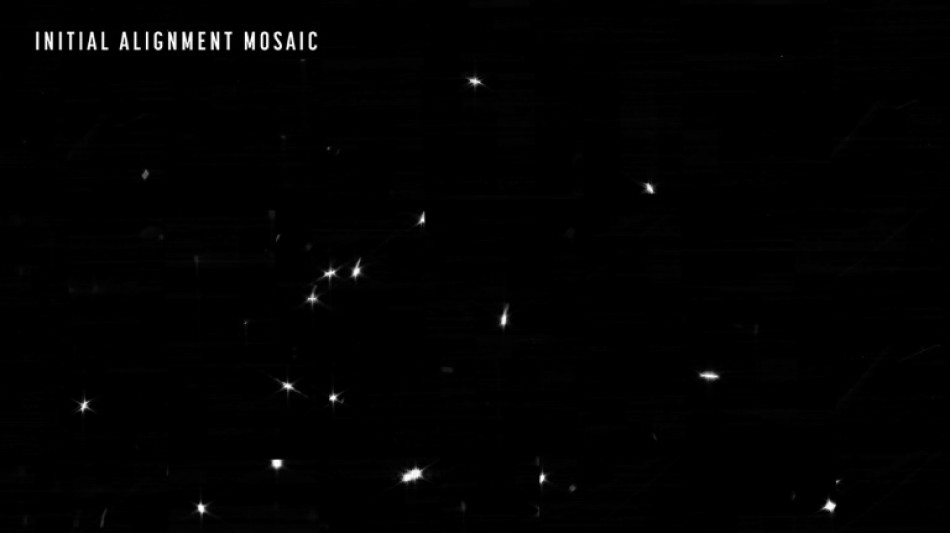
The first picture sent back of the cosmos is far from stunning: 18 blurry white dots on a black background, all showing the same object: HD 84406 a bright, isolated star in the constellation Ursa Major.

But in fact it represents a major milestone. The 18 dots were captured by the primary mirror's 18 individual segments -- and the image is now the basis for aligning and focusing those hexagonal pieces.

The light bounced off the segments to Webb's secondary mirror, a round object located at the end of long booms, and then to the Near Infrared Camera (NIRCam) instrument -- Webb's main imaging device.

"The entire Webb team is ecstatic at how well the first steps of taking images and aligning the telescope are proceeding," said Marcia Rieke, principal investigator for the NIRCam instrument and regents professor of astronomy, University of Arizona, in a statement.

"We were so happy to see that light make its way into NIRCam."

The image capturing process began on February 2, with Webb pointing at different positions around the predicted location of the star.

Though Webb's initial search covered an area of the sky about equal to the size of the full Moon, the dots were all located near the center portion, meaning the observatory is already relatively well positioned for final alignment.

To aid the process, the team also captured a "selfie" taken not through an externally mounted camera but through a special lens on board NIRCam.

NASA had previously said a selfie wasn't possible, so the news comes as a welcome bonus for space fans.

"I think pretty much the reaction was holy cow," Lee Feinberg, Webb optical telescope element manager, told reporters in a call, explaining that the team wasn't sure it was possible to obtain such an image using starlight alone.

The $10 billion observatory launched from French Guiana on December 25 and is now in an orbit that is aligned with the Earth's around the Sun, one million miles (1.5 million kilometers away) from our planet, in a region of space called the second Lagrange point.

Webb will begin its science mission by summer, which includes using its high resolution instruments to peer back in time 13.5 billion years to the first generation of galaxies that formed after the Big Bang.

Visible and ultraviolet light emitted by the very first luminous objects has been stretched by the Universe's expansion, and arrives today in the form of infrared, which Webb is equipped to detect with unprecedented clarity.

Its mission also includes the study of distant planets, known as exoplanets, to determine their origin, evolution and habitability.

H.Sasidharan--DT