Tracing uncertainty: Google harnesses quantum mechanics at California lab / Photo: Frederic J. BROWN - AFP
Outside, balmy September sunshine warms an idyllic coast, as California basks in yet another perfect day.
Inside, it's minus 460 Fahrenheit (-273 Celsius) in some spots, pockets of cold that bristle with the impossible physics of quantum mechanics -- a science in which things can simultaneously exist, not exist and also be something in between.
This is Google's Quantum AI laboratory, where dozens of super-smart people labor in an office kitted out with climbing walls and electric bikes to shape the next generation of computers -- a generation that will be unlike anything users currently have in their pockets or offices.
"It is a new type of computer that uses quantum mechanics to do computations and allows us... to solve problems that would otherwise be impossible," explains Erik Lucero, lead engineer at the campus near Santa Barbara.
"It's not going to replace your mobile phone, your desktop; it's going to be working in parallel with those things."
Quantum mechanics is a field of research that scientists say could be used one day to help limit global warming, design city traffic systems or develop powerful new drugs.
The promises are so great that governments, tech giants and start-ups around the world are investing billions of dollars in it, employing some of the biggest brains around.
- Schrodinger's cat -
Old fashioned computing is built on the idea of binary certainty: tens of thousands of "bits" of data that are each definitely either "on" or "off," represented by either a one or a zero.
Quantum computing uses uncertainty: its "qubits" can exist in a state of both one-ness and zero-ness in what is called a superposition.
The most famous illustration of a quantum superposition is Schrodinger's cat -- a hypothetical animal locked in a box with a flask of poison which may or may not shatter.
While the box is shut, the cat is simultaneously alive and dead. But once you interfere with the quantum state and open the box, the question of the cat's life or death is resolved.
Quantum computers use this uncertainty to perform lots of seemingly contradictory calculations at the same time -- a bit like being able to go down every possible route in a maze all at once, instead of trying each one in series until you find the right path.
The difficulty for quantum computer designers is getting these qubits to maintain their superposition long enough to make a calculation.
As soon as something interferes with them -- noise, muck, the wrong temperature -- the superposition collapses, and you're left with a random and likely nonsensical answer.
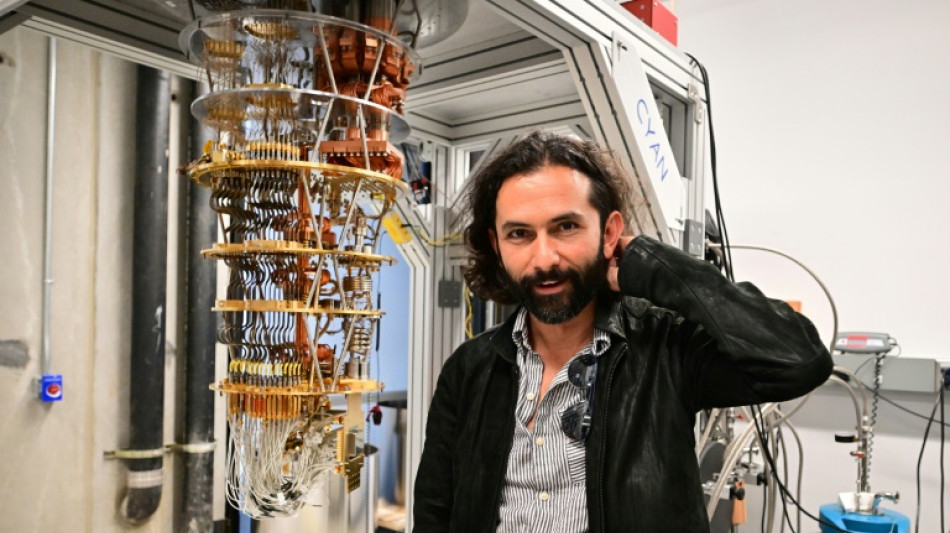
The quantum computer Google showed off to journalists resembles a steampunk wedding cake hung upside-down from a support structure.
Each layer of metal and curved wires gets progressively colder, down to the final stage, where the palm-sized processor is cooled to just 10 Millikelvin, or about -460 Fahrenheit (-273 Celsius).
That temperature -- only a shade above absolute zero, the lowest temperature possible in the universe -- is vital for the superconductivity Google's design relies on.
While the layer-cake computer is not huge -- about half a person high -- a decent amount of lab space is taken up with the equipment to cool it -- pipes whoosh overhead with helium dilutions compressing and expanding, using the same process that keeps your refrigerator cold.
- Future -
But... what does it all actually do?
Well, says Daniel Lidar, an expert in quantum systems at the University of Southern California, it's a field that promises much when it matures, but which is still a toddler.
"We've learned how to crawl but we've certainly not yet learned how to how to walk or jump or run," he told AFP.
The key to its growth will be solving the problem of the superpositional collapses -- the opening of the cat's box -- to allow for meaningful calculations.
As this process of error correction improves, problems such as city traffic optimization, which is fiendishly hard on a classical computer because of the number of independent variables involved -- the cars themselves -- could come within reach, said Lidar.
"On (an error-corrected) quantum computer, you could solve that problem," he said.
For Lucero and his colleagues, these future possibilities are worth the brain ache.
"Quantum mechanics is one of the best theories that we have today to experience nature. This is a computer that speaks the language of nature.
"And if we want to go out and figure out these really challenging problems, to help save our planet, and things like climate change, than having a computer that can do exactly that, I'd want that."
A.Al-Mehrazi--DT