Climate change fuels drop in Albania's migrant birds
Thousands of migratory birds have failed to make their annual visit to Albania's western coast this winter, experts say, pointing to climate change, overfishing and urbanisation as likely factors.
The number of waterbirds recorded in January 2022 in the Divjaka-Karavasta wetlands -- an internationally important wintering site along the European migratory flyway –- was 25 percent lower than at this time last year.
Western Albania recorded the drop during the annual International Waterbird Census, a three-day global event to monitor the migration patterns of waterfowl across the world. Several species are affected by the decline, according to Taulant Bino from the Albanian Ornithological Society.
"We discovered that some 9,000 waterbirds are missing from the Divjaka-Karavasta lagoons compared to last year," said Ardian Koci, head of the Divjaka-Karavasta National Park, where the protected wetlands are located.
Koci told AFP a total of 25,000 birds were counted in Divjaka-Karavasta -– one of the most important wetland ecosystems in the Mediterranean -- during the census on January 15-16, as compared to 34,000 in the survey a year earlier.
"The reasons are multiple but above all, it is global warming that has disrupted the migration and breeding seasons," Koci explained.
Nexhip Hysolokaj, a regional biodiversity expert, said scientists in Albania had tracked a rapid decline in migratory bird populations over the past three years.
- Disruptive weather patterns -
And while scientists say more research is needed to understand exactly how climate change is affecting birds, some point to the simple fact that ever-warmer weather means certain species no longer need to leave their northern breeding grounds when winter comes in order to find food further south.
"If there aren’t extreme temperatures in northern Europe, they prefer not to move, or they just migrate over shorter distances," said Mirjan Topi, the author of the first guide to Albania's birds.
In recent years, several species of migrating geese -- including the Greylag Goose, the White-fronted Goose and the rare Lesser White-fronted Goose, which breeds in the tundra of northern Russia and Scandinavia -- have largely failed to make their winter pilgrimage to Albania's marshes.
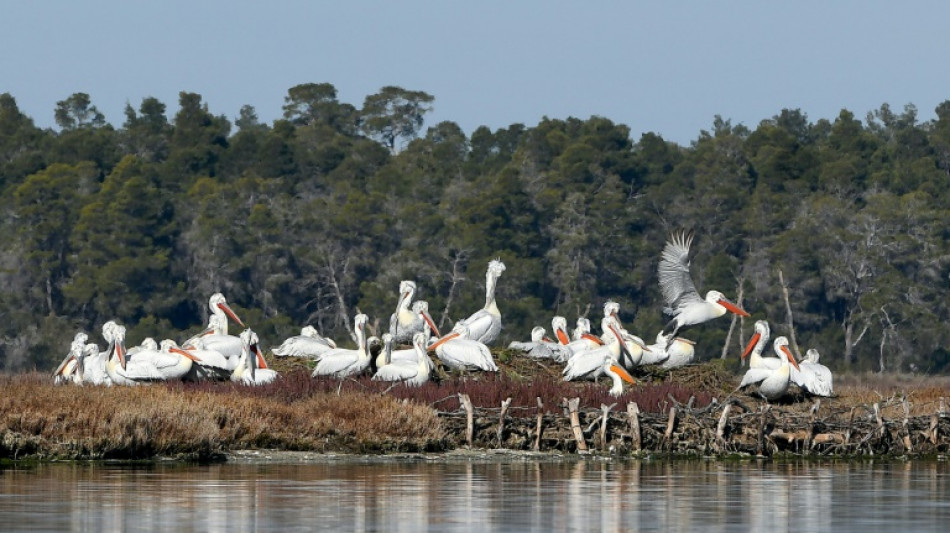
The western lagoons are also famous for their resident Greater Flamingos and Dalmatian Pelicans, which have a three-metre wingspan rivalling that of the albatross.
But experts say the breeding cycle of the iconic pelican -- whose fragmented populations are a concern for the long-term stability of the species -- is being disrupted by increasingly erratic weather patterns.
In 2021, the pelicans began breeding at the start of January. This year, the nesting season did not begin until the end of January -- a difference of several weeks -- after a winter that started exceptionally late.
"The pelican breeding season seems to be behind last year," Sajmir Hoxha, an expert in Albania for the French conservation group Noe, told AFP.
Meanwhile, illegal fishing has depleted vital food sources in Albania’s lagoons, and rapid urbanisation is threatening fragile ecosystems, especially in the network of marshes and sand dunes along the tourist magnet that is the Adriatic coast.
To add to the pressures, a sprawling international airport is set to be built near the protected marshlands of the Vjosa-Narta region, just south of Divjaka-Karavasta.
This 100-million-euro ($114-million) project, backed by a Turkish-Swiss consortium, "would directly affect wildlife and is a threat to species that breed there, winter there or stop over there on their way to Divjaka", Topi said.
H.Yousef--DT