Dubai Telegraph - US heat wave soars as California wildfire rages

EUR -
AED 4.327013
AFN 74.799506
ALL 95.44918
AMD 434.632751
ANG 2.108473
AOA 1081.398388
ARS 1641.143952
AUD 1.623621
AWG 2.120389
AZN 2.006455
BAM 1.957801
BBD 2.372845
BDT 144.81802
BGN 1.965014
BHD 0.444516
BIF 3505.710256
BMD 1.177994
BND 1.495961
BOB 8.14032
BRL 5.788075
BSD 1.178124
BTN 112.228138
BWP 15.840325
BYN 3.294595
BYR 23088.683139
BZD 2.369452
CAD 1.609658
CDF 2604.545214
CHF 0.91602
CLF 0.026856
CLP 1057.019122
CNY 8.00443
CNH 8.00103
COP 4430.341336
CRC 539.956478
CUC 1.177994
CUP 31.216842
CVE 110.760844
CZK 24.332528
DJF 209.352695
DKK 7.473182
DOP 69.678399
DZD 155.548198
EGP 62.101135
ERN 17.669911
ETB 183.954984
FJD 2.570975
FKP 0.863991
GBP 0.863393
GEL 3.151149
GGP 0.863991
GHS 13.299276
GIP 0.863991
GMD 85.993551
GNF 10339.844194
GTQ 8.991412
GYD 246.413954
HKD 9.22188
HNL 31.326285
HRK 7.535742
HTG 154.190872
HUF 355.944446
IDR 20520.06714
ILS 3.418362
IMP 0.863991
INR 112.280561
IQD 1543.397172
IRR 1545001.028178
ISK 143.608926
JEP 0.863991
JMD 185.861548
JOD 0.835217
JPY 185.065262
KES 152.020463
KGS 103.015363
KHR 4726.831334
KMF 492.401267
KPW 1060.194583
KRW 1735.562101
KWD 0.362716
KYD 0.981812
KZT 545.822523
LAK 25844.635416
LBP 105501.229303
LKR 379.491103
LRD 215.603115
LSL 19.363156
LTL 3.47831
LVL 0.712557
LYD 7.451743
MAD 10.741679
MDL 20.192811
MGA 4898.047916
MKD 61.655417
MMK 2473.229623
MNT 4213.339863
MOP 9.500832
MRU 47.042482
MUR 55.047458
MVR 18.142479
MWK 2042.905413
MXN 20.25266
MYR 4.620681
MZN 75.285788
NAD 19.363156
NGN 1607.514748
NIO 43.356155
NOK 10.814368
NPR 179.564058
NZD 1.97433
OMR 0.452936
PAB 1.178104
PEN 4.047437
PGK 5.117317
PHP 71.981913
PKR 328.199428
PLN 4.238652
PYG 7241.37073
QAR 4.304628
RON 5.203434
RSD 117.390626
RUB 86.684882
RWF 1722.975694
SAR 4.419578
SBD 9.446843
SCR 16.494848
SDG 707.384876
SEK 10.854389
SGD 1.494126
SHP 0.879492
SLE 29.037764
SLL 24701.941457
SOS 673.293895
SRD 44.061101
STD 24382.09822
STN 24.525484
SVC 10.308668
SYP 130.224809
SZL 19.357114
THB 38.04038
TJS 11.027312
TMT 4.122979
TND 3.418215
TOP 2.836327
TRY 53.443945
TTD 7.986231
TWD 36.958389
TZS 3077.508119
UAH 51.77576
UGX 4429.565099
USD 1.177994
UYU 46.968669
UZS 14304.803211
VES 588.096996
VND 31010.693043
VUV 139.683928
WST 3.188944
XAF 656.633725
XAG 0.013721
XAU 0.000249
XCD 3.183588
XCG 2.123297
XDR 0.816642
XOF 656.639305
XPF 119.331742
YER 281.098838
ZAR 19.342423
ZMK 10603.360584
ZMW 22.275051
ZWL 379.3136
  • RBGPF

    0.2700

    63.18

    +0.43%

  • CMSC

    -0.0200

    23.09

    -0.09%

  • RYCEF

    0.4200

    16.79

    +2.5%

  • RIO

    2.8300

    108.21

    +2.62%

  • GSK

    -0.4850

    49.925

    -0.97%

  • RELX

    -0.2350

    33.345

    -0.7%

  • NGG

    0.6000

    87.49

    +0.69%

  • BCE

    0.2600

    24.4

    +1.07%

  • BP

    0.9750

    44.315

    +2.2%

  • BTI

    1.8900

    60.17

    +3.14%

  • JRI

    0.0003

    13.15

    0%

  • CMSD

    0.0713

    23.605

    +0.3%

  • VOD

    0.1640

    16.364

    +1%

  • BCC

    -0.7000

    69.97

    -1%

  • AZN

    -0.5100

    182.34

    -0.28%

US heat wave soars as California wildfire rages
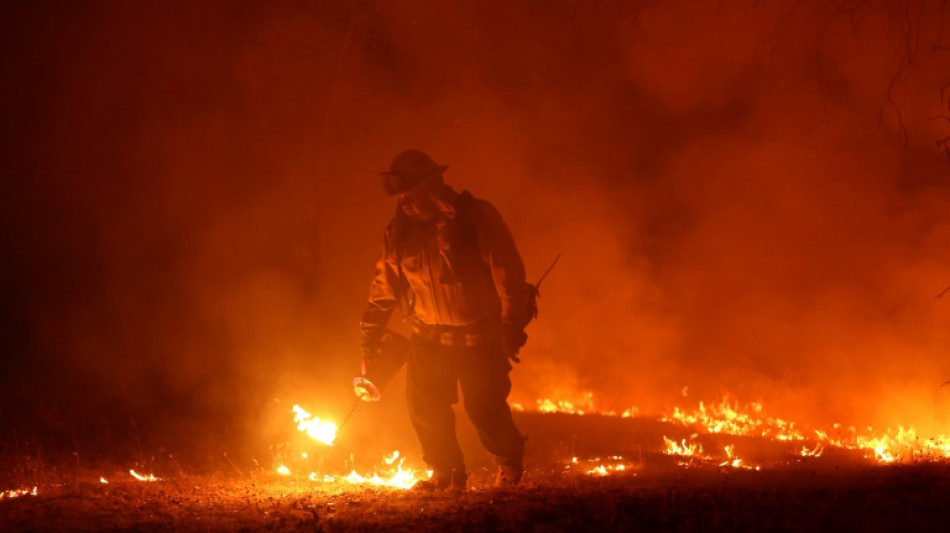
US heat wave soars as California wildfire rages / Photo: JUSTIN SULLIVAN - GETTY IMAGES NORTH AMERICA/AFP

US heat wave soars as California wildfire rages

Tens of millions of Americans already baking in a scorching heat wave braced Saturday for record-setting temperatures to climb, while a major fire ravaged part of California.

Text size:

The country's central and northeast regions face the brunt of the extreme temperatures, which are not expected to peak until Sunday at the earliest and have sent public health officials scrambling.

More than a dozen states are under a heat advisory, with central US metropolitan areas such as Dallas and Oklahoma City expected to reach highs of over 100 degrees Fahrenheit (above 38 degrees Celsius) for at least the next five days.

A heat emergency is meanwhile in effect for cities up and down the northeast coast, from Boston to Philadelphia to Washington.

Not even the usually cool Pacific Northwest will escape the far-reaching heat, with the region expected to face several days in the 90s next week.

The high temperatures, which demonstrate the threat of global warming, have already caused an uptick in emergency calls for heat-related illness.

Cities have meanwhile been forced to open cooling stations and increase outreach to at-risk communities such as the homeless and those without access to air conditioning.

"This is really one of the things that we recognize in Oklahoma -- heat is the number one weather-related killer across the United States. It far surpasses any other" nature-related cause of death, Joseph Kralicek, director of the Tulsa Area Emergency Management Agency, told CNN.

Residents of the central US city were expecting temperatures to reach 103 degrees Fahrenheit Saturday and up to 106 degrees on Sunday and Monday.

The nation's capital was predicted to reach temperatures at or near 100 degrees Fahrenheit Saturday, with New York not far behind.

- Fire conditions increased -

"Look for daytime max temps to eclipse the century mark in the Central Plains and record breaking high temps from the Central Plains to the Northeast today," the National Weather Service said in a forecast.

"Sunday grows even hotter in the northeast," it said.

The sweltering heat has increased the risk of blazes, such as the major Oak Fire, which broke out Friday in California near Yosemite National Park where giant sequoias have already been threatened by fire in recent days.

Spread over more than 6,555 acres (2,650 hectares), the Oak Fire has already destroyed ten properties and damaged five others. As of midday Saturday, it was 0 percent contained, according to California's Department of Forestry and Fire Protection.

In recent years, California and other parts of the western United States have been ravaged by huge, hot and fast-moving wildfires, driven by years of drought and a warming climate.

Severe thunderstorms are meanwhile expected in the Midwest Saturday, with the potential for damaging winds, large hail and tornadoes, the NWS said.

Various regions of the globe have been hit by extreme heat waves in recent months, such as Western Europe in July and India in March to April, incidents that scientists say are an unmistakable sign of climate change.

F.El-Yamahy--DT