Dubai Telegraph - US medical agency will scale back testing on monkeys

EUR -
AED 4.327108
AFN 75.40719
ALL 95.469537
AMD 434.725041
ANG 2.108923
AOA 1081.629064
ARS 1650.727597
AUD 1.623956
AWG 2.123787
AZN 1.999297
BAM 1.958219
BBD 2.373352
BDT 144.848906
BGN 1.965433
BHD 0.444753
BIF 3507.596044
BMD 1.178245
BND 1.49628
BOB 8.142056
BRL 5.793314
BSD 1.178375
BTN 112.252074
BWP 15.843703
BYN 3.295298
BYR 23093.607434
BZD 2.369957
CAD 1.610379
CDF 2668.725934
CHF 0.915662
CLF 0.02668
CLP 1050.048955
CNY 8.012951
CNH 8.001941
COP 4426.585029
CRC 540.071638
CUC 1.178245
CUP 31.2235
CVE 110.355877
CZK 24.335949
DJF 209.842743
DKK 7.473127
DOP 69.766763
DZD 155.830536
EGP 62.116854
ERN 17.673679
ETB 183.994217
FJD 2.571521
FKP 0.864175
GBP 0.863712
GEL 3.151798
GGP 0.864175
GHS 13.303544
GIP 0.864175
GMD 86.595675
GNF 10339.902681
GTQ 8.99333
GYD 246.466508
HKD 9.224035
HNL 31.332966
HRK 7.534409
HTG 154.223758
HUF 355.640351
IDR 20525.504027
ILS 3.419091
IMP 0.864175
INR 112.28689
IQD 1543.726344
IRR 1545268.680998
ISK 143.781277
JEP 0.864175
JMD 185.901189
JOD 0.83536
JPY 184.998636
KES 152.169713
KGS 103.03766
KHR 4727.839461
KMF 492.506219
KPW 1060.420699
KRW 1732.75698
KWD 0.362782
KYD 0.982021
KZT 545.938935
LAK 25850.147493
LBP 105523.730332
LKR 379.572039
LRD 215.649098
LSL 19.367285
LTL 3.479052
LVL 0.712709
LYD 7.453332
MAD 10.74397
MDL 20.197117
MGA 4899.092559
MKD 61.651293
MMK 2473.757107
MNT 4214.238473
MOP 9.502858
MRU 47.052515
MUR 55.059614
MVR 18.140327
MWK 2043.341119
MXN 20.233818
MYR 4.621669
MZN 75.301835
NAD 19.367285
NGN 1608.469828
NIO 43.365402
NOK 10.818336
NPR 179.602355
NZD 1.975352
OMR 0.453022
PAB 1.178355
PEN 4.0483
PGK 5.118409
PHP 71.976664
PKR 328.269425
PLN 4.238932
PYG 7242.915151
QAR 4.305546
RON 5.209374
RSD 117.398042
RUB 86.718484
RWF 1723.343166
SAR 4.42052
SBD 9.448858
SCR 16.485242
SDG 707.533214
SEK 10.85829
SGD 1.494239
SHP 0.879679
SLE 29.043548
SLL 24707.209823
SOS 673.437493
SRD 44.070499
STD 24387.298371
STN 24.530715
SVC 10.310866
SYP 130.252583
SZL 19.361242
THB 38.019607
TJS 11.029663
TMT 4.123858
TND 3.418944
TOP 2.836932
TRY 53.464883
TTD 7.987934
TWD 36.970039
TZS 3078.17328
UAH 51.786803
UGX 4430.509825
USD 1.178245
UYU 46.978687
UZS 14307.854103
VES 588.222424
VND 31017.306923
VUV 139.713719
WST 3.189624
XAF 656.77377
XAG 0.013838
XAU 0.000249
XCD 3.184266
XCG 2.12375
XDR 0.816816
XOF 656.779351
XPF 119.331742
YER 281.158781
ZAR 19.283646
ZMK 10605.622741
ZMW 22.279802
ZWL 379.394499
  • CMSC

    0.0000

    23.11

    0%

  • BCE

    0.2950

    24.435

    +1.21%

  • RELX

    -0.3250

    33.255

    -0.98%

  • NGG

    0.7100

    87.6

    +0.81%

  • JRI

    -0.0147

    13.135

    -0.11%

  • RBGPF

    0.2700

    63.18

    +0.43%

  • GSK

    -0.3300

    50.08

    -0.66%

  • RIO

    2.8500

    108.23

    +2.63%

  • BCC

    -0.1750

    70.495

    -0.25%

  • CMSD

    0.0661

    23.5998

    +0.28%

  • RYCEF

    0.4300

    16.8

    +2.56%

  • AZN

    0.4100

    183.26

    +0.22%

  • BP

    0.8850

    44.225

    +2%

  • VOD

    0.1850

    16.385

    +1.13%

  • BTI

    2.0000

    60.28

    +3.32%

US medical agency will scale back testing on monkeys
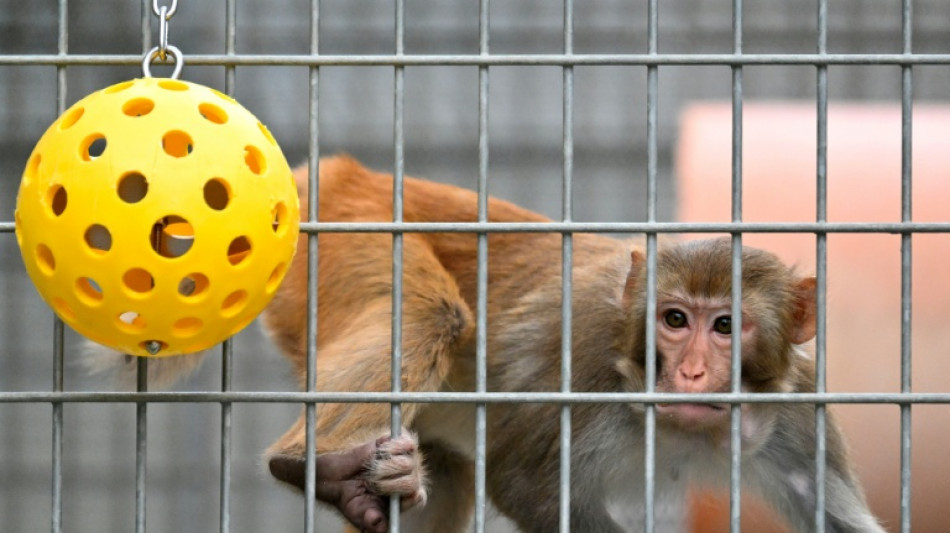
US medical agency will scale back testing on monkeys / Photo: Christophe SIMON - AFP/File

US medical agency will scale back testing on monkeys

The United States will scale back certain drug-safety testing requirements on monkeys, federal regulators said Tuesday, marking the latest step by President Donald Trump's administration to limit the use of animals in research.

Text size:

Under new draft guidance from the Food and Drug Administration, computer models, lab-grown mini-organs, and human studies will replace the use of non-human primates in testing monoclonal antibodies -- lab-engineered proteins used to treat cancers, autoimmune conditions and other diseases.

"We are delivering on our roadmap commitment to eliminate animal testing requirements in drug evaluation and our promise to accelerate cures and meaningful treatments for Americans," FDA Commissioner Marty Makary said in a statement.

The statement added that typical nonclinical programs involving monoclonal antibodies could include more than 100 macaque monkeys -- apes are no longer used in any invasive research in the US -- yet often do not yield human-approved treatments.

The move was welcomed by animal-advocacy groups.

Zaher Nahle, a former animal researcher who is now the senior scientific advisor for nonprofit Center for a Humane Economy, told AFP the move was an "important step."

"These primates are not reliable in terms of predicting the toxicity, so you can get at least equal or better results in terms of your accuracy in predicting toxicology using other approaches," he added.

What's more, he noted, studies show that more than 90 percent of drugs deemed safe and effective in animals fail to win approval for human use.

The FDA's announcement follows a report in the journal Science last month that the Centers for Disease Control and Prevention would close its primate labs.

It "moves us one step closer to wiping out the federal government's wasteful monkey business," Justin Goodman of White Coat Waste Project told AFP.

But the National Institutes of Health -- the country's primary biomedical research agency -- remains a notable "outlier," he added. According to public data, 7,700 primates are confined in federal government labs and breeding facilities, of which 6,700 are at NIH.

Advocates of animal research have pushed back.

"Poorly planned transitions -- including premature study termination -- can place animals at serious risk and may undermine years of scientific investment intended to strengthen public health preparedness and advance lifesaving medical progress," advocacy group Americans for Medical Progress said after the CDC news was reported.

Proponents of animal testing say the research has been indispensable for major medical advances, including vaccines for diphtheria, yellow fever, measles and Covid-19.

Critics counter that decades-old laws have created regulatory lock-in, that publication incentives reward animal studies in top journals, and that a lucrative "animal-industrial complex" has helped entrench the status quo.

H.El-Hassany--DT