Dubai Telegraph - SpaceX's Starship megarocket launches on latest test flight

EUR -
AED 4.221747
AFN 72.422506
ALL 96.096124
AMD 433.854203
ANG 2.057804
AOA 1054.144007
ARS 1605.343242
AUD 1.62721
AWG 2.072078
AZN 1.960051
BAM 1.958112
BBD 2.314834
BDT 141.027774
BGN 1.964949
BHD 0.433991
BIF 3414.18599
BMD 1.149558
BND 1.470207
BOB 7.970482
BRL 6.017126
BSD 1.149357
BTN 106.012117
BWP 15.671644
BYN 3.423907
BYR 22531.328422
BZD 2.311641
CAD 1.573341
CDF 2603.747768
CHF 0.906288
CLF 0.026491
CLP 1046.005378
CNY 7.996609
CNH 7.923573
COP 4257.949753
CRC 539.842224
CUC 1.149558
CUP 30.463276
CVE 111.075975
CZK 24.455341
DJF 204.299564
DKK 7.472308
DOP 70.525208
DZD 152.070977
EGP 60.259119
ERN 17.243364
ETB 180.911604
FJD 2.544489
FKP 0.867846
GBP 0.86372
GEL 3.126595
GGP 0.867846
GHS 12.51293
GIP 0.867846
GMD 84.494185
GNF 10087.367912
GTQ 8.80948
GYD 240.586214
HKD 9.001093
HNL 30.54346
HRK 7.53374
HTG 150.639208
HUF 390.941602
IDR 19501.09466
ILS 3.589419
IMP 0.867846
INR 106.076517
IQD 1505.92042
IRR 1518623.031549
ISK 143.200349
JEP 0.867846
JMD 180.793508
JOD 0.815051
JPY 183.004388
KES 148.749321
KGS 100.528243
KHR 4619.499883
KMF 493.160304
KPW 1034.601807
KRW 1714.737502
KWD 0.352971
KYD 0.957739
KZT 555.010269
LAK 24686.749085
LBP 102984.32807
LKR 357.895771
LRD 210.656014
LSL 19.266793
LTL 3.394345
LVL 0.695356
LYD 7.368303
MAD 10.80013
MDL 19.99779
MGA 4776.411683
MKD 61.626292
MMK 2413.659739
MNT 4105.397681
MOP 9.269227
MRU 46.114513
MUR 53.730146
MVR 17.772616
MWK 1996.781613
MXN 20.349122
MYR 4.516039
MZN 73.469562
NAD 19.267225
NGN 1571.74444
NIO 42.212001
NOK 11.131183
NPR 169.626436
NZD 1.964706
OMR 0.441999
PAB 1.149367
PEN 3.941261
PGK 4.945974
PHP 68.697741
PKR 321.042684
PLN 4.265129
PYG 7459.809679
QAR 4.188126
RON 5.093117
RSD 117.412322
RUB 93.404853
RWF 1677.204498
SAR 4.313632
SBD 9.255847
SCR 16.038223
SDG 690.88424
SEK 10.746495
SGD 1.469888
SHP 0.862466
SLE 28.275548
SLL 24105.659962
SOS 656.973773
SRD 43.190599
STD 23793.520804
STN 24.830444
SVC 10.056964
SYP 127.054834
SZL 19.266787
THB 37.222575
TJS 11.033426
TMT 4.029199
TND 3.357813
TOP 2.767858
TRY 50.790212
TTD 7.794272
TWD 36.73957
TZS 2994.597374
UAH 50.668778
UGX 4339.162089
USD 1.149558
UYU 46.725587
UZS 13915.39409
VES 512.985756
VND 30221.868582
VUV 137.447144
WST 3.144287
XAF 656.738289
XAG 0.014209
XAU 0.000229
XCD 3.106737
XCG 2.071364
XDR 0.819094
XOF 661.569692
XPF 119.331742
YER 274.167096
ZAR 19.188978
ZMK 10347.394961
ZMW 22.382628
ZWL 370.157069
  • RBGPF

    0.1000

    82.5

    +0.12%

  • CMSC

    0.0000

    22.99

    0%

  • NGG

    -0.0100

    90.89

    -0.01%

  • RIO

    2.0300

    89.86

    +2.26%

  • RELX

    0.3300

    34.47

    +0.96%

  • RYCEF

    -0.1500

    16.4

    -0.91%

  • AZN

    2.1100

    192.01

    +1.1%

  • VOD

    0.1900

    14.6

    +1.3%

  • CMSD

    -0.0400

    22.95

    -0.17%

  • GSK

    0.3800

    53.77

    +0.71%

  • BTI

    1.0100

    60.94

    +1.66%

  • BCE

    0.6521

    25.9

    +2.52%

  • JRI

    -0.0500

    12.54

    -0.4%

  • BP

    0.2300

    42.9

    +0.54%

  • BCC

    1.7200

    71.72

    +2.4%

SpaceX's Starship megarocket launches on latest test flight
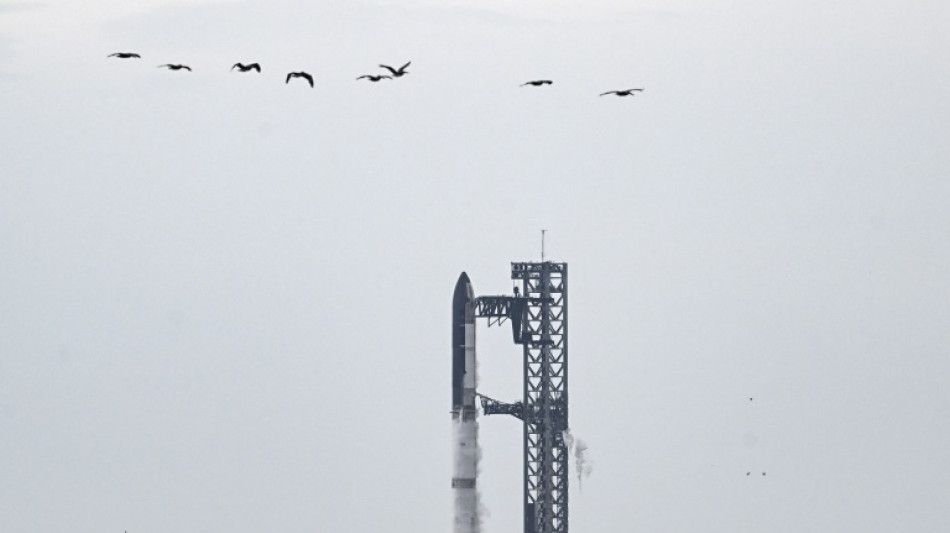
SpaceX's Starship megarocket launches on latest test flight / Photo: RONALDO SCHEMIDT - AFP

SpaceX's Starship megarocket launches on latest test flight

SpaceX's Starship megarocket roared into the skies Tuesday on its 10th test flight, following a string of explosive failures that cast doubt about its ability to realize Elon Musk's vision of colonizing Mars.

Text size:

Standing 403 feet (123 meters) tall, the most powerful launch vehicle ever built lifted off from the company's Starbase in southern Texas at 6:30pm local time (2330 GMT), triggering loud cheers from engineering teams, a webcast showed.

Starship is key to Musk's ambitions of making humanity a multiplanetary species, while NASA is awaiting a modified version to act as a lander for its plans to return astronauts to the Moon.

A launch attempt on Sunday was scrubbed due to a fuel leak on the launchpad, and on Monday weather intervened as thick clouds forced another delay.

Much is riding on the mission, after the last three flights ended with the upper stage exploding: twice over the Caribbean and once after reaching space. In June, an upper stage blew up during a ground test.

"We've had so many tests and it hasn't proven itself reliable," Dallas Kasaboski, a space analyst for consulting firm Analysys Mason, told AFP. "The successes have not exceeded the failures."

The goal is to send the upper stage ship -- eventually intended to carry crew and cargo -- halfway across the globe before splashing down off northwestern Australia.

Outfitted with prototype heat-shield materials, it will deploy dummy Starlink satellites while flying a trajectory meant to stress-test its rear flaps.

The booster, known as Super Heavy, splashed down safely in the Gulf of Mexico. While SpaceX previously wowed observers by catching the booster in the launch tower's "chopstick arms," this flight instead focused on collecting data on how it performed when an engine unexpectedly cuts out.

Despite recent setbacks, Starship is not seen as being at a crisis point. SpaceX's "fail fast, learn fast" philosophy has already given it a commanding lead in launches with its Falcon rockets, while Dragon capsules ferry astronauts to the ISS and Starlink has become a geopolitical asset.

Still, Starship presents new challenges. Musk has identified developing a fully reusable orbital heat shield as the toughest task, noting it took nine months to refurnish the Space Shuttle's heat shield between flights.

"What we're trying to achieve here with Starship is to have a heat shield that can be flown immediately," he said on a webcast Monday.

Another hurdle is proving Starship can be refueled in orbit with super-cooled propellant -- an essential but untested step for the vehicle to carry out deep-space missions.

Time is running short to ready a modified version as NASA's lunar lander for 2027, and for Musk to make good on his vow to send an uncrewed Starship to Mars next year.

I.El-Hammady--DT



