Dubai Telegraph - Artists, scientists breathe life into prehistoric woman

EUR -
AED 4.221747
AFN 72.422506
ALL 96.096124
AMD 433.854203
ANG 2.057804
AOA 1054.144007
ARS 1605.343242
AUD 1.62721
AWG 2.072078
AZN 1.960051
BAM 1.958112
BBD 2.314834
BDT 141.027774
BGN 1.964949
BHD 0.433991
BIF 3414.18599
BMD 1.149558
BND 1.470207
BOB 7.970482
BRL 6.017126
BSD 1.149357
BTN 106.012117
BWP 15.671644
BYN 3.423907
BYR 22531.328422
BZD 2.311641
CAD 1.573341
CDF 2603.747768
CHF 0.906288
CLF 0.026491
CLP 1046.005378
CNY 7.996609
CNH 7.923573
COP 4257.949753
CRC 539.842224
CUC 1.149558
CUP 30.463276
CVE 111.075975
CZK 24.455341
DJF 204.299564
DKK 7.472308
DOP 70.525208
DZD 152.070977
EGP 60.259119
ERN 17.243364
ETB 180.911604
FJD 2.544489
FKP 0.867846
GBP 0.86372
GEL 3.126595
GGP 0.867846
GHS 12.51293
GIP 0.867846
GMD 84.494185
GNF 10087.367912
GTQ 8.80948
GYD 240.586214
HKD 9.001093
HNL 30.54346
HRK 7.53374
HTG 150.639208
HUF 390.941602
IDR 19501.09466
ILS 3.589419
IMP 0.867846
INR 106.076517
IQD 1505.92042
IRR 1518623.031549
ISK 143.200349
JEP 0.867846
JMD 180.793508
JOD 0.815051
JPY 183.004388
KES 148.749321
KGS 100.528243
KHR 4619.499883
KMF 493.160304
KPW 1034.601807
KRW 1714.737502
KWD 0.352971
KYD 0.957739
KZT 555.010269
LAK 24686.749085
LBP 102984.32807
LKR 357.895771
LRD 210.656014
LSL 19.266793
LTL 3.394345
LVL 0.695356
LYD 7.368303
MAD 10.80013
MDL 19.99779
MGA 4776.411683
MKD 61.626292
MMK 2413.659739
MNT 4105.397681
MOP 9.269227
MRU 46.114513
MUR 53.730146
MVR 17.772616
MWK 1996.781613
MXN 20.349122
MYR 4.516039
MZN 73.469562
NAD 19.267225
NGN 1571.74444
NIO 42.212001
NOK 11.131183
NPR 169.626436
NZD 1.964706
OMR 0.441999
PAB 1.149367
PEN 3.941261
PGK 4.945974
PHP 68.697741
PKR 321.042684
PLN 4.265129
PYG 7459.809679
QAR 4.188126
RON 5.093117
RSD 117.412322
RUB 93.404853
RWF 1677.204498
SAR 4.313632
SBD 9.255847
SCR 16.038223
SDG 690.88424
SEK 10.746495
SGD 1.469888
SHP 0.862466
SLE 28.275548
SLL 24105.659962
SOS 656.973773
SRD 43.190599
STD 23793.520804
STN 24.830444
SVC 10.056964
SYP 127.054834
SZL 19.266787
THB 37.222575
TJS 11.033426
TMT 4.029199
TND 3.357813
TOP 2.767858
TRY 50.790212
TTD 7.794272
TWD 36.73957
TZS 2994.597374
UAH 50.668778
UGX 4339.162089
USD 1.149558
UYU 46.725587
UZS 13915.39409
VES 512.985756
VND 30221.868582
VUV 137.447144
WST 3.144287
XAF 656.738289
XAG 0.014209
XAU 0.000229
XCD 3.106737
XCG 2.071364
XDR 0.819094
XOF 661.569692
XPF 119.331742
YER 274.167096
ZAR 19.188978
ZMK 10347.394961
ZMW 22.382628
ZWL 370.157069
  • NGG

    -0.0100

    90.89

    -0.01%

  • CMSD

    -0.0400

    22.95

    -0.17%

  • RIO

    2.0300

    89.86

    +2.26%

  • GSK

    0.3800

    53.77

    +0.71%

  • AZN

    2.1100

    192.01

    +1.1%

  • BP

    0.2300

    42.9

    +0.54%

  • CMSC

    0.0000

    22.99

    0%

  • BCC

    1.7200

    71.72

    +2.4%

  • BCE

    0.6521

    25.9

    +2.52%

  • RBGPF

    0.1000

    82.5

    +0.12%

  • BTI

    1.0100

    60.94

    +1.66%

  • RYCEF

    -0.1500

    16.4

    -0.91%

  • JRI

    -0.0500

    12.54

    -0.4%

  • RELX

    0.3300

    34.47

    +0.96%

  • VOD

    0.1900

    14.6

    +1.3%

Artists, scientists breathe life into prehistoric woman
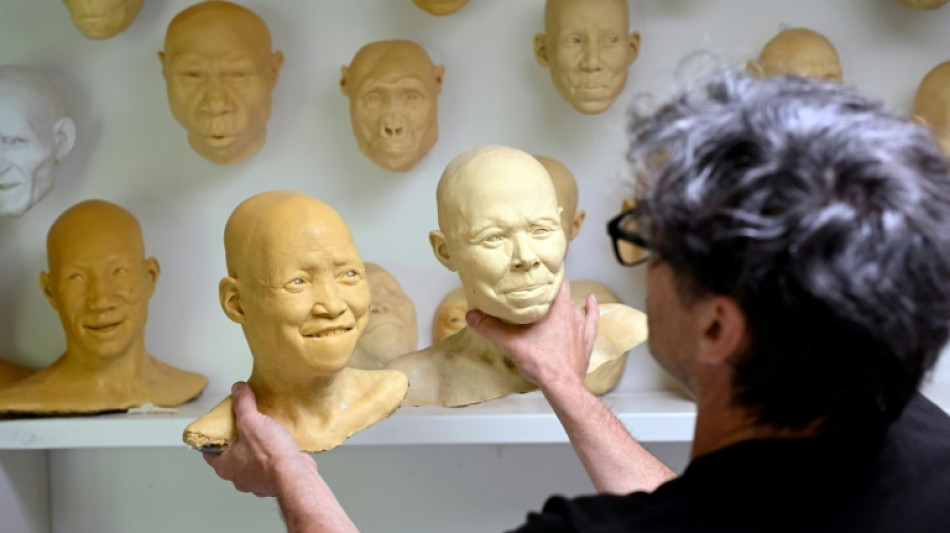
Artists, scientists breathe life into prehistoric woman / Photo: Nicolas TUCAT - AFP

Artists, scientists breathe life into prehistoric woman

With her clear blue eyes and slightly nervous gaze, the reconstructed bust of Mos'anne -- a woman who lived around 10,500 years ago -- is uncannily lifelike.

Text size:

Reborn via a close partnership between science and art, Mos'anne's bust was created at Belgium's Ghent University as part of a project to explore how the region's last hunter-gatherers lived during the Mesolithic era.

"Part of the project is also understanding the genetics of these people, figuring out their kinship and so on, and to be able to really translate the science that we do to a wider audience," the project's lead researcher, Isabelle de Groote, told AFP.

Scientists chose the skull of Mos'anne -- named by public vote in reference to Belgium's Meuse Valley -- for reconstruction, as it was exceptionally well-preserved.

The bones held a large amount of preserved DNA, making it possible to reconstruct the woman -- aged between 35 and 60 at her death -- with remarkable realism.

"We also know that in the Mesolithic times, she is genetically part of the Western hunter-gatherer group," said de Groote.

Using genetic testing, researchers were able to determine the Mesolithic woman's skin and eye colour.

"This group is known for having very dark skin and blue eyes, a bit like Cheddar Man in Britain," she said, referring to the man who lived in Britain around 10,000 years ago, whose skeleton was discovered in 1903.

- 'Mixed emotions' -

Mos'anne's DNA revealed valuable clues about her appearance but it was the unique skills of Dutch "paleo-artists" Alfons and Adrie Kennis that brought her back to life.

After receiving guidance from the researchers -- including instructions to use ochre pigment on Mos'anne's headband -- the twins began their work, from moulding the skull to the final decorative feather, meticulously sculpting each facial muscle in clay.

"The biggest part of the reconstruction is forming a character," Alfons Kennis said from their Darwin-esque studio in Arnhem.

"You can make a forensic reconstruction... use the data, apply the muscles, apply the skin, but you get no character," Kennis said of their artistic process.

The Kennis brothers -- whose surname means "knowledge" in Dutch -- take about six months to complete a reconstruction.

They gained global recognition in the 2000s, their work exhibited in museums worldwide and featured in specialist publications.

The twins, fascinated by evolution and visual art since childhood, draw inspiration from archived anthropological images of early encounters between isolated populations and researchers.

"At the first meeting, there's nervousness, shyness. People are laughing, maybe out of nerves," said Kennis.

"When a prehistoric ancestor meets you for the first time, you see these mixed emotions... It's these emotions that we want to show."

Much about Mos'anne remains unknown. In Ghent, researchers are still analysing her to find out what she would eat.

With her headband dotted with duck feathers, golden skin, and pierced animal teeth adorning her ears and necklace, the prehistoric woman seems closer to us than ever.

"It was always my wish to be able to make it more tangible in a way," De Groote said.

G.Koya--DT