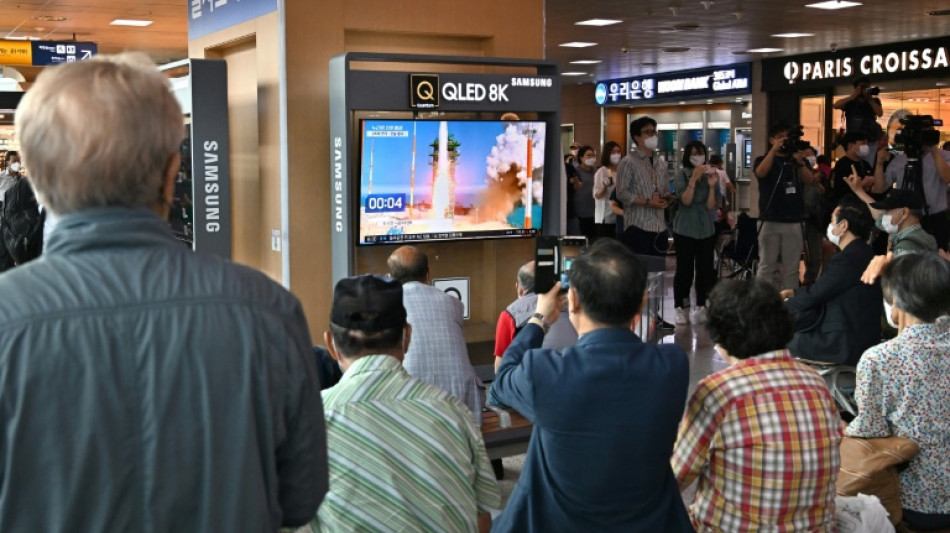
South Korea launches domestically-developed space rocket / Photo: Jung Yeon-je - AFP
South Korea launched its first domestically-developed space rocket on Tuesday, the government said, the country's second attempt after a launch last October failed.
The Korea Satellite Launch Vehicle II, a 200-tonne liquid fuel rocket informally called Nuri, lifted off from the launch site in Goheung at 4:00pm (0700 GMT).
"Nuri has completed its flight according to plan. Engineers are now analysing its flight data, which will take around 30 minutes to complete," said Oh Tae-seok, Seoul's deputy minister of science, technology and innovation.
South Korea's second test launch of its homegrown space rocket comes eight months after the first test failed to put a dummy satellite into orbit, a setback for the country's attempt to join the ranks of advanced space-faring nations.
All three stages of the rocket worked in the first test last October, with the vehicle reaching an altitude of 700 kilometres (430 miles), and the 1.5-tonne payload separating successfully.
But it failed to put a dummy satellite into orbit after the third-stage engine stopped burning earlier than scheduled.
However, on Tuesday it appeared that stage of the launch had worked as planned.
"Nuri separates dummy satellite," South Korea's YTN Television reported minutes after lift-off, adding shortly after that the launch "appears to be a success".
In Tuesday's test, in addition to the dummy satellite, Nuri carried a rocket performance verification satellite and four cube satellites developed by four local universities for research purposes.
The three-stage Nuri rocket has been a decade in development at a cost of 2 trillion won ($1.5 billion).
It weighs 200 tonnes and is 47.2 metres (155 feet) long, fitted with a total of six liquid-fuelled engines.
In Asia, China, Japan and India all have advanced space programmes, and the South's nuclear-armed neighbour North Korea was the most recent entrant to the club of countries with their own satellite launch capability.
- Lunar ambitions -
Ballistic missiles and space rockets use similar technology and Pyongyang put a 300-kilogram (660-pound) satellite into orbit in 2012 in what Washington condemned as a disguised missile test.
Even now, only six nations -- not including North Korea -- have successfully launched a one-tonne payload on their own rockets.
If Tuesday's launch works, South Korea will become the seventh nation in the world to have mastered technology to launch a space vehicle that carries more than a one-tonne satellite.
The South Korean space programme has a mixed record -- its first two launches in 2009 and 2010, which in part used Russian technology, both ended in failure.
The second one exploded two minutes into the flight, with Seoul and Moscow blaming each other.
Eventually a 2013 launch succeeded, but still relied on a Russian-developed engine for its first stage.
The satellite launch business is increasingly the preserve of private companies, notably Elon Musk's SpaceX, whose clients include the US space agency NASA and the South Korean military.
The Tuesday test looks set to bring South Korea closer to achieving its space ambitions, including a plan to land a probe on the Moon by 2030.
South Korea plans to conduct four more such test launches by 2027.
D.Naveed--DT