Dubai Telegraph - Huge planet discovered orbiting tiny star puzzles scientists

EUR -
AED 4.393893
AFN 78.953262
ALL 96.712183
AMD 453.508778
ANG 2.141423
AOA 1096.982427
ARS 1727.451153
AUD 1.698153
AWG 2.153291
AZN 2.038317
BAM 1.958071
BBD 2.409094
BDT 146.15954
BGN 2.008985
BHD 0.450954
BIF 3552.929735
BMD 1.196273
BND 1.513155
BOB 8.264587
BRL 6.209182
BSD 1.196087
BTN 110.048653
BWP 15.598093
BYN 3.378819
BYR 23446.943706
BZD 2.40559
CAD 1.614436
CDF 2700.552296
CHF 0.916189
CLF 0.026045
CLP 1028.388088
CNY 8.312181
CNH 8.311936
COP 4359.217493
CRC 591.786453
CUC 1.196273
CUP 31.701225
CVE 110.804782
CZK 24.31101
DJF 212.601738
DKK 7.467074
DOP 75.365224
DZD 154.565403
EGP 56.018941
ERN 17.94409
ETB 186.066631
FJD 2.620557
FKP 0.868017
GBP 0.866818
GEL 3.223992
GGP 0.868017
GHS 13.105188
GIP 0.868017
GMD 87.921452
GNF 10468.58156
GTQ 9.177646
GYD 250.240271
HKD 9.337171
HNL 31.565615
HRK 7.533166
HTG 156.781862
HUF 380.306994
IDR 20082.72598
ILS 3.701501
IMP 0.868017
INR 109.882846
IQD 1566.917574
IRR 50392.985067
ISK 145.000343
JEP 0.868017
JMD 187.6777
JOD 0.848092
JPY 183.222907
KES 154.40293
KGS 104.613833
KHR 4810.580119
KMF 492.864764
KPW 1076.725699
KRW 1713.94742
KWD 0.366574
KYD 0.996756
KZT 600.856975
LAK 25728.844638
LBP 107110.745044
LKR 370.069269
LRD 221.276674
LSL 18.872091
LTL 3.532282
LVL 0.723613
LYD 7.513716
MAD 10.831664
MDL 20.118337
MGA 5353.320097
MKD 61.634363
MMK 2512.666424
MNT 4266.975685
MOP 9.616255
MRU 47.712345
MUR 54.011532
MVR 18.494352
MWK 2074.00578
MXN 20.611939
MYR 4.698357
MZN 76.274769
NAD 18.872091
NGN 1660.235465
NIO 44.021063
NOK 11.418823
NPR 176.078245
NZD 1.969161
OMR 0.459945
PAB 1.196087
PEN 4.00004
PGK 5.19803
PHP 70.595039
PKR 334.579101
PLN 4.204623
PYG 8026.310264
QAR 4.360258
RON 5.097551
RSD 117.40341
RUB 90.022504
RWF 1745.124288
SAR 4.486872
SBD 9.663103
SCR 16.582304
SDG 719.559071
SEK 10.538893
SGD 1.512627
SHP 0.897514
SLE 29.066997
SLL 25085.238207
SOS 682.391552
SRD 45.462545
STD 24760.428343
STN 24.528452
SVC 10.46614
SYP 13230.266835
SZL 18.865884
THB 37.449369
TJS 11.171559
TMT 4.186954
TND 3.425373
TOP 2.880337
TRY 51.937248
TTD 8.118417
TWD 37.536041
TZS 3068.439642
UAH 51.190079
UGX 4254.935589
USD 1.196273
UYU 45.262503
UZS 14554.8832
VES 428.83521
VND 31103.08859
VUV 143.037152
WST 3.250046
XAF 656.718773
XAG 0.010292
XAU 0.000222
XCD 3.232987
XCG 2.155701
XDR 0.815887
XOF 656.718773
XPF 119.331742
YER 285.195798
ZAR 18.827632
ZMK 10767.891779
ZMW 23.652436
ZWL 385.199301
  • RBGPF

    0.0000

    82.4

    0%

  • SCS

    0.0200

    16.14

    +0.12%

  • CMSD

    0.0392

    24.09

    +0.16%

  • CMSC

    0.0100

    23.71

    +0.04%

  • RYCEF

    -0.1700

    16.43

    -1.03%

  • GSK

    0.5600

    50.66

    +1.11%

  • NGG

    0.3900

    85.07

    +0.46%

  • BCE

    0.2200

    25.49

    +0.86%

  • RELX

    -1.2100

    36.17

    -3.35%

  • RIO

    1.7600

    95.13

    +1.85%

  • AZN

    -0.6300

    92.59

    -0.68%

  • BTI

    0.0600

    60.22

    +0.1%

  • VOD

    0.1400

    14.71

    +0.95%

  • BCC

    -0.5500

    80.3

    -0.68%

  • JRI

    -0.0500

    12.94

    -0.39%

  • BP

    0.3400

    38.04

    +0.89%

Huge planet discovered orbiting tiny star puzzles scientists
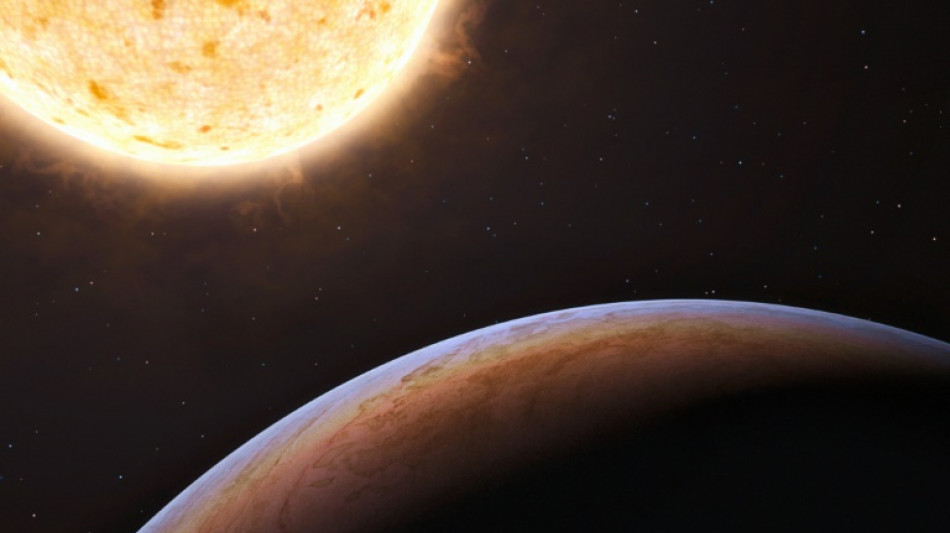
Huge planet discovered orbiting tiny star puzzles scientists / Photo: HO - ESO/AFP/File

Huge planet discovered orbiting tiny star puzzles scientists

Astronomers announced Wednesday they have discovered a massive planet orbiting a tiny star, a bizarre pairing that has stumped scientists.

Text size:

Most of the stars across the Milky Way are small red dwarfs like TOI-6894, which has only 20 percent the mass of our Sun.

It had not been thought possible that such puny, weak stars could provide the conditions needed to form and host huge planets.

But an international team of astronomers have detected the unmistakable signature of a gas giant planet orbiting the undersized TOI-6894, according to a study in the journal Nature Astronomy.

This makes the star the smallest star yet known to host a gas giant.

The planet has a slightly larger radius than Saturn, but only half its mass. It orbits its star in a little over three days.

The astronomers discovered the planet when searching through more than 91,000 low-mass red dwarfs observed by NASA's TESS space telescope.

Its existence was then confirmed by ground-based telescopes, including Chile's Very Large Telescope.

"The fact that this star hosts a giant planet has big implications for the total number of giant planets we estimate exist in our galaxy," study co-author Daniel Bayliss of the UK's Warwick University said in a statement.

Another co-author, Vincent Van Eylen, of University College London, said it was an "intriguing discovery".

"We don't really understand how a star with so little mass can form such a massive planet!" he said.

"This is one of the goals of the search for more exoplanets. By finding planetary systems different from our solar system, we can test our models and better understand how our own solar system formed."

- How do you make a planet? -

The most prominent theory for how planets form is called core accretion.

The process begins when a ring of gas and dust -- called a protoplanetary disc -- which surrounds a newly formed star builds up into a planetary core. This core attracts more gas that forms an atmosphere, eventually snowballing into a gas giant.

Under this theory, it is difficult for low-mass stars to host giant planets because there is not enough gas and dust to begin building a core in the first place.

A rival theory proposes that these planets instead form when their protoplanetary disc becomes gravitationally unstable and breaks up, with the collapsing gas and dust forming a planet.

However neither theory seems to explain the existence of the newly discovered planet, TOI-6894b, the researchers said.

The planet also interests scientists because it is strangely cold.

Most of the gas giants discovered outside our Solar System so far have been what are known as "hot Jupiters", where temperatures soar well over 1,000 degrees Celsius.

But the newly discovered planet appears to be under 150C, the researchers said.

"Temperatures are low enough that atmospheric observations could even show us ammonia, which would be the first time it is found in an exoplanet atmosphere," said study co-author Amaury Triaud of Birmingham University.

The James Webb space telescope is scheduled to turn its powerful gaze towards the planet in the next year, which could help uncover some more mysteries of this strange planet.

C.Akbar--DT