
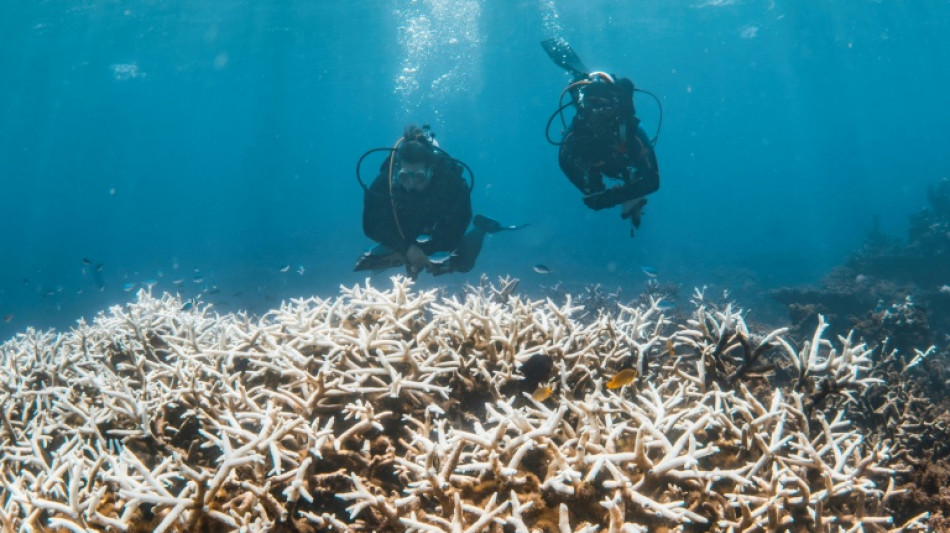
Coral frozen in time throws lifeline for Great Barrier Reef / Photo: Violeta J Brosig - Minderoo Foundation/AFP
Rows of tanks filled with liquid nitrogen sit in temperature-controlled chambers at Sydney's Taronga zoo, cradling parts of the Great Barrier Reef's diverse and magnificent corals frozen in time.
The world's largest store of cryogenically frozen coral is a frosty Noah's Ark for an ecosystem that scientists warn could be the first to disappear if climate change is not combatted fast enough.
Trillions of cells from dozens of key coral species on the Great Barrier Reef (GBR) -— collected each year during mass spawning -- offer the chance to regenerate damaged and diminished corals now and into the future.
"Essentially, a pause button has been pressed on their biological clocks," said Justine O'Brien, manager of conservation science at Taronga Conservation Society Australia.
"I hope our collective efforts can help to retain the reef's beautiful diversity," she told AFP.
Since the coral programme began in 2011, Taronga's CryoDiversity Bank has been intruding annually on the GBR's spawning, when corals send eggs and sperm into the waters for breeding.
Scientists collect the sperm and mix it with cryoprotectants, which remove water as the samples freeze, and protect internal cell structures.
Eggs contain too much water and fat to be frozen without damage using current techniques, so for now cannot be similarly banked, but other cells are also harvested and frozen for research.
The samples are placed into liquid nitrogen and stored at -196 degrees Celsius (-320 Fahrenheit). Strict measures ensure the temperature never changes.
"We can keep them alive indefinitely," O'Brien said.
"You could thaw them out a few years from now, a few decades from now or hundreds of years from now and they will have retained the same fertilising potential that existed when they were initially collected and frozen."
- Coral disease, death -
So far the bank has 34 species of the approximately 400 kinds of hard corals on the GBR, prioritising those most essential to reef structure and function, with plans to expand.
In addition to reproduction, the samples can be used for research and record-keeping, helping track the effects of warming seas, overfishing and pollution that threaten coral reefs globally.
Scientists forecast that at 1.5 Celsius (34.7 Fahrenheit) of warming, some 70 to 90 percent of the world's coral reefs could disappear -- a disastrous prospect for people and the planet.
Coral reefs support not just marine life but hundreds of millions of people living in coastal communities by providing food, protection from storms and livelihoods through fishing and tourism.
Warming oceans cause coral to expel the algae that provides not just their characteristic colour but also their food. Once bleached, they are exposed to disease and death by starvation.
A global coral bleaching event has been unfolding since 2023, spreading to 84 percent of the world's reefs, across the Pacific, Indian and Atlantic oceans.
Live coral cover has halved since the 1950s due to climate change and environmental damage, the International Coral Reef Initiative, a global conservation partnership, said this year.
Next week, nations will meet in France for a UN oceans summit where they will be under pressure to deliver action and much-needed funds to better protect the world's overexploited and polluted seas.
But the third UN Ocean Conference may struggle to find global consensus and raise money given ongoing disagreements over deep-sea mining, plastic trash and overfishing.
- 'Window closing' -
O'Brien warns the GBR is under pressure, despite the resilience it has already shown.
"We know the frequency and severity of impacts that are now occurring are not giving the reef enough recovery time," she said.
The cryobank, one of just a handful around the world, offers a glimmer of hope.
Last year, Taronga and Australian Institute of Marine Science researchers successfully thawed frozen coral sperm to fertilise fresh eggs, producing viable coral larvae that were placed back onto the reef.
It was a world-first for the GBR and preliminary surveys show the transplants have grown well.
These efforts -- part of a broader programme looking at everything from shading corals to transplanting more heat-tolerant varieties -- are a "small part of the solution to the global coral reef crisis," said WWF-Australia's head of oceans Richard Leck.
But he warned that more needs to be done to ensure the long-term survival of coral.
"Reefs are incredibly resilient and they do bounce back remarkably quickly after major disturbances," he told AFP.
"There is certainly a window to get reefs through climate change, but it is clear that that window is closing."
W.Darwish--DT



