
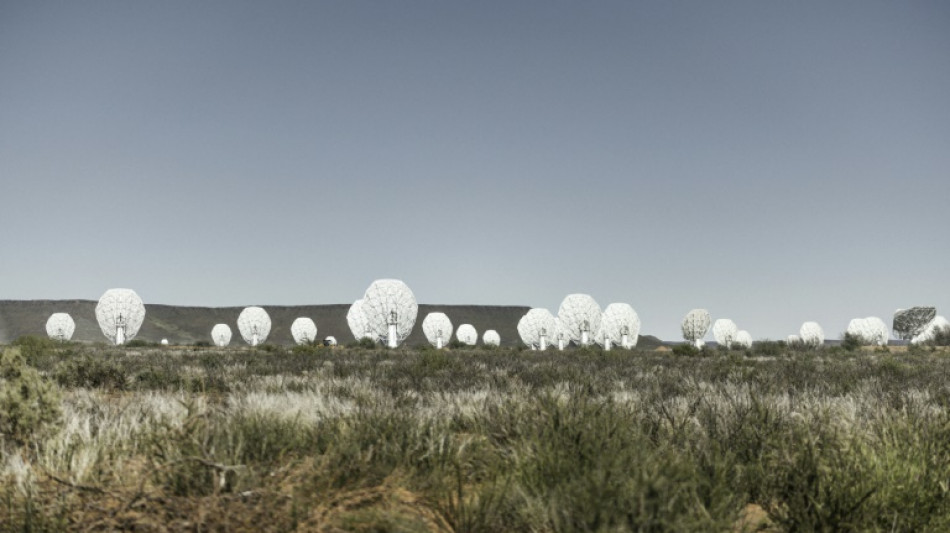
S.Africa's vast radio telescope draws new generation to the cosmos / Photo: MARCO LONGARI - AFP
When Lungelo Zondi first learnt about stars and galaxies at primary school in South Africa, she dreamt of having a live feed into the universe for uninterrupted space exploration.
Today, aged 25, her childhood vision has pretty much come true.
From her desk in Cape Town, Zondi monitors one of the world’s largest radio telescopes, the MeerKAT, made up of 64 giant white dishes that stand in a semi-desert region 600 kilometres (370 miles) away.
Through the screen of her computer, she can tune into radio signals emitted by stars and galaxies light-years away using the massive antennae that are 13.5 metres (44 feet) in diametre and turned up to the heavens.
"This is so interesting and fascinating: we're collecting data from the universe," Zondi said of the job of telescope operator at the South African Radio Astronomy Observatory (SARAO) that she started just two months ago.
Since 2005, SARAO has awarded 1,369 bursaries to students of applied mathematics, computer science, astrophysics and other subjects.
The bubbly engineering student is among them and part of a young generation of South Africans now able to look into the cosmos since the 2018 inauguration of the MeerKAT super radio telescope, which put the country on the map of global astronomy.
- World's most powerful -
As impressive as they are, the 64 dishes of the MeerKAT are just the start of an even bigger project, the Square Kilometre Array (SKA) Observatory that will be the world's most powerful radio telescope when it is completed by 2030.
The project will hook up another 133 South African dishes and more than 131,000 antennae based in Western Australia to allow humans to look back billions of years to when the "first stars and galaxies started lighting up the darkness", according to SKAO.
In the seven years since it was launched in the remote and sparsely populated Karoo region, MeerKAT has already "pushed the boundaries of scientific knowledge," said Adrian Tiplady, SARAO deputy managing director.
Its feats include groundbreaking radio images of the centre of the Milky Way, the discovery of immense radio galaxies stretching across millions of light-years, and the tracking of cosmic ripples through spacetime.
And with the MeerKAT programme to help train young South Africans, it is also keeping an eye on its future.
"It really covers the broad base of skills needed to actively participate in a global astronomy enterprise," Tiplady said.
"It has meant that the youth of South Africa now are excited about science, engineering and technology. We've really grown from a handful of radio astronomers some 10 or 20 years ago to a thriving and diverse community," he said.
An astrophysics group at the University of the Western Cape has benefited.
In 2011, "it started with just one South African faculty (member) at the time… and one student doing the PhD", Mario Santos, 50, professor in the university's physics and astronomy department, said.
"Now we have about 25 students and six faculty members," he added, saying the growth was "completely" linked to MeerKAT's development and South Africa’s selection as SKA host.
- Time machine -
In the control room at SARAO’s offices in Cape Town, Zondi and her colleagues monitor the health of the antennae and send them instructions to execute observations requested by scientists from all over the world.
There have been more than 1,200 submissions for observation time since 2019, with the biggest share from local research teams, Tiplady said.
"The world is watching us, so we have to make things perfect," said Sipho Molefe, another telescope operator. The 34-year-old studied electrical engineering and never imagined he would be working in astronomy.
"It makes people dream," he said. "There's a feeling that we're contributing to a bigger and larger environment in terms of information and development of technology."
The quiet and empty Karoo from where the MeerKAT's sensitive antennae listen to the universe was identified as holding tremendous potential for South African astronomy in the 1990s.
The facility operates in a "radio quiet zone" where radio waves, cell phone signals and wireless connections are strictly controlled to prevent interference with the telescope's tracking.
“When we're building a telescope, it's almost like building a time machine," Tiplady said.
"Something like MeerKAT or the SKA will detect radio signals that have been travelling through the universe since the birth of the universe itself.”
“It's a true marvel of scientific and technical excellence... and we're proud of South Africa to be a part of this,” he told AFP.
W.Zhang--DT



