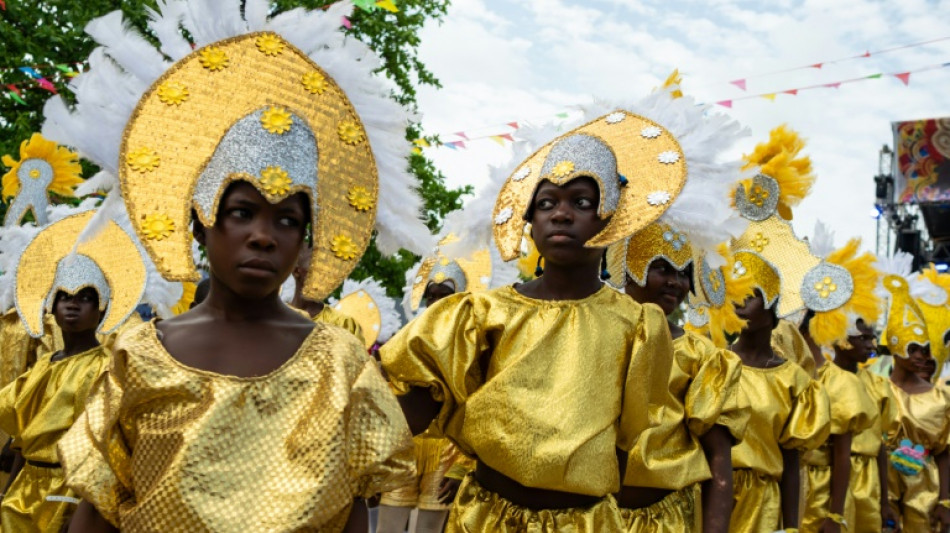
Afro-Brazilian carnival celebrates cultural kinship in Lagos / Photo: TOYIN ADEDOKUN - AFP
Thousands of young and old descendants of formerly enslaved people donned elaborate costumes Sunday to bring the rhythm, vibrancy and colours of Brazil's Rio Carnival to the streets of Lagos in Nigeria.
The festival, albeit on a smaller scale than that of its Brazilian model, helps to keep their heritage alive and celebrate the city's Afro-Brazilian history.
After Brazil abolished slavery, some of those who had been enslaved returned to west Africa, settling in several countries including Nigeria and Sierra Leone.
They brought with them Latin American culture -- dance, food, religion and colours -- that lives on today in pockets of the megacity of Lagos.
At Sunday's Fanti Carnival, a stilt-walking woman in a green-and-yellow dress with a yellow fascinator on her head danced rhythmically to sounds of loud drums and trumpets, sometimes stealing a hug from a man also performing on stilts.
Just behind them, a group of young men in striking face masks were preparing for a "dragon dance" using long rubber dragons similar to those that feature in Chinese New Year celebrations.
"We want to keep (our heritage) alive, very colourful... we love colours," said retired fine art teacher Onabolu Abiola, 67, dressed in the green and yellow of the Brazilian flag.
"During this period, we don't bother ourselves with the economic situation or whatever... everybody comes together to have fun," said he added, breaking into an impromptu dance to traditional Nigerian Yoruba music.
- 'Story of hope' -
"We are here to show culture, we are here to make history -- the celebration of culture is important," said 50-year-old Mayegun Musiliu as he walked with fellow performers. "This is how we sustain it."
Brazil was the last place in the Americas to abolish slavery when it formally ended the practice in 1888.
Many slaves were forced to adopt Portuguese names, and today in Nigeria, it is common to find people with Yoruba first names and Portuguese surnames.
One of them is Aduke Gomez, a 62-year-old lawyer and historian.
"The story of Afro-Brazilians is a story of tragedy... but it's a story of hope, it's a story of resilience," she said. Loud music blaring from speakers almost drowned out her words.
"Personally, I'm very proud to be an Afro-Brazilian descendent because when you think of the chances of how many people came back and when they came back -- they came back with nothing... and many of them worked and lived to become educated and were contributing positively."
The carnival, she added, "is not just a day, it's a tangible legacy of what my ancestors went through".
- A little-known legacy -
Another participant, renowned filmmaker and actress Joke Silva, 64, recalled how her parents always used to bring her to the Fanti festival as a child.
She said she now continued the tradition, bringing her children to the celebrations.
"There needs to be more interrogation on how the trauma of (slavery)... has been part of what we are today. But that is not to claim victimhood," she said.
The carnival represents a part of Nigeria's history that is not always well known -- though some are trying to change that.
Kelenchi Anabaraonye, 27, curated a history exhibition at the festival.
"I had friends who were named Pionero, Pereira, Da Silva, Gomez," said Anabaraonye.
"Back then I thought they were jesting with the names, because you have a Yoruba first name and why are your surnames foreign? I didn't know that there was some historical connection."
I.Uddin--DT