Dubai Telegraph - Faux gras? Scientists craft 'more ethical' version of French delicacy

EUR -
AED 4.39647
AFN 79.010777
ALL 96.7817
AMD 453.834235
ANG 2.142963
AOA 1097.770504
ARS 1728.714548
AUD 1.697422
AWG 2.154839
AZN 2.03606
BAM 1.959479
BBD 2.410826
BDT 146.2646
BGN 2.010429
BHD 0.451359
BIF 3555.483592
BMD 1.197133
BND 1.514243
BOB 8.270527
BRL 6.218144
BSD 1.196947
BTN 110.127756
BWP 15.609305
BYN 3.381248
BYR 23463.797441
BZD 2.40732
CAD 1.614512
CDF 2702.527156
CHF 0.914657
CLF 0.026043
CLP 1028.337353
CNY 8.318156
CNH 8.313415
COP 4373.125105
CRC 592.211831
CUC 1.197133
CUP 31.724012
CVE 110.884406
CZK 24.328187
DJF 212.75416
DKK 7.467485
DOP 75.419599
DZD 154.65435
EGP 56.059366
ERN 17.956988
ETB 186.200377
FJD 2.621956
FKP 0.868641
GBP 0.866784
GEL 3.226251
GGP 0.868641
GHS 13.114581
GIP 0.868641
GMD 88.00166
GNF 10476.106643
GTQ 9.184243
GYD 250.420144
HKD 9.344996
HNL 31.588305
HRK 7.535923
HTG 156.894557
HUF 380.549872
IDR 20097.400931
ILS 3.704161
IMP 0.868641
INR 109.934056
IQD 1568.04388
IRR 50429.2077
ISK 144.996855
JEP 0.868641
JMD 187.812603
JOD 0.848796
JPY 183.318702
KES 154.514154
KGS 104.688869
KHR 4816.661042
KMF 493.218172
KPW 1077.499653
KRW 1713.586906
KWD 0.366789
KYD 0.997473
KZT 601.288873
LAK 25747.338611
LBP 102474.544325
LKR 370.335275
LRD 221.435728
LSL 18.885656
LTL 3.534821
LVL 0.724134
LYD 7.519117
MAD 10.83945
MDL 20.132798
MGA 5357.167785
MKD 61.629467
MMK 2514.472536
MNT 4270.0428
MOP 9.623167
MRU 47.746641
MUR 54.05048
MVR 18.507873
MWK 2075.496582
MXN 20.615098
MYR 4.704817
MZN 76.329328
NAD 18.885656
NGN 1661.703631
NIO 44.052706
NOK 11.415096
NPR 176.204811
NZD 1.969152
OMR 0.460301
PAB 1.196947
PEN 4.002915
PGK 5.201766
PHP 70.529025
PKR 334.819598
PLN 4.205952
PYG 8032.0796
QAR 4.363392
RON 5.097505
RSD 117.394378
RUB 90.079313
RWF 1746.378689
SAR 4.490097
SBD 9.670049
SCR 16.594223
SDG 720.018515
SEK 10.539112
SGD 1.512703
SHP 0.898159
SLE 29.091786
SLL 25103.269553
SOS 682.882058
SRD 45.495226
STD 24778.226215
STN 24.546083
SVC 10.473663
SYP 13239.776792
SZL 18.879445
THB 37.386326
TJS 11.179589
TMT 4.189964
TND 3.427835
TOP 2.882408
TRY 52.027807
TTD 8.124253
TWD 37.561827
TZS 3070.644609
UAH 51.226874
UGX 4257.99405
USD 1.197133
UYU 45.295038
UZS 14565.345295
VES 429.143458
VND 31125.445585
VUV 143.139968
WST 3.252382
XAF 657.190824
XAG 0.010137
XAU 0.00022
XCD 3.23531
XCG 2.15725
XDR 0.816474
XOF 657.190824
XPF 119.331742
YER 285.394994
ZAR 18.826046
ZMK 10775.631872
ZMW 23.669438
ZWL 385.476184
  • SCS

    0.0200

    16.14

    +0.12%

  • RBGPF

    0.0000

    82.4

    0%

  • CMSD

    0.0392

    24.09

    +0.16%

  • BCC

    -0.5500

    80.3

    -0.68%

  • CMSC

    0.0100

    23.71

    +0.04%

  • RYCEF

    -0.1700

    16.43

    -1.03%

  • JRI

    -0.0500

    12.94

    -0.39%

  • NGG

    0.3900

    85.07

    +0.46%

  • VOD

    0.1400

    14.71

    +0.95%

  • BCE

    0.2200

    25.49

    +0.86%

  • RIO

    1.7600

    95.13

    +1.85%

  • RELX

    -1.2100

    36.17

    -3.35%

  • GSK

    0.5600

    50.66

    +1.11%

  • BTI

    0.0600

    60.22

    +0.1%

  • AZN

    -0.6300

    92.59

    -0.68%

  • BP

    0.3400

    38.04

    +0.89%

Faux gras? Scientists craft 'more ethical' version of French delicacy
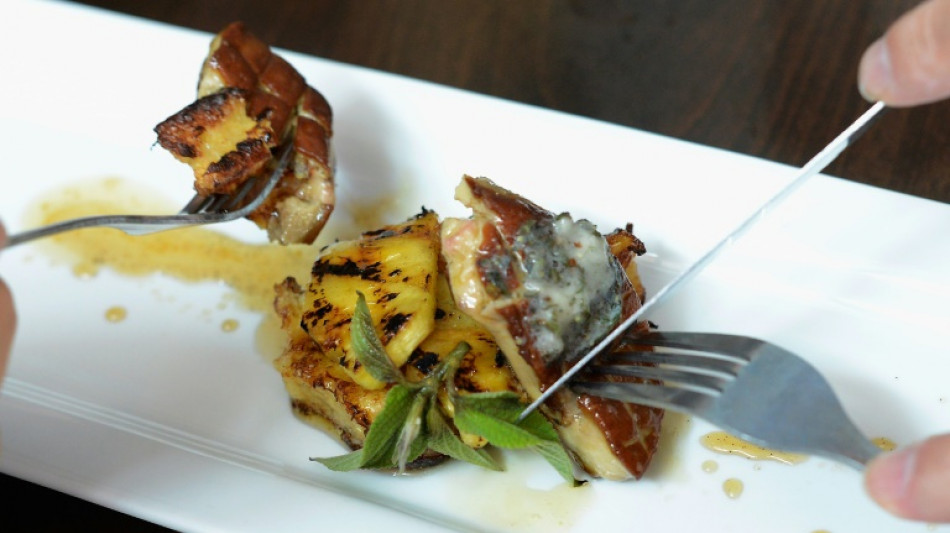
Faux gras? Scientists craft 'more ethical' version of French delicacy / Photo: KEVORK DJANSEZIAN - GETTY IMAGES NORTH AMERICA/AFP/File

Faux gras? Scientists craft 'more ethical' version of French delicacy

Foie gras — the fattened liver of ducks or geese — is a French delicacy prized for its rich, buttery flavor. But its production, which involves force-feeding the animals, has led to bans in several countries.

Text size:

Now, a team of scientists says they've developed a more ethical alternative: one that mimics the taste and texture of the dish, minus the controversy.

The results were published Tuesday in the journal Physics of Fluids.

"It was always a dream to make foie gras more accessible and better for animal welfare," said lead author Thomas Vilgis, a professor of food science at the Max Planck Institute for Polymer Research in Mainz, Germany. "It's good to stop these force-feeding practices —- or at least reduce them."

Vilgis and his colleagues from his own institute and the University of Southern Denmark were adamant about one thing: no outside additives.

They initially tried cooking collagen from the birds' skin and bones into the liver-fat emulsion, but the result lacked the signature silky texture.

Then came the breakthrough: treating the fat with the bird's own lipases: enzymes the body naturally uses to break down fats. This tweak replicated a key part of the foie gras formation process, without resorting to force-feeding.

"At the end of the process, it allows the fat to recrystallize into the large crystals which form aggregates like the ones we see in the original foie gras," Vilgis said.

According to the authors, the elegance of the method lies in its simplicity: harvest the liver and fat, treat the fat with lipases, mix, sterilize — and voila.

Laser microscopy gave the new product a thumbs-up: the emulsion structure, fat droplet size, and shape closely matched traditional foie gras. Even the aroma passed the test.

To test texture, the team turned to industrial compression devices -— machines that gently press on food samples to measure firmness. The new foie gras held up well, offering a mouthfeel strikingly close to the original.

"We could really see the influence of these large fat particles, which we call in the paper 'percolating clusters,'" Vilgis said.

"At the beginning of the 'bite,' these large clusters have a high resistance, creating a similar mouthfeel of elasticity -— without being too rubbery like after the collagen or gelatin addition."

Vilgis has filed a patent for the process and now hopes to partner with companies to bring this kinder foie gras to market.

F.Damodaran--DT