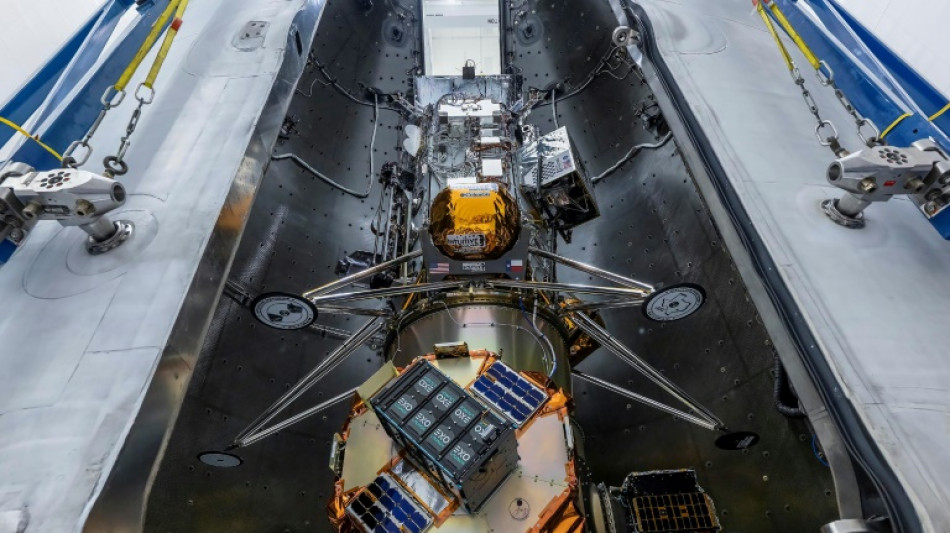
Private US company set for second Moon landing attempt / Photo: Handout - Intuitive Machines, LLC/AFP
Intuitive Machines made history last year as the first private company to put a robot on the Moon, although the triumph was marred by the lander tipping onto its side.
Now, the Houston-based firm is gearing up for a second attempt, determined to achieve a perfect touchdown.
Intuitive Machines' hexagonal-shaped lander, Athena, is set to launch aboard a SpaceX Falcon 9 rocket during a window that opens at 7:02 pm (0002 GMT) Wednesday from the Kennedy Space Center in Florida, according to an official spaceflight advisory.
If all goes well, it will touch down around March 6 at a spot called the Mons Mouton plateau, a site closer to the lunar south pole than any previously targeted.
Athena carries scientific instruments, including a drill to search for ice beneath the surface and a unique hopping drone named Grace after a famous computer scientist, Grace Hopper. It is designed to traverse the Moon's rugged inclines, boulders, and craters -- a valuable capability to support future crewed missions.
Also aboard is a small rover, which will test a lunar cellular network provided by Nokia Bell Labs by relaying commands, images, and video between the lander, rover, and hopper.
Until recently, soft lunar landings were achieved only by a handful of well-funded national space agencies.
Now, the US is working to make private missions routine through the Commercial Lunar Payload Services (CLPS) program, a public-private collaboration aimed at delivering key NASA hardware to the surface at a fraction of the cost of traditional missions. The effort supports the broader Artemis program, which aims to return astronauts to the Moon and apply lessons learned there to prepare for reaching Mars.
"This is a really sophisticated mission enabled by the partnerships between the government and US industry," said Joel Kearns, NASA's deputy associate administrator for exploration.
- Nailing the landing -
The first major hurdle, however, will be achieving a perfect landing -- a feat the company fell short of with its first lander, Odysseus, which went to space in February 2024. It caught a foot on the surface and tipped over, coming to rest at a 30-degree angle -- limiting its solar power and preventing it from completing NASA experiments under a $118 million contract.
This time, the price tag is $62.5 million.
"Landing on the Moon is very challenging," said Kearns. "It's a lot tougher than landing on Earth, where we have the advantage of air, wings, parachutes, and things like that."
But on the Moon, which has an atmosphere so thin it's practically a vacuum, spacecraft must rely solely on controlled bursts from thrusters to slow their descent.
Intuitive Machines CEO Trent Martin acknowledged the challenges and said the company had made key improvements -- including better cabling for the laser altimeter, an instrument that provides altitude and velocity readings and helps select a safe landing site.
Another issue the IM-1 mission faced was accurately determining its position en route to the Moon. To improve this, Intuitive Machines has enhanced coordination with NASA's Deep Space Network (DSN) for more precise navigation.
Athena's arrival at the Moon is set to be preceded on March 2 by another private US lander, Firefly Aerospace's Blue Ghost, which launched on a more circuitous journey back in January, sharing a ride with Tokyo-based ispace's Resilience lander.
Also hitching a ride on this rocket will be NASA's Lunar Trailblazer probe, which will enter orbit after a four-month journey and begin a two-year mission to study the distribution of different forms of water on the Moon.
These missions come at a delicate time for NASA, amid speculation that it may scale back or cancel its astronaut program to the Moon in favor of Mars -- a key goal of both President Donald Trump and his close advisor Elon Musk.
A.Murugan--DT