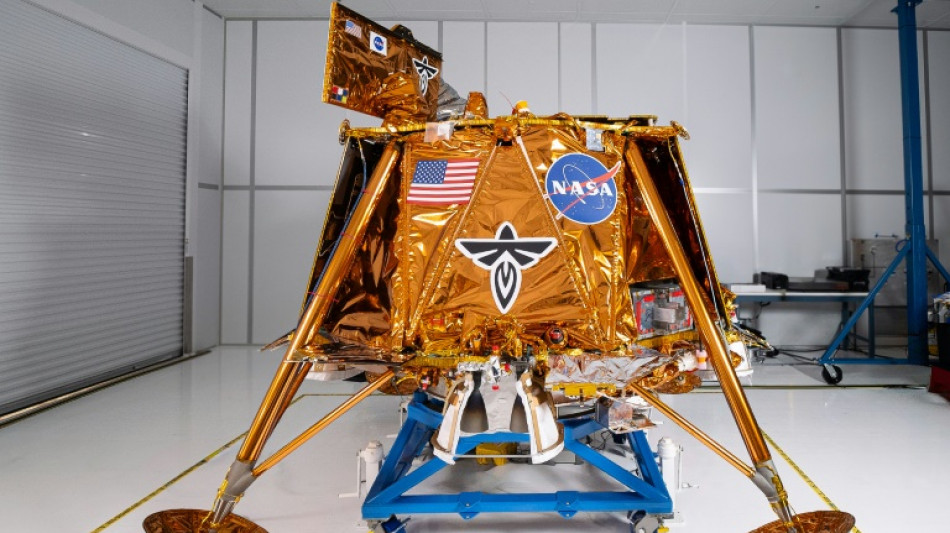
US, Japanese lunar landers set to launch on single rocket / Photo: - - Firefly Aerospace/AFP/File
One rocket, two missions: Lunar landers built by US and Japanese companies are poised to "rideshare" to the Moon, showcasing the private sector's growing role in space exploration.
SpaceX is targeting a 1:11 am (0611 GMT) Wednesday liftoff of a Falcon 9 rocket from the Kennedy Space Center in Florida, with very favorable weather conditions forecast.
On board are two privately developed, uncrewed lunar landers: Firefly Aerospace's Blue Ghost and ispace's Resilience from Japan, which will also deploy a micro rover.
Both aim to build on the success of Texas-based Intuitive Machines, which last year became the first company to successfully touch down on Earth's celestial neighbor.
Until recently, soft landings on the Moon were achieved only by a handful of well-funded national space agencies, starting with the Soviet Union in 1966.
Now, however, several emerging US companies are attempting to replicate this feat under NASA's experimental Commercial Lunar Payload Services (CLPS) program, designed to cut costs and stimulate a lunar economy.
The US plans to establish a sustained human presence on the Moon later this decade under the Artemis program, leveraging commercial partners to deliver critical hardware at a fraction of the cost of government-led missions.
"Each milestone we complete will provide valuable data for future missions and ultimately keep the United States and our international partners at the forefront of space exploration," Firefly Aerospace CEO Jason Kim said Tuesday.
"Firefly is a go for launch. Let's go ghost riders in the sky!"
- Staying upright -
On the Japanese side, Tokyo-based ispace's first attempt to land on the Moon ended in an unsalvageable "hard landing" in April 2023.
"That's why we hope to send a message to people across Japan that it's important to challenge ourselves again, after enduring failure and learning from it," ispace founder and CEO Takeshi Hakamada said last week.
Blue Ghost is stacked atop Resilience inside the Falcon 9, SpaceX executive Julianna Scheiman said, and will be deployed first, followed by Resilience nearly 30 minutes later.
The two spacecraft have different timelines for reaching the Moon.
Blue Ghost aims to complete its journey in 45 days, gradually lifting its orbit around Earth before entering lunar orbit and touching down near Mons Latreille, a volcanic feature in Mare Crisium on the Moon's northeast near side.
"With ten NASA instruments on this flight, we're conducting scientific investigations... from characterizing Earth's magnetosphere to understanding lunar dust and the Moon's interior structure and thermal properties," NASA scientist Maria Banks said.
Blue Ghost also carries technology demonstrations focused on navigation and computing in the Moon's harsh radiation environment.
Meanwhile, Resilience will take four to five months to reach its destination in Mare Frigoris, on the Moon's far north.
Its payload includes scientific instruments, but the centerpiece is Tenacious, a micro rover developed by ispace-Europe, a Luxembourg-based subsidiary.
The four-wheeled robot features a high-definition camera and will attempt to scoop up regolith -- the Moon's loose surface material.
It also carries on its front a small red "Moonhouse" created by Swedish artist Mikael Genberg.
These ambitious goals hinge on achieving a successful soft landing -- a task fraught with challenges.
Spacecraft must navigate treacherous boulders and craters and, in the absence of an atmosphere to support parachutes, rely entirely on thrusters for a controlled descent.
A final hurdle, as recent missions have shown, is remaining upright.
When Intuitive Machines' Odysseus landed in April 2024, it tipped over, limiting the investigations it could perform.
Similarly, Japan's SLIM lander, which touched down in March 2024, landed at a wonky angle, leaving its solar panels poorly positioned, similarly curtailing its operational lifespan.
R.Mehmood--DT