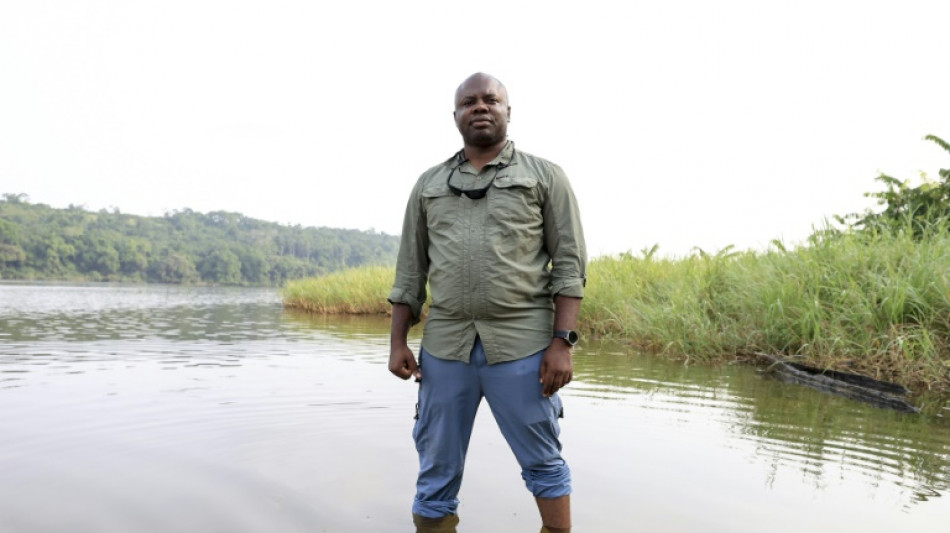
Saving the mysterious African manatee at Cameroon hotspot / Photo: Daniel Beloumou Olomo - AFP
Ever since his first hard-won sightings of African manatees, award-winning marine biologist Aristide Takoukam Kamla has been devoted to protecting the little known and atrisk aquatic mammals.
African manatees are found in fresh water along the coast of western Africa, such as in Cameroon's vast Lake Ossa where the researcher first saw them more than 10 years ago.
But they are shy creatures -- spotting them requires setting out before dawn when the lake is glassy and tranquil, all the better for following the trails of bubbles and, maybe just maybe, catching two big nostrils taking a quick breath.
"I was expecting to see them like on YouTube: in clear water, jumping like dolphins... a completely surreal idea" stemming from publications on manatees in Florida, the 39-year-old Cameroonian recalled, smiling.
Their African cousins, however, are very different and the then University of Dschang apprentice researcher had to row for a long time before being rewarded.
Thanks to local fishermen, Takoukam Kamla has now learnt how to spot African manatees more easily within the darkened depths of the 4,500-hectare (11,000-acre) Lake Ossa, part of a sprawling wildlife reserve in southwestern Cameroon.
They are his "favourite animal", the subject of his doctorate at the University of Florida -- and the reason he won this year's prestigious Whitley Award that recognises groundbreaking biodiversity work by grassroots conservationists.
- Endangered habitat, poaching -
American scientist Sarah Farinelli was moved to tears after seeing five African manatees, including a female with her calf, while out on the lake with Takoukam Kamla.
"Its huge! There are certain places in Africa where it's impossible to see them," said Farinelli, who is in her 30s and studies the marine mammals in Nigeria.
Much still eludes researchers about the Trichechus senegalensis -- how many are in Cameroon; how long do they live; when and where do they migrate.
African manatees are found between Mauritania and Angola but "it's a very little studied species, around which many mysteries still remain", Takoukam Kamla said.
Sometimes known as sea cows, the large marine herbivore is listed as "vulnerable" on the red list of the International Union for Conservation of Nature.
But the Cameroonian scientist thinks that is "an under-estimation of the real status of this species, which is subject to poaching" and whose habitat is "constantly in danger".
Takoukam Kamla set up the African Marine Mammal Conservation Organisation which has five laboratories including in the lakeside fishing village of Dizangue.
On Lake Ossa, the animal's sole predators are human -- only a few years ago, manatees were still being served up in the village restaurant.
Manatee hunting is now outlawed and the dish has vanished from menus. A blue statue of a manatee has even been erected in their honour.
But threats remain.
Takoukam Kamla, standing on the shores of the lake, points to a palm oil refinery whose waste is dumped into the water.
Another threat is the positioning of a net across the lake to maximise catches as it could "trap a small manatee in its mesh", he complained, getting into a heated discussion with a fisherman in his dug-out canoe.
"We're indigenous, we live off this and we have never had to suffer prohibitions at home," the old man grumbled bitterly.
"If you want to impose bans on us, you will have to pay us every month."
- Biological combat -
Relations between the scientists and the local communities whose fishing traditions have been passed down the generations are tricky.
But an environmental threat that struck three years ago brought their two worlds together.
Half of the lake's surface became covered by the invasive giant salvinia -- Salvinia molesta -- a free-floating plant that has made the lake uninhabitable for both fish and manatees.
To combat it, scientists used a microscopic insect that feeds exclusively on salvinia and called on the fishermen to help.
"They used to take the salvinia infested with weevils and put a bit everywhere in the lake," AMMCO researcher Thierry Aviti said.
Three years on, the menacing plant has all but disappeared.
"At one point, we couldn't cope anymore" but promises were kept, Dizangue fisherman Thierry Bossambo said, marked by the memories of long nights with no fish.
The bridges built with the fishermen is something Takoukam Kamla is keen to maintain to avoid "parachute science", a term referring to scientists dropping into local communities from their academic ivory towers to undertake field work.
And to counter possible poaching, he wants to develop the area's eco-tourism.
It's a "priority", agreed Gilbert Oum Ndjocka, curator of the nearby Douala-Edea National Park, who said "all stakeholders are allies for conservation".
D.Naveed--DT