Cancer, cardiovascular drugs tipped for Nobel as prize week opens / Photo: Jonathan NACKSTRAND - AFP/File
Cancer research or drugs treating cardiovascular illnesses could win a Nobel Prize on Monday when a week of laureate announcements kicks off, bringing a ray of optimism to a world beset by crises.
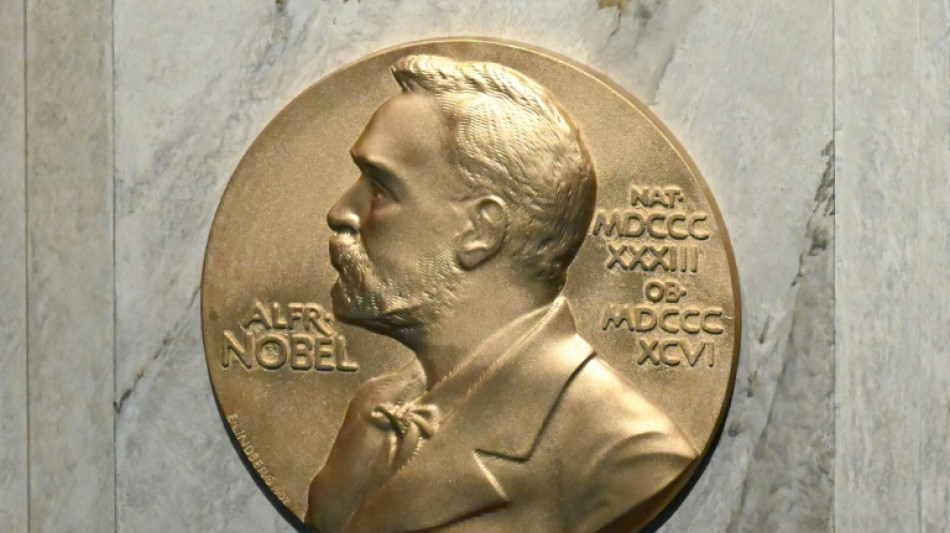
Awarded since 1901, the Nobel Prizes honour those who have, in the words of prize creator and scientist Alfred Nobel, "conferred the greatest benefit on humankind", highlighting encouraging advances at a time when the world is witnessing devastating wars in the Middle East and Ukraine and a climate on the brink of collapse.
The Nobel Prize in Medicine is first out, announced on Monday around 11:30 am (0930 GMT) in Stockholm.
Among those seen as possible laureates is Kevan Shokat, an American biologist who figured out how to block the KRAS cancer gene behind a third of cancers, including challenging-to-treat lung, colon and pancreatic tumours.
"These are now being tested for new treatments thanks to his discovery," said Annika Ostman, science reporter at Swedish public radio SR.
Research into how to treat cardiovascular illnesses could also get the nod, with the work of geneticists Jonathan Cohen and Helen Hobbs mentioned.
They identified genes that regulate the metabolism of essential lipids such as cholesterol, which has led to a new class of cholesterol-lowering drugs, David Pendlebury, head of the Clarivate analytics group that identifies Nobel-worthy research, told AFP.
Hobbs won the Breakthrough Prize in Life Sciences in 2016, sharing the honour with Swedish geneticist Svante Paabo, who went on to win the Nobel in 2022.
Pendlebury also spotlighted a trio of neuroscientists who have researched the basal ganglia, a region in the brain important for motivation and reward, and how it regulates our behaviour.
The three are US neuroscientist Ann Graybiel, Okihide Hikosaka of Japan and German-born Wolfram Schultz.
Other potential winners are Davor Solter and Azim Surani for their study of epigenetics, which examines how cells control the activities of genes without changing the DNA.
Last year, the medicine prize went to researchers Katalin Kariko and Drew Weissman for their work on messenger RNA technology that paved the way for groundbreaking Covid-19 vaccines.
- Atomic scale microscope -
For the Nobel Prize in Physics, announced on Tuesday, SR's science experts suggested the honour could go to Swiss physicist Christoph Gerber, a pioneer in the development of the atomic force microscope.
"This is a microscope that gives 3D images on such an incredibly small scale that they sometimes are even atomic resolution," said SR science reporter Camilla Widebeck.
The tool has become indispensable in nanotechnology and nano research, she added.
Clarivate also mentioned Gerber as a possible winner, as well as David Deutsch and Peter Shor for their work on quantum algorithms and quantum computing.
Lars Brostrom at SR meanwhile said he hoped to see American-Jordanian Omar Yaghi win Wednesday's chemistry prize.
Yaghi developed a type of customised porous material known as MOF (Metal-organic framework), now used in commercial products that can, among other things, absorb and decontaminate toxins, act as a catalyst or even absorb water from desert air.
Karl Deisseroth, a US psychiatrist and neurologist, has also been mentioned for the past decade as a possible laureate for developing the field of optogenetics, using light to control cells.
Speculation is also rife for the literature prize, to be announced on Thursday and perhaps the most highly anticipated Nobel after the peace prize.
Several pundits believe Chinese author Can Xue will be the Swedish Academy's choice this year -- and she has the lowest odds on several betting sites.
An avant-garde fiction writer often likened to Kafka, her experimental style flips between utopia and dystopia and transforms the mundane into the surreal.
"I think it will be a woman from a language zone outside Europe," Bjorn Wiman, culture editor at Sweden's newspaper of record, Dagens Nyheter, told AFP.
Others suggest it could go to Australian novelist Gerald Murnane, Britain's Salman Rushdie or Kenya's Ngugi wa Thiong'o.
- Who deserves the Peace Prize? -
The climax of the week comes Friday when the Peace Prize laureate is announced, but experts say predictions are harder than ever this year due to the growing number of crises in the world.
The UN agency for Palestinian refugees UNRWA, the International Court of Justice and Afghan women's rights activist Mahbouba Seraj have been mentioned as possibilities.
Given the existential risks to humanity posed by weapons systems that can operate autonomously without human control, several Nobel-watchers have also cited the Campaign to Stop Killer Robots as a potential laureate.
The economics prize wraps up the 2024 Nobel season on October 14.
It could go to research on the economics of child development, the integration of nature in the economy, or the effects of corruption on economic growth.
J.Chacko--DT