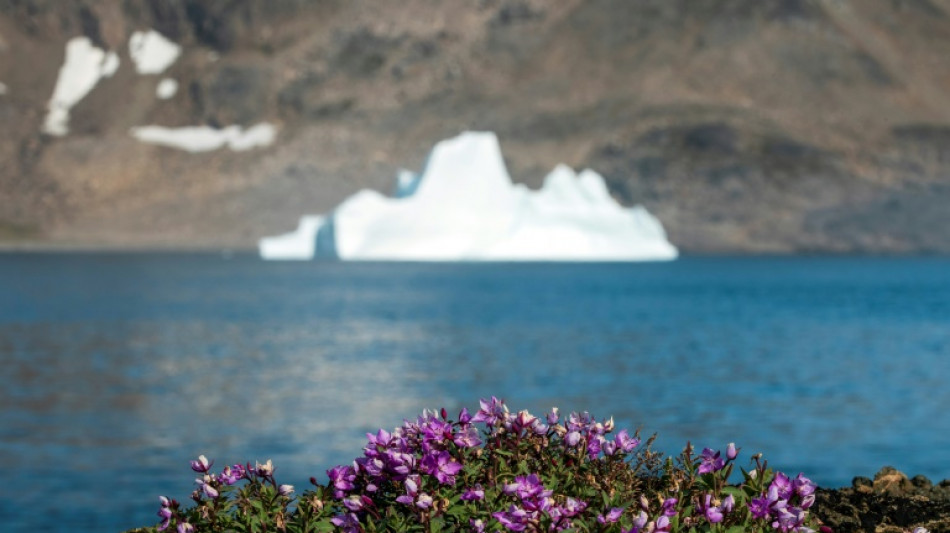
Greenland fossils reveal greater sea-level threat from climate change
/ Photo: Jonathan NACKSTRAND - AFP/File
In the not-too-distant past, Greenland lived up to its name.
Scientists have discovered plant and insect remains under a two-mile-deep (three km) ice core extracted from the center of the island, providing the clearest proof yet that nearly all of this vast territory was green within the past million years, when atmospheric carbon levels were much lower than today.
Their research, published Monday in the Proceedings of the National Academy of Sciences, indicates even greater potential for global sea level rise due to human-caused climate than previously thought.
The ice core, named GISP2, was drilled in 1993 and although its rock and ice had been studied extensively, nobody had thought to look for fossils in the "till," or the mixed sediment at the bottom.
That's because until recently the idea that Greenland was ice-free in the recent geologic past seemed too far-fetched.
"Literally, we saw the fossils within the first hour, maybe half hour, of working on it," lead author Paul Bierman, a professor of environmental science at the University of Vermont, told AFP.
To their amazement, researchers found within this three-inch-layer soil willow wood, spores from spikemoss, fungi, the compound eye of an insect, and a poppy seed -- together suggesting a vibrant tundra ecosystem.
If ice at the center of the island had melted away, it almost certainly means that it was also absent across the rest of Greenland -- spelling trouble for today's fossil-fuel supercharged climate, said Bierman.
If greenhouse gas emissions from burning fossil fuels are not drastically reduced, Greenland's ice sheet could almost entirely melt over the next several centuries to a few millennia, resulting in a sea level rise of approximately 23 feet (seven meters) that would wipe away the world's coastal cities.
"Hundreds of millions of people around the world are going to lose their places to live," he warned.
- Checkmate for impenetrable ice-fortress theory -
The new work builds on two important recent findings. In 2016, scientists tested bedrock from the same 1993 ice core, using radioactive dating to estimate it could be no more than 1.1 million-years-old.
Their modeling also showed that if the ice was melted at the GISP2 site, then 90 percent of the rest of Greenland would have been ice-free.
But the finding was controversial because of a longstanding theory that Greenland was an impenetrable ice fortress for the past several million years.
Then in 2019, Bierman and an international team reexamined another ice core, this time extracted from the abandoned US military base, Camp Century, near the coast of Greenland in the 1960s.
They were shocked to learn it contained not just sediment but leaves and moss. More advanced dating techniques available to them helped them constrain the disappearance of that section of ice to 416,000 years ago.
The discovery of organic matter in the core from near the coast prompted Bierman to go back to the 1993 core to look for similar material -- and finding it confirmed unequivocally what scientists had previously inferred through models and calculations.
"The ice had to be gone, because otherwise there would be no plants, no insects, and no soil fungus," said Bierman. "Now we know for sure that the ice was gone not just at Camp Century but at GISP2 right at the center of the ice sheet. Now we know the whole ice sheet is vulnerable to melting."
Co-author Halley Mastro, a graduate student at the University of Vermont who studied the fossils, emphasized the need for further drilling into Greenland's ice cores to find more ancient organisms that hold important implications for our future.
"It's so obvious once you know it's there -- but if you didn't expect it to be there, and you weren't looking for these tiny little dark flecks that float a little bit differently, you would never see them," she told AFP.
U.Siddiqui--DT