Dubai Telegraph - Webb spots giant star clusters shaping galaxy in early universe

EUR -
AED 4.244975
AFN 72.820848
ALL 95.94014
AMD 432.845748
ANG 2.069125
AOA 1059.9439
ARS 1612.448734
AUD 1.630495
AWG 2.083478
AZN 1.975557
BAM 1.955854
BBD 2.312344
BDT 140.86392
BGN 1.97576
BHD 0.436373
BIF 3409.360338
BMD 1.155882
BND 1.472956
BOB 7.933839
BRL 6.034974
BSD 1.148121
BTN 106.962842
BWP 15.666656
BYN 3.550075
BYR 22655.290457
BZD 2.309044
CAD 1.587587
CDF 2629.632268
CHF 0.912315
CLF 0.02673
CLP 1055.440177
CNY 7.976107
CNH 7.970767
COP 4269.250781
CRC 537.156773
CUC 1.155882
CUP 30.630877
CVE 110.276655
CZK 24.461703
DJF 204.451609
DKK 7.470992
DOP 69.417337
DZD 152.86546
EGP 60.38409
ERN 17.338232
ETB 179.257046
FJD 2.552824
FKP 0.865823
GBP 0.862028
GEL 3.138164
GGP 0.865823
GHS 12.532325
GIP 0.865823
GMD 85.53555
GNF 10062.063468
GTQ 8.782928
GYD 240.195386
HKD 9.054875
HNL 30.389212
HRK 7.534385
HTG 150.595917
HUF 390.905473
IDR 19574.864484
ILS 3.583986
IMP 0.865823
INR 107.871312
IQD 1503.841849
IRR 1520129.533815
ISK 143.802901
JEP 0.865823
JMD 180.379064
JOD 0.819543
JPY 183.053012
KES 148.900854
KGS 101.079471
KHR 4602.486441
KMF 494.717881
KPW 1040.237132
KRW 1733.840599
KWD 0.354151
KYD 0.956727
KZT 552.128355
LAK 24631.603335
LBP 102816.866801
LKR 357.867823
LRD 210.101297
LSL 19.345045
LTL 3.41302
LVL 0.699181
LYD 7.352777
MAD 10.78784
MDL 20.120127
MGA 4777.504939
MKD 61.659387
MMK 2427.090222
MNT 4126.123457
MOP 9.262658
MRU 45.822843
MUR 53.702177
MVR 17.857711
MWK 1990.910421
MXN 20.5022
MYR 4.552961
MZN 73.864954
NAD 19.345045
NGN 1563.781237
NIO 42.254466
NOK 10.986195
NPR 171.141088
NZD 1.965433
OMR 0.444448
PAB 1.148032
PEN 3.95431
PGK 4.955524
PHP 69.242543
PKR 320.634588
PLN 4.267078
PYG 7460.788537
QAR 4.186943
RON 5.094202
RSD 117.457276
RUB 99.582279
RWF 1676.077146
SAR 4.339533
SBD 9.303214
SCR 16.360031
SDG 694.685812
SEK 10.751888
SGD 1.478948
SHP 0.867211
SLE 28.492821
SLL 24238.283596
SOS 654.969224
SRD 43.347864
STD 23924.427123
STN 24.50259
SVC 10.04528
SYP 128.031659
SZL 19.350045
THB 37.827979
TJS 10.992206
TMT 4.045588
TND 3.390958
TOP 2.783086
TRY 51.215642
TTD 7.781822
TWD 36.948699
TZS 2991.323614
UAH 50.488736
UGX 4339.458641
USD 1.155882
UYU 46.504915
UZS 13994.389439
VES 525.56301
VND 30414.149497
VUV 137.591978
WST 3.171932
XAF 656.026336
XAG 0.015839
XAU 0.000246
XCD 3.123829
XCG 2.068958
XDR 0.815886
XOF 656.026336
XPF 119.331742
YER 275.735655
ZAR 19.390507
ZMK 10404.313415
ZMW 22.474375
ZWL 372.193586
  • BCC

    -1.9800

    69.86

    -2.83%

  • RYCEF

    -0.5900

    16.01

    -3.69%

  • CMSD

    0.0100

    22.9

    +0.04%

  • RELX

    -0.0400

    33.82

    -0.12%

  • RBGPF

    -13.5000

    69

    -19.57%

  • JRI

    -0.1630

    12.16

    -1.34%

  • RIO

    -2.0700

    85.65

    -2.42%

  • BCE

    -0.0200

    25.73

    -0.08%

  • NGG

    -1.8700

    85.53

    -2.19%

  • CMSC

    0.0200

    22.85

    +0.09%

  • VOD

    0.0500

    14.42

    +0.35%

  • GSK

    0.3100

    52.37

    +0.59%

  • BTI

    0.6300

    58.72

    +1.07%

  • AZN

    0.5100

    188.93

    +0.27%

  • BP

    1.2500

    45.86

    +2.73%

Webb spots giant star clusters shaping galaxy in early universe
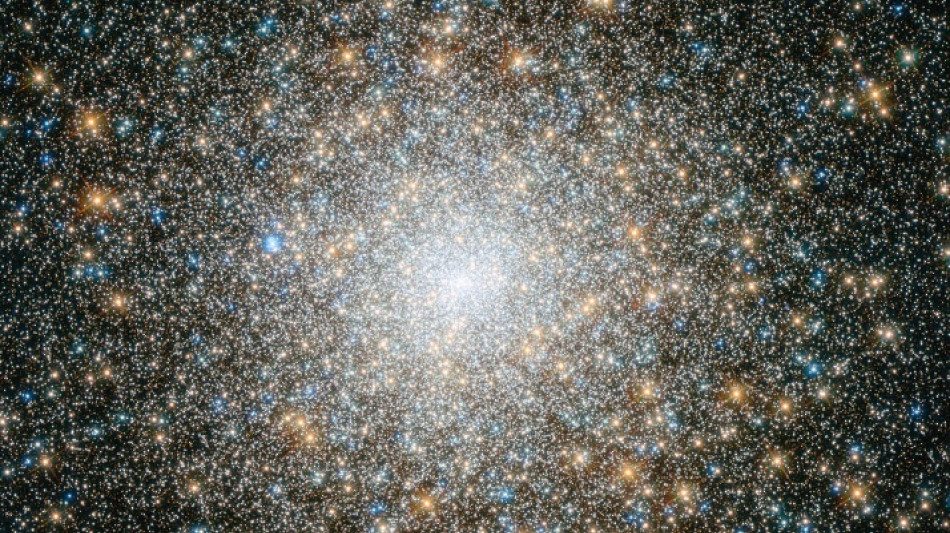
Webb spots giant star clusters shaping galaxy in early universe / Photo: - - ESA/HUBBLE/AFP/File

Webb spots giant star clusters shaping galaxy in early universe

The James Webb space telescope has discovered massive clusters of stars in the early universe so huge and densely packed that they influenced how their galaxy formed, astronomers said on Monday.

Text size:

The five clumps of stars, known as globular proto-clusters, are the earliest ever observed, dating back to 460 million years after the Big Bang when the universe was three percent its current age.

They were spotted in the Cosmic Gems Arc, an infant galaxy discovered by the Hubble telescope in 2018.

Looking into space means looking back in time, and the galaxy exists in what is called the epoch of reionisation, when the first stars and galaxies emerged and lit up the universe.

It is difficult to see that far back, but the Webb telescope's ability to detect infrared wavelengths has allowed it peer farther back into this cosmic dawn than ever before.

The discovery of the five globular proto-clusters marks "the first time we have been able to observe this type of object at this distance," said Adelaide Claeyssens, a co-author of the new study in the journal Nature.

It should help scientists better understand the "formation of star clusters that we can see in the nearby universe -- which are now very old -- and their influence on the formation of galaxies," the Stockholm University astronomer told AFP.

- Black hole seeds? -

There is nothing like these clusters in the universe we see around us, said lead study author Angela Adamo, also from Stockholm University.

Our home galaxy, the Milky Way, is now home to around 170 globular clusters.

But there were once thousands of them, before they were broken up and scattered when the galaxy expanded, Adamo told AFP.

Those that did survive are relative lightweights, making up an "insignificant" mass compared to all the other stars in the galaxy.

However the five clusters in the Cosmic Gems Arc are true heavyweights, representing nearly a third of their galaxy's total mass.

The young stars are also packed closely together.

Imagine there were a million stars jammed into the four light years of space that separate the Sun and its nearest star Proxima Centauri, Adamo said.

A separate study recently suggested that stars near the heart of globular proto-clusters are up to 10,000 more massive than the Sun.

Adamo said that such huge stars produce immense amounts of radiation, which means they "shape how galaxies form stars" and how gas is distributed around the galaxies.

And at the end of their short and violent lives, some of these behemoth stars likely create black holes, she added.

Some could even become the seeds that grow into the supermassive black holes squatting at the centre of galaxies, Adamo speculated.

To find out more, the researchers want to study more globular proto-clusters near the cosmic dawn. The James Webb Space telescope will help in this hunt, Adamo said.

But it will be the European Southern Observatory's Extremely Large Telescope, expected to start scanning the skies in 2028, that will help scientists "understand the physical processes within this galaxy," Adamo said.

So we have to wait a few more years to find out more about what happened over 13.2 billion years ago.

V.Munir--DT