Dubai Telegraph - Whale of a tail: Scientists track unique humpback 'fingerprint'

EUR -
AED 4.238266
AFN 72.705309
ALL 95.668561
AMD 435.658397
ANG 2.065855
AOA 1058.268309
ARS 1609.771702
AUD 1.639387
AWG 2.080184
AZN 1.97751
BAM 1.950038
BBD 2.323724
BDT 141.568013
BGN 1.972637
BHD 0.435974
BIF 3415.123752
BMD 1.154055
BND 1.475559
BOB 7.972546
BRL 6.110604
BSD 1.153786
BTN 107.862753
BWP 15.732717
BYN 3.500472
BYR 22619.477726
BZD 2.320434
CAD 1.585014
CDF 2625.474851
CHF 0.91074
CLF 0.026905
CLP 1062.377083
CNY 7.963499
CNH 7.967717
COP 4274.065722
CRC 538.905302
CUC 1.154055
CUP 30.582457
CVE 109.940623
CZK 24.503702
DJF 205.455588
DKK 7.471427
DOP 68.486744
DZD 152.485097
EGP 60.289738
ERN 17.310825
ETB 181.835175
FJD 2.558422
FKP 0.864455
GBP 0.866701
GEL 3.133279
GGP 0.864455
GHS 12.577001
GIP 0.864455
GMD 85.40008
GNF 10112.85554
GTQ 8.837848
GYD 241.389876
HKD 9.04104
HNL 30.538368
HRK 7.532406
HTG 151.36079
HUF 393.26443
IDR 19567.002288
ILS 3.597022
IMP 0.864455
INR 108.141357
IQD 1511.414412
IRR 1517726.563899
ISK 143.791167
JEP 0.864455
JMD 181.263615
JOD 0.818185
JPY 183.607265
KES 149.473342
KGS 100.919682
KHR 4610.436957
KMF 493.935903
KPW 1038.59276
KRW 1735.923728
KWD 0.35366
KYD 0.961472
KZT 554.688597
LAK 24776.113307
LBP 103329.822982
LKR 359.91496
LRD 211.135221
LSL 19.463106
LTL 3.407624
LVL 0.698076
LYD 7.386175
MAD 10.781197
MDL 20.09289
MGA 4810.847387
MKD 61.669046
MMK 2423.253558
MNT 4119.601018
MOP 9.312942
MRU 46.184533
MUR 53.675008
MVR 17.830323
MWK 2000.714273
MXN 20.680943
MYR 4.545786
MZN 73.744287
NAD 19.462938
NGN 1564.587431
NIO 42.454371
NOK 11.041017
NPR 172.580059
NZD 1.976919
OMR 0.443748
PAB 1.153806
PEN 3.988896
PGK 4.980263
PHP 69.186784
PKR 322.126581
PLN 4.278601
PYG 7535.700782
QAR 4.219015
RON 5.096766
RSD 117.418159
RUB 96.218081
RWF 1678.761398
SAR 4.333505
SBD 9.288507
SCR 15.852941
SDG 693.586815
SEK 10.807898
SGD 1.479539
SHP 0.86584
SLE 28.44801
SLL 24199.968523
SOS 659.360285
SRD 43.26264
STD 23886.608183
STN 24.427715
SVC 10.095171
SYP 127.82927
SZL 19.469387
THB 37.907216
TJS 11.081899
TMT 4.039192
TND 3.407531
TOP 2.778687
TRY 51.146676
TTD 7.827836
TWD 36.931833
TZS 2985.152508
UAH 50.543634
UGX 4361.094896
USD 1.154055
UYU 46.492623
UZS 14066.436344
VES 524.732218
VND 30365.494792
VUV 137.374477
WST 3.166918
XAF 654.032957
XAG 0.016596
XAU 0.000253
XCD 3.118891
XCG 2.079347
XDR 0.814597
XOF 654.021656
XPF 119.331742
YER 275.299978
ZAR 19.628086
ZMK 10387.883774
ZMW 22.527728
ZWL 371.605235
  • CMSC

    -0.1400

    22.71

    -0.62%

  • RYCEF

    -0.6100

    15.99

    -3.81%

  • CMSD

    -0.2600

    22.64

    -1.15%

  • RBGPF

    -13.5000

    69

    -19.57%

  • GSK

    -0.3300

    52.04

    -0.63%

  • RIO

    -2.3200

    83.33

    -2.78%

  • RELX

    -0.3800

    33.44

    -1.14%

  • NGG

    -2.7200

    82.81

    -3.28%

  • VOD

    -0.0600

    14.36

    -0.42%

  • BTI

    -1.1500

    57.57

    -2%

  • BCE

    0.0800

    25.81

    +0.31%

  • JRI

    -0.1510

    12.009

    -1.26%

  • BCC

    -1.0900

    68.77

    -1.58%

  • AZN

    -4.0200

    184.91

    -2.17%

  • BP

    -0.9150

    44.945

    -2.04%

Whale of a tail: Scientists track unique humpback 'fingerprint'
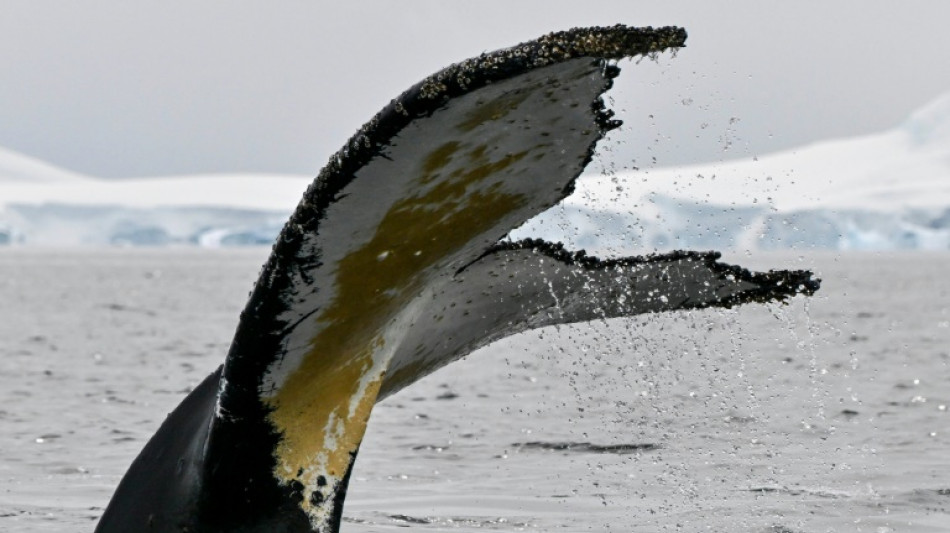
Whale of a tail: Scientists track unique humpback 'fingerprint' / Photo: Juan BARRETO - AFP

Whale of a tail: Scientists track unique humpback 'fingerprint'

In Antarctica, a scientist waits patiently for two frolicking humpback whales to poke their tails out of the icy waters so she can take a photographic "fingerprint" of the unique colors and patterns that allow researchers to identify individuals of the species.

Text size:

Andrea Bonilla, a Colombian scientist at Cornell University in the United States, has been working with a team of researchers since 2014 to catalog humpback whales from a visual analysis of their tails -- or flukes.

"What we are doing is tracking the history of each individual," Bonilla told AFP onboard the ARC Simon Bolivar during a scientific expedition by the Colombian navy.

Over the years, the team has identified 70 whales, and hopes to see some of them again to record any physical changes that could provide clues to their migratory patterns, population sizes, health and sexual maturity.

On the tail, "the coloration and patterns that each whale has is unique, it is like a fingerprint, so what we do is look at the different marks they have, the different scars" to identify an individual, said Bonilla.

Global populations of humpbacks have bounced back after once being decimated by commercial whaling, but the ocean giants remain under threat from vessel strikes, illegal fishing, pollution and underwater noise.

Today there are about 84,000 adult specimens in the world, according to the International Union for Conservation of Nature.

The importance of tail identification was highlighted in a study published last month in the Royal Society Open Science journal which showed the number of humpback whales in the North Pacific had plummeted 20 percent in less than a decade.

Tracking some 33,000 whales through photos of their flukes, scientists noted the steep decline which they speculate was due to starvation because of marine heat waves.

- 'Accumulating energy' -

Photo identification is common in the study of marine mammals, although the use of fluke identification is most used with humpbacks both because of their unique markings, and their habit of raising their tails out off the water while diving.

Different populations of humpback whales live across the world's oceans, carrying out mammoth migrations from warmer breeding spots to feeding grounds in polar waters.

"They take advantage of this great biomass of food that is here (in Antarctica) and for several months they are simply accumulating energy," said Bonilla.

Using photographs, the scientist draws reproductions of the details of the tails of the enormous marine mammals, which can reach up to 18 meters (59 feet) long and weigh about 40 tons.

On a computer, she zooms in on the details of the flukes, which can reveal attacks from other animals, "if there is some type of skin disease" or information about their diet.

The inventory allows scientists to track the movement of specific whales, which is crucial for conservation initiatives.

"If a whale always comes to the same area to reproduce, it is important to protect those areas. If they cease to exist or are disturbed, that whale will have nowhere to go," warned Bonilla.

Y.Amjad--DT