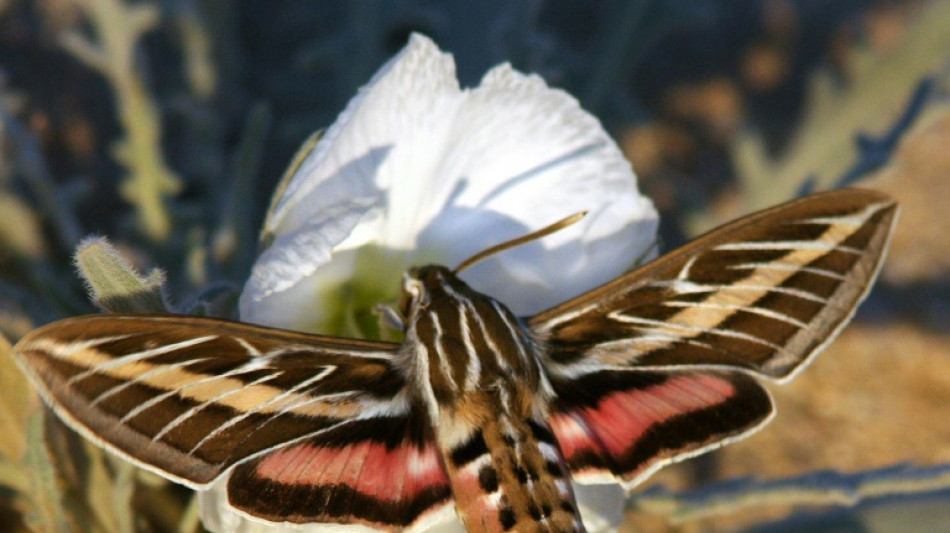
Noxious fumes at night aren't a pollinating moth's delight / Photo: Ron Wolf - University of Washington/AFP
Certain plants have flowers that open only in the evening, and depend on nocturnal pollinators such as moths to thrive.
But a new paper published in Science on Thursday finds an atmospheric pollutant that is much more prevalent at night drastically reduces the fluttering creatures' ability to track floral scents.
It adds to a growing understanding of how human activities, including not just air but also light and noise pollution, are negatively impacting the natural world.
"Our impacts on the environment are affecting human health, etc, that we tend to concentrate on, but they're also affecting ecosystem functioning through these plants and pollinators," senior author Jeff Riffell, a biology professor at the University of Washington, told AFP.
Riffell said the role of nitrate radicals (NO3) on flower scents hadn't been well studied, because the chemical is around at night and prior research focused on the impacts of pollution on daytime pollinators like bees.
Nitrate radicals form when nitrogen dioxide reacts in the atmosphere with ozone -- both of which come from burning fossil fuels, and have natural sources too.
Unlike nitrogen dioxide and ozone, however, nitrate radicals rapidly degrade in sunlight, making them virtually absent in daytime.
For their study, Riffell and colleagues chose the pale evening primrose (Oenothera pallida), a wildflower that grows in arid settings across the western United States.
Its white flowers emit a strong, piney scent that attracts the white-lined sphinx moth (Hyles lineata) and the tobacco hawk moth (Manduca sexta), species which use their powerful antennae to sniff out pollen from miles away.
- Pollinator crisis -
First, the team chemically analyzed the wildflower's scent to unravel its chemical recipe, revealing a complex bouquet of chemicals.
Next, they separated out the individual chemicals and exposed them one at a time to the moths, to determine exactly which ones were responsible for attracting the winged insects.
This revealed a subset of the chemicals, known as monoterpene compounds, were largely responsible for the scent, and further tests showed that nitrate radicals decimated the levels of these compounds.
Finally, the team carried out wind tunnel experiments involving the moths and the scent chemicals that they emitted at controlled levels from a fake flower.
"What we found is that the moths really were very sensitive to the flower scent and would kind of navigate upwind and try to feed from this artificial flower," said Rifell.
"But if we added NO3, then all of a sudden, for one species of moth, it totally eliminated their ability to recognize the flower. And for another species, it reduced their attraction to the flower by 50 percent."
The nitrate radicals were comparable to those found at night in a typical urban environment, modeled on Seattle. When the team ran the experiment with the pollutants typically present during the day, they saw far less of an impact.
Overall, the experiment revealed a strong impact on pollination activity, at a time when the world's pollinators are in crisis.
Around three-quarters of the more than 240,000 species of flowering plants depend on pollinators, and over 70 pollinator species are endangered or threatened, said Rifell.
The team also ran computer simulations to determine which parts of the world would be most likely to experience problems as a result of this effect.
Areas identified include much of Europe, the Middle East, Central and South Asia, and southern Africa.
"Outside of human activity, some regions accumulate more NO3 because of natural sources, geography and atmospheric circulation," said co-senior author Joel Thornton, a professor of atmospheric sciences.
"But human activity is producing more NO3 everywhere. We wanted to understand how those two sources — natural and human — combine and where levels could be so high that they could interfere with the ability of pollinators to find flowers."
U.Siddiqui--DT