Dubai Telegraph - Water supply fears as Morocco hit by worst drought since 1980s

EUR -
AED 4.181514
AFN 75.147376
ALL 93.878019
AMD 417.342673
AOA 1045.23594
ARS 1707.67536
AUD 1.63429
AWG 2.05233
AZN 1.933608
BAM 1.959943
BBD 2.293037
BDT 140.547076
BHD 0.429306
BIF 3405.182623
BMD 1.138602
BND 1.472807
BOB 12.973422
BRL 5.847405
BSD 1.138501
BTN 109.051024
BWP 15.683081
BYN 3.265889
BYR 22316.592858
BZD 2.28974
CAD 1.605622
CDF 2573.239939
CHF 0.932031
CLF 0.027154
CLP 1068.77139
CNY 7.703893
CNH 7.710736
COP 3660.820724
CRC 517.992613
CUC 1.138602
CUP 30.172944
CVE 110.498562
CZK 24.189194
DJF 202.738531
DKK 7.474943
DOP 66.330203
DZD 152.108109
EGP 57.499725
ERN 17.079025
ETB 183.756909
FJD 2.541075
FKP 0.855859
GBP 0.85653
GEL 2.983124
GGP 0.855859
GHS 13.263034
GIP 0.855859
GMD 84.256006
GNF 9993.122587
GTQ 8.68532
GYD 238.143367
HKD 8.928203
HNL 30.499467
HRK 7.537085
HTG 148.793854
HUF 361.521402
IDR 20610.967547
ILS 3.483671
IMP 0.855859
INR 108.919946
IQD 1491.452502
IRR 1565719.630246
ISK 142.199924
JEP 0.855859
JMD 180.291083
JOD 0.807254
JPY 186.53882
KES 147.505871
KGS 99.571004
KHR 4602.70859
KMF 493.014388
KRW 1657.485027
KWD 0.353661
KYD 0.948701
KZT 544.498522
LAK 25803.541264
LBP 101950.995078
LKR 382.578661
LRD 206.064657
LSL 19.131655
LTL 3.361995
LVL 0.688729
LYD 7.304439
MAD 10.680375
MDL 20.151506
MGA 4879.313465
MKD 61.65004
MMK 2391.262995
MNT 4094.220098
MOP 9.195537
MRU 45.541261
MUR 54.072321
MVR 17.602773
MWK 1974.172834
MXN 19.861864
MYR 4.659188
MZN 72.767556
NAD 19.131739
NGN 1554.623578
NIO 41.898377
NOK 11.032304
NPR 174.482039
NZD 1.970117
OMR 0.437806
PAB 1.138506
PEN 3.875374
PGK 5.020612
PHP 70.070117
PKR 316.241644
PLN 4.328104
PYG 6848.475708
QAR 4.150373
RON 5.231533
RSD 117.390985
RUB 89.778775
RWF 1669.0205
SAR 4.268718
SBD 9.182421
SCR 15.393442
SDG 683.731914
SEK 11.066269
SGD 1.471603
SLE 27.610697
SOS 650.672477
SRD 43.097784
STD 23566.755874
STN 24.551788
SVC 9.962057
SZL 19.134361
THB 38.179023
TJS 10.491075
TMT 3.996492
TND 3.38033
TRY 53.946925
TTD 7.743333
TWD 36.874185
TZS 3013.312745
UAH 51.198519
UGX 4298.066001
USD 1.138602
UYU 45.736674
UZS 13718.998016
VES 844.708079
VND 29985.075149
VUV 135.683313
WST 3.132302
XAF 657.343549
XAG 0.019981
XAU 0.000283
XCD 3.077128
XCG 2.051828
XDR 0.81664
XOF 657.346441
XPF 119.331742
YER 271.157735
ZAR 19.071126
ZMK 10248.782993
ZMW 21.290001
ZWL 366.629275
  • CMSC

    0.0896

    21.81

    +0.41%

  • BCC

    2.1700

    80.39

    +2.7%

  • BTI

    1.1300

    61.95

    +1.82%

  • NGG

    0.0650

    81.275

    +0.08%

  • BCE

    0.5210

    21.761

    +2.39%

  • AZN

    1.5000

    171.14

    +0.88%

  • GSK

    1.7300

    53.71

    +3.22%

  • JRI

    0.0700

    12.98

    +0.54%

  • RIO

    -0.4900

    91.46

    -0.54%

  • RBGPF

    0.0000

    66

    0%

  • RYCEF

    -0.0700

    18.8

    -0.37%

  • BP

    -0.5000

    41.81

    -1.2%

  • CMSD

    0.0940

    22.144

    +0.42%

  • VOD

    0.5450

    16.345

    +3.33%

  • RELX

    2.1800

    37.83

    +5.76%

Water supply fears as Morocco hit by worst drought since 1980s

Water supply fears as Morocco hit by worst drought since 1980s

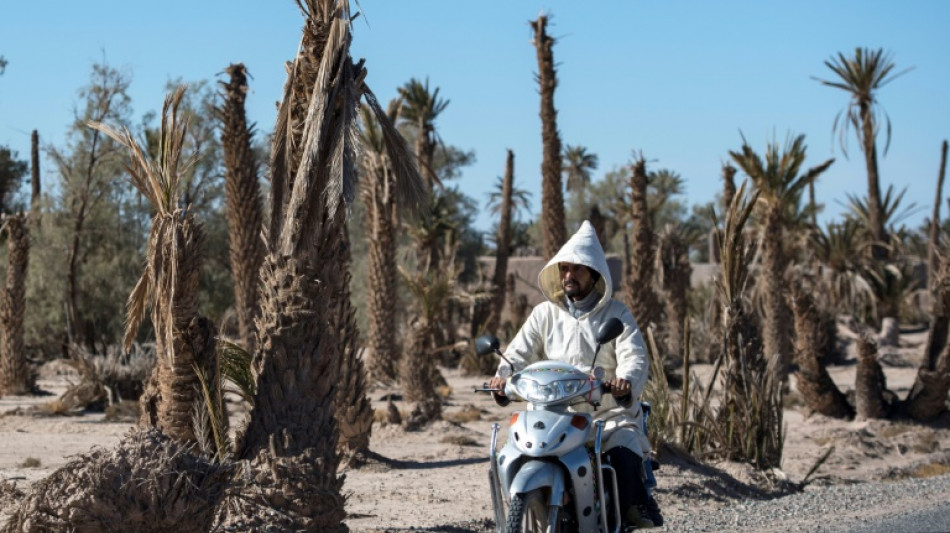
As Morocco withers under its worst drought in 40 years, experts warn that a combination of climate change and bad resource management could trigger severe drinking water shortages.

Text size:

"The country hasn't seen a situation like this since the start of the 1980s," said water policy expert Abderrahim Hendouf.

While it was usually farmers who bore the brunt of repeated droughts in the North African kingdom, today water supplies to cities are under threat, water minister Nizar Baraka told parliament in mid-March.

Morocco has had little rain since September, and authorities say its reservoirs have received just 11 percent of what they would in an average year.

"That's a worrying sign," Abdelaziz Zerouali, the water ministry's head of research and planning, told state television station M2, adding that some preemptive measures had been taken to mitigate the risks.

Two major cities, tourist hub Marrakesh and Oujda in the east, already started tapping into groundwater reserves in December to ensure adequate supplies.

The government in February also released a package of around one billion euros in aid to the beleaguered agricultural sector, which makes up some 14 percent of GDP and is the top employer in the Moroccan countryside.

"We need to change our vision of water," Zerouali told a conference on the right to water in Rabat.

"Climate change is real and we will have to face it."

- 'Absolute scarcity' -

Moroccans have access to just 600 cubic metres of water per person per year, far below the 2,600 cubic metres they enjoyed in the 1960s.

According to the United Nations' definition, water scarcity occurs when supplies drop below 1,000 cubic metres per person annually, while supplies of 500 cubic metres are considered "absolute scarcity".

The decline in supplies in Morocco is a result of a mix of environmental factors, high demand and over-exploitation of groundwater for farming, according to Baraka.

In a recent report for the Moroccan Institute for Policy Analysis, Amal Ennabih wrote that "Morocco's water scarcity is deeply linked to the way water is used in irrigation, consuming around 80 percent of Morocco's water annually".

The kingdom, with its Atlantic and Mediterranean coastlines, hopes desalination plants can help make up the deficit, although they are energy-intensive and pump brine back into the sea which causes its own environmental problems.

Moreover, efforts to build 15 more dams and more desalination facilities have been bogged down by delays.

One such plant has been under construction since 2020 near Casablanca, the country's commercial capital, which could face severe water shortages by 2025.

Baraka notes that a desalination plant meant to serve the northeastern resort town of Saidia has also yet to come online, causing water shortages.

Another desalination plant came online recently, supplying 70 percent of the needs of the Atlantic coastal city of Agadir, a tourist hub and centre of a major farming area.

That should provide some relief to a city that in autumn 2020 was so short of water that at night the taps ran dry.

T.Jamil--DT