Dubai Telegraph - New microscopic organisms found in deep sea trench baffle Chile scientists

EUR -
AED 4.32145
AFN 75.308617
ALL 95.344815
AMD 432.885163
ANG 2.106168
AOA 1080.216545
ARS 1644.790435
AUD 1.62497
AWG 2.121013
AZN 1.96537
BAM 1.95566
BBD 2.370251
BDT 144.659675
BGN 1.962866
BHD 0.444172
BIF 3503.013705
BMD 1.176706
BND 1.494325
BOB 8.13142
BRL 5.767629
BSD 1.176836
BTN 112.105428
BWP 15.823005
BYN 3.290993
BYR 23063.437841
BZD 2.366861
CAD 1.608133
CDF 2665.23869
CHF 0.916325
CLF 0.026653
CLP 1048.97409
CNY 8.002484
CNH 7.995035
COP 4405.716748
CRC 539.366086
CUC 1.176706
CUP 31.182709
CVE 110.211708
CZK 24.33328
DJF 209.568604
DKK 7.472689
DOP 69.675619
DZD 155.645536
EGP 62.132784
ERN 17.65059
ETB 183.753846
FJD 2.570456
FKP 0.863046
GBP 0.864932
GEL 3.147731
GGP 0.863046
GHS 13.286165
GIP 0.863046
GMD 86.489882
GNF 10326.394586
GTQ 8.981581
GYD 246.144523
HKD 9.212743
HNL 31.292032
HRK 7.533033
HTG 154.022279
HUF 355.96887
IDR 20489.393439
ILS 3.422508
IMP 0.863046
INR 112.08566
IQD 1541.709613
IRR 1543249.935145
ISK 143.805346
JEP 0.863046
JMD 185.658326
JOD 0.834331
JPY 184.89523
KES 151.983825
KGS 102.902841
KHR 4721.66299
KMF 491.863379
KPW 1059.03536
KRW 1733.232385
KWD 0.362296
KYD 0.980738
KZT 545.225718
LAK 25816.376745
LBP 105385.873658
LKR 379.076165
LRD 215.367373
LSL 19.341984
LTL 3.474507
LVL 0.711777
LYD 7.443595
MAD 10.729934
MDL 20.170732
MGA 4892.692362
MKD 61.6406
MMK 2470.52538
MNT 4208.732973
MOP 9.490444
MRU 46.991045
MUR 54.987238
MVR 18.123661
MWK 2040.671689
MXN 20.259042
MYR 4.615631
MZN 75.203378
NAD 19.341984
NGN 1605.721178
NIO 43.308749
NOK 10.829465
NPR 179.367722
NZD 1.978702
OMR 0.452325
PAB 1.176816
PEN 4.043011
PGK 5.111722
PHP 71.930848
PKR 327.840572
PLN 4.239825
PYG 7233.452974
QAR 4.299921
RON 5.210927
RSD 117.376466
RUB 86.961918
RWF 1721.091783
SAR 4.414745
SBD 9.436514
SCR 16.472104
SDG 706.593251
SEK 10.874763
SGD 1.493969
SHP 0.87853
SLE 29.005976
SLL 24674.932214
SOS 672.557712
SRD 44.007618
STD 24355.438695
STN 24.498668
SVC 10.297396
SYP 130.08242
SZL 19.335949
THB 38.147639
TJS 11.015254
TMT 4.118471
TND 3.414478
TOP 2.833226
TRY 53.396924
TTD 7.977498
TWD 36.935979
TZS 3071.203
UAH 51.719148
UGX 4424.721787
USD 1.176706
UYU 46.917313
UZS 14289.162258
VES 587.453968
VND 30976.785774
VUV 139.531196
WST 3.185457
XAF 655.915758
XAG 0.014498
XAU 0.000252
XCD 3.180107
XCG 2.120976
XDR 0.815749
XOF 655.921332
XPF 119.331742
YER 280.791457
ZAR 19.35199
ZMK 10591.767529
ZMW 22.250695
ZWL 378.898856
  • RBGPF

    0.7000

    63.61

    +1.1%

  • CMSC

    0.1400

    23.11

    +0.61%

  • CMSD

    0.1140

    23.534

    +0.48%

  • NGG

    0.9800

    86.89

    +1.13%

  • BCE

    -0.4300

    24.14

    -1.78%

  • BCC

    -2.0900

    70.67

    -2.96%

  • VOD

    0.5100

    16.2

    +3.15%

  • RYCEF

    -0.4100

    16.37

    -2.5%

  • RELX

    0.0759

    33.58

    +0.23%

  • RIO

    2.2700

    105.38

    +2.15%

  • JRI

    0.0000

    13.15

    0%

  • BTI

    0.2000

    58.28

    +0.34%

  • AZN

    0.3300

    182.85

    +0.18%

  • BP

    -0.4700

    43.34

    -1.08%

  • GSK

    -0.0900

    50.41

    -0.18%

New microscopic organisms found in deep sea trench baffle Chile scientists

New microscopic organisms found in deep sea trench baffle Chile scientists

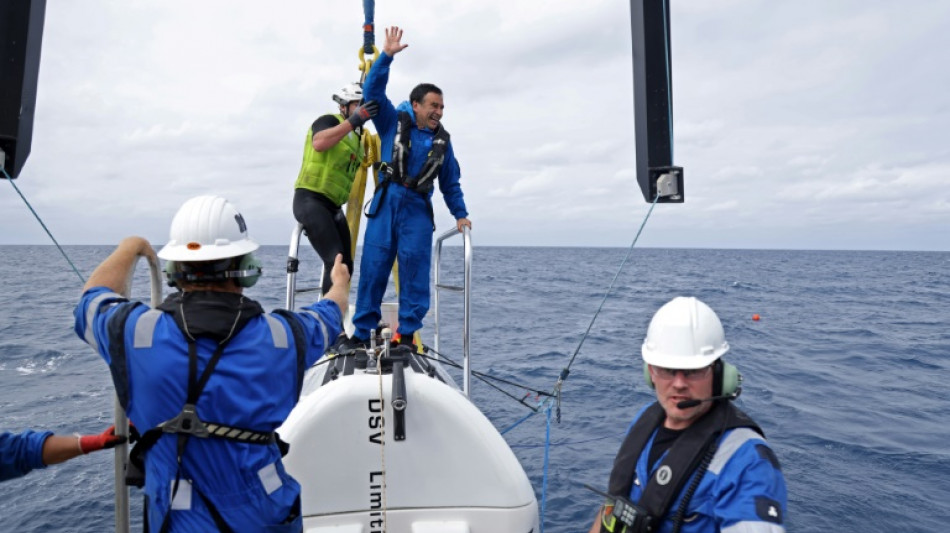
When Chilean scientist Osvaldo Ulloa led an expedition 8,000 meters under the sea to an area where no human had ever been, his team discovered microscopic organisms that generated more questions than answers.

Text size:

The January submarine expedition dove into the Atacama Trench, created by the meeting of two tectonic plates in the eastern Pacific Ocean.

"We pulled off the feat of taking humans into the trench where no other human being had been before," Ulloa, the director of the Millennium Institute of Oceanography at the University of Concepcion, told AFP.

He was joined by American explorer Victor Vescovo and Millennium assistant director Ruben Escribano on the 12-week journey off Chile's northern coast in the 5,900-kilometer (3,650-mile) long trench that extends up to Ecuador.

By the time the expedition, named Atacama Hadal, reached a depth of 100 meters it was already in pitch black darkness, with the crew members' vision limited to what the submarine's powerful LED light could capture.

Further down out of the darkness emerged remarkable examples of deep sea life.

"We came across geological structures and there we saw a type of holothurians or translucent sea cucumbers, like jelly, that we had not recorded and were most probably new species," said Ulloa.

"We also discovered bacterial communities that had filaments that we did not even know existed in the Atacama Trench and which feed on chemical and inorganic compounds.

"That opened up a huge number of questions: What are those compounds? What type of bacteria are they? We have no idea, we're going to have to go back there."

The expedition also found species of amphipods, a type of crustacean closely related to shrimp, which were scavenging crustaceans, segmented worms and translucent fish. They were discovered in the same place in an unmanned expedition in 2018.

- 'Incredibly ambitious' –

The Atacama Trench -- also known as the Peru-Chile Trench -- lies where the Nazca and South American tectonic plates converge.

It is an area that has produced many earthquakes and tsunamis.

"We will put three sensors on the South American Plate and two on the Nazca Plate to see how the oceanic floor is deformed," said Ulloa.

For the moment, "these types of sensors only exist on land."

The devices will allow scientists to observe where energy is building in areas that have not had an earthquake, thus helping predict where the next temblor will take place.

"It is an incredibly ambitious project," said Ulloa, adding that it is "the largest experiment that has been done in underwater geology here in Chile."

The sensors are due to be placed during the second half of this year.

"There is a lot of interest from the international community to put more sensors in this region to study all the processes associated with the collision of these two plates."

Y.Rahma--DT