
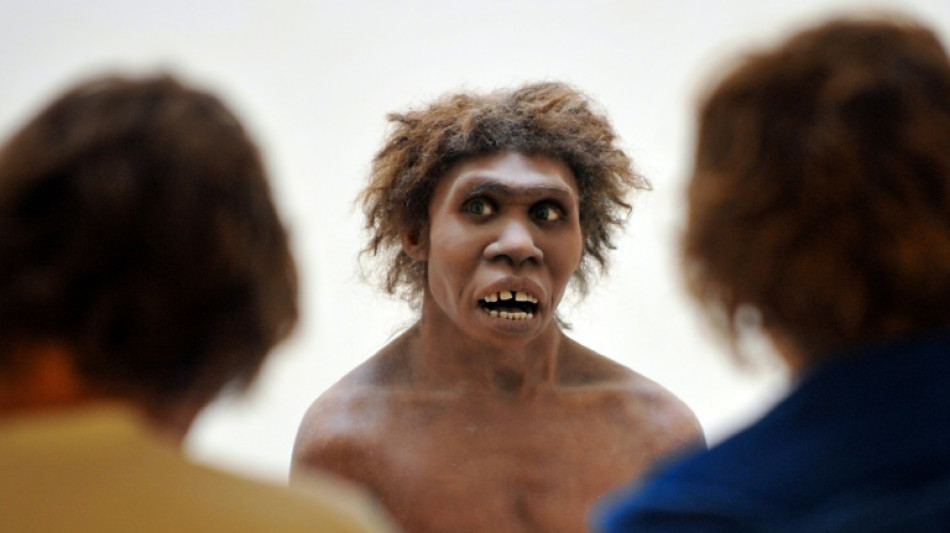
Scepticism about claim human ancestors nearly went extinct / Photo: PIERRE ANDRIEU - AFP/File
Could the lives of the eight billion people currently on Earth have depended on the resilience of just 1,280 human ancestors who very nearly went extinct 900,000 years ago?
That is the finding of a recent study which used genetic analysis modelling to determine that our ancestors teetered on the brink of annihilation for nearly 120,000 years.
However, scientists not involved in the research have criticised the claim, one telling AFP there was "pretty much unanimous" agreement among population geneticists that it was not convincing.
None denied that the ancestors of humans could have neared extinction at some point, in what is known as a population bottleneck.
But experts expressed doubts that the study could be so precise, given the extraordinarily complicated task of estimating population changes so long ago, and emphasised that similar methods had not spotted this massive population crash.
It is extremely difficult to extract DNA from the few fossils of human relatives dating from more than a couple of hundred thousand years ago, making it hard to know much about them.
But advances in genome sequencing mean that scientists are now able to analyse genetic mutations in modern humans, then use a computer model that works backwards in time to infer how populations changed -- even in the distant past.
The study, published in the journal Science earlier this month, looked at the genomes of more than 3,150 modern-day humans.
The Chinese-led team of researchers developed a model to crunch the numbers, which found that the population of breeding human ancestors shrank to about 1,280 around 930,000 years ago.
- 99 percent of ancestors wiped out? -
"About 98.7 percent of human ancestors were lost" at the start of the bottleneck, said co-author Haipeng Li of the Shanghai Institute of Nutrition and Health, Chinese Academy of Sciences.
"Our ancestors almost went extinct and had to work together to survive," he told AFP.
The bottleneck, potentially caused by a period of global cooling, continued until 813,000 years ago, the study said.
Then there was a population boom, possibly sparked by a warming climate and "control of fire", it added.
The researchers suggested that inbreeding during the bottleneck could explain why humans have a significantly lower level of genetic diversity compared to many other species.
The population squeeze could have even contributed to the separate evolution of Neanderthals, Denisovans and modern humans, all of which are thought to have potentially split from a common ancestor roughly around that time, the study suggested.
It could also explain why so few fossils of human ancestors have been found from the period.
However, archaeologists have pointed out that some fossils dating from the time have been discovered in Kenya, Ethiopia, Europe and China, which may suggest that our ancestors were more widespread than such a bottleneck would allow.
"The hypothesis of a global crash does not fit in with the archaeological and human fossil evidence," the British Museum's Nicholas Ashton told Science.
In response, the study's authors said that hominins then living in Eurasia and East Asia may not have contributed to the ancestry of modern humans.
"The ancient small population is the ancestor of all modern humans. Otherwise we would not carry the traces in our DNA," Li said.
- 'Extremely sceptical' -
Stephan Schiffels, group leader for population genetics at Germany's Max Planck Institute for Evolutionary Anthropology, told AFP he was "extremely sceptical" that the researchers had accounted for the statistical uncertainty involved in this kind of analysis.
Schiffels said it will "never be possible" to use genomic analysis of modern humans to get such a precise number as 1,280 from that long ago, emphasising that there are normally wide ranges of estimations in such research.
Li said their range was between 1,270 and 1,300 individuals -- a difference of just 30.
Schiffels also said the data used for the research had been around for years, and previous methods using it to infer past population sizes had not spotted any such near-extinction event.
The authors of the study simulated the bottleneck using some of these previous models, this time spotting their population crash.
However, since the models should have picked up the bottleneck the first time, "it is hard to be convinced by the conclusion", said Pontus Skoglund of the UK's Francis Crick Institute.
Aylwyn Scally, a researcher in human evolutionary genetics at Cambridge University, told AFP there was "a pretty much unanimous response amongst population geneticists, people who work in this field, that the paper was unconvincing".
Our ancestors may have neared extinction at some point but the ability of modern genomic data to infer such an event was "very weak", he said.
"It's probably one of those questions that we're not going to answer."
H.Nadeem--DT



