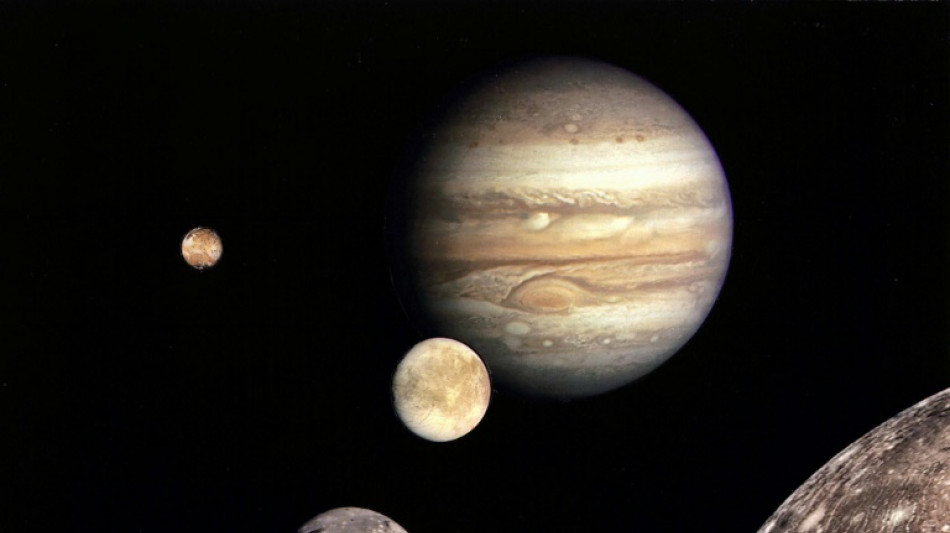
Search for alien life extends to Jupiter's icy moons / Photo: NASA - NASA/AFP/File
Could vast, long-hidden oceans be teeming with alien life in our very own Solar System?
A new chapter in humanity's search for extraterrestrial life opens on Thursday as Europe's JUICE spacecraft blasts off on a mission to investigate the icy moons of Jupiter.
First discovered by Italian astronomer Galileo Galilei more than 400 years ago, these ice-covered moons are so far from the Sun that they were long dismissed as possible candidates to host life in our backyard.
Until recently, the Solar System's habitable zone was thought to "end at Mars", French astrophysicist Athena Coustenis, one of the scientific leads of the European Space Agency (ESA)'s JUICE mission, told AFP.
But NASA's Galileo probe to Jupiter in 1995 and the more recent Cassini spacecraft's trip to Saturn caused scientists to broaden their horizons.
The gas giant planets themselves were correctly ruled out, but their icy moons -- particularly Jupiter's Europa and Ganymede, and Saturn's Enceladus and Titan -- offered fresh hope of nearby life.
Under their icy surfaces are thought to be huge oceans of liquid water -- a crucial ingredient for life as we know it.
Nicolas Altobelli, a JUICE project scientist at ESA, said it would be "the first time that we explore habitats beyond the frost line" between Mars and Jupiter.
Beyond that line, temperatures plummet and "liquid water can no longer exist on the surface", Altobelli told AFP earlier this year.
- 'Gigantic' ocean -
The Jupiter Icy Moons Explorer (JUICE) mission launches from Europe's spaceport in Kourou, French Guiana on Thursday on an eight-year odyssey through space.
By July 2031 it will have entered Jupiter's orbit, from which it will probe Ganymede, Europa and fellow icy moon Callisto.
Then, in 2034, JUICE will enter the orbit of Ganymede, the first time a spacecraft has done so around a moon other than our own.
As well as being the largest moon in the Solar System, Ganymede is also the only one that has its own magnetic field, which protects it from dangerous radiation.
This is just one of several signs that Ganymede's hidden ocean could provide a stable environment for life.
Unlike similar missions to Mars, which focus on finding signs of ancient life long since extinguished, scientists hope Jupiter's icy moons will still be home to living organisms, even if only tiny or single-celled.
Such habitability requires a power source. Lacking energy from the Sun, the moons could instead take advantage of the gravity that Jupiter exerts on its satellites.
The force creates a process called tidal heating, which warms the interior of the moons and keeps their water liquid.
Ganymede's "gigantic" liquid ocean is trapped between two thick layers of ice dozens of kilometres beneath the surface, said Carole Larigauderie, JUICE project head at French space agency CNES.
"On Earth, we still find life forms at the bottom of the abyss," she added.
Tiny microbes such as bacteria and archaea have been found to be able to survive on Earth without sunlight, raising hopes that life elsewhere will be able to do the same.
As well as water and energy, life needs nutrients.
"The big question is therefore whether Ganymede's ocean contains" the necessary chemical elements, Coustenis said.
The ocean would need to be able to absorb the nutrients from anything that fell on the moon's surface, for example, which would eventually dissolve into the water, she added.
- Not alone -
JUICE's array of instruments will probe Ganymede's ocean to determine its depth, distance from the surface and -- hopefully -- its composition.
The ESA's 1.6 billion euro ($1.7 billion) probe will spend eight months orbiting Ganymede, getting as close as 200 kilometres (125 miles) from the moon, all while sheltered from radiation.
It will not be the only spacecraft lurking around Jupiter.
NASA's Europa Clipper mission is scheduled to launch in October next year. It will take a quicker path to Jupiter, arriving at Europa in 2030.
If one -- or more -- of Jupiter's moons ticks all the boxes to host life, the "logical next step" would be to send a mission to land on the surface, said Cyril Cavel, JUICE project manager at manufacturer Airbus.
Although there are no plans for such a mission, which could definitively prove the existence of life outside of Earth, "that's part of the dream," he said.
R.Mehmood--DT