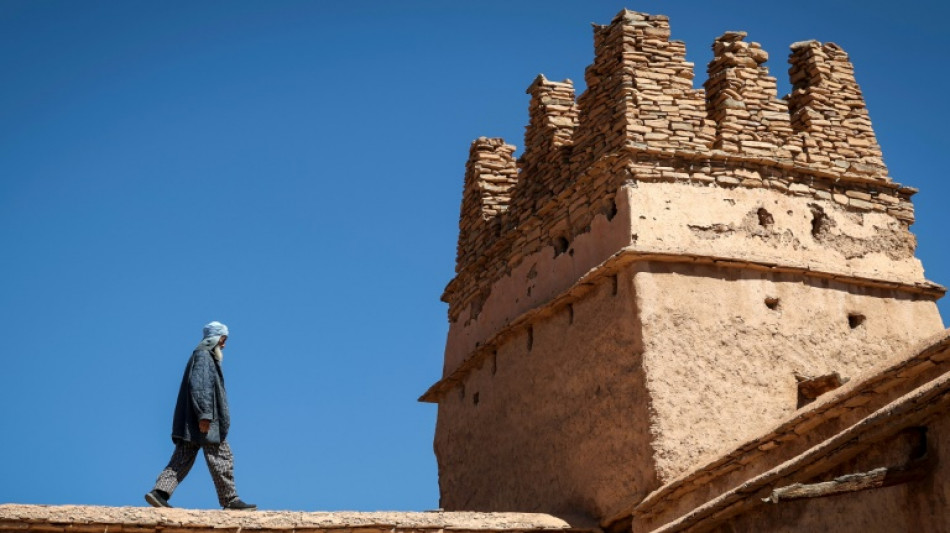
Moroccan villagers keep communal store tradition alive / Photo: FADEL SENNA - AFP
Surrounded by olive and palm trees in a Moroccan mountain village, a centuries-old collective granary preserves the ancient practices of the Amazigh culture.
"The traditions are vanishing, but not here," said proud village elder Hossine Oubrahim, in Ait Kine in the Anti-Atlas mountains.
High in the rugged hills some 460 kilometres (280 miles) south of the capital Rabat, Ait Kine is home to one of country's few remaining collective granaries called agadir in Amazigh, Morocco's Berber language.
The imposing, fully functional structure, likely built in the 18th century and restored in 2012, is still used by local residents to store and protect their produce.
"We were raised on the tradition of storing our grains, dried fruit, oil and valuables there," recalled Oubrahim, in his 70s and wearing an indigo-coloured tunic.
"And we continue to respect it."
The village's granary is a "monument" that "represents our community spirit", said Abdelghani Charai, a 60-year-old merchant who returned to his ancestral home in Ait Kine after years away.
- Grains, fruit, family archives -
The granary, built using a practice known as rammed earth, sits in the village centre, protected by a fortified wall with a stone watchtower.
In the past, during times of unrest and rebellion against the government, it offered a safe place for storage, Charai explained.
"The granary guaranteed security," he said.
Inside, 76 cubicles are arranged in three levels around an open courtyard with a water cistern.
The agadir has stocks of barley, dates and almonds, but it is also used to safeguard documents like marriage and birth certificates, religious texts and contracts, and recipes for traditional medicine inscribed on palm stems.
Lahcen Boutirane, the guardian of the collective storeroom, said the village's 63 remaining families use it.
"Others have left, but they keep their archives here," he told AFP.
Unwritten laws have kept these granaries sacred and inviolable spaces, not only storing crops to use in drought but also protecting them from attacks, said archaeologist Naima Keddane.
Boutirane stressed the importance of preserving Ait Kine's agadir, which "bears witness to our ancestors' ingenuity".
- 'Solidarity' -
Collective granaries can be found elsewhere in North Africa -- in Algeria's Aures mountains, Tunisia's south and Libya's Nafusa mountains -- but they are most common in Morocco, though many are no longer in use.
The kingdom has more than 550 ancient igoudar -- the plural of agadir -- according to the culture ministry, which is preparing a UNESCO World Heritage nomination.
They are located primarily across central and southern Morocco, in caves or on cliff sides, on hilltops and in valleys.
"The challenge is to save Morocco's collective granaries, which have almost disappeared in Algeria, Tunisia and Libya," said architect and anthropologist Salima Naji.
Passionate about these "institutions of solidarity", she had helped restore Ait Kine's agadir, now an attraction for both researchers and tourists.
A group of Italian visitors appreciated the carved wooden door, adorned with forged iron.
"We are doing a tour of granaries," said guide Emanuele Maspoli, describing them as "extraordinary places that attest to the historical wealth of Morocco's oases".
"It's a magical place," said tourist Antonella Dalla.
Y.Sharma--DT