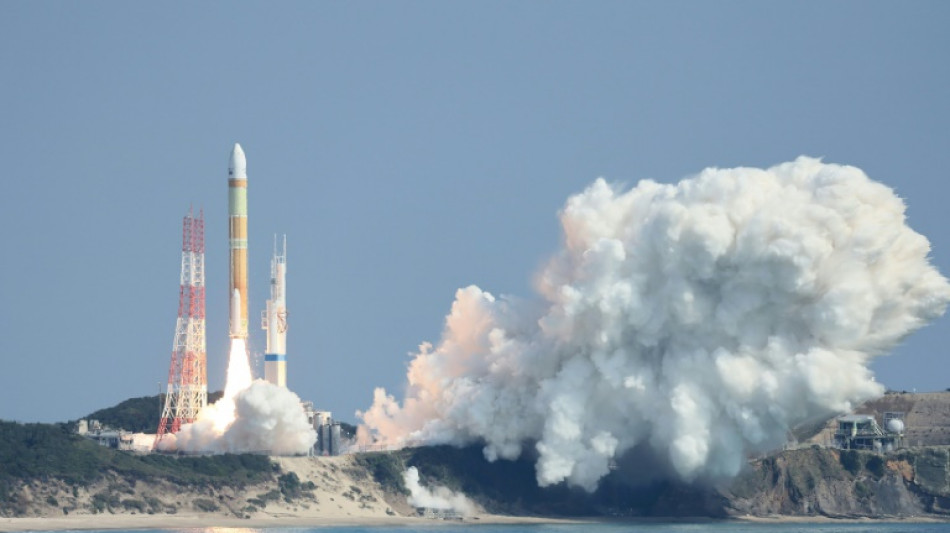
Japan's new H3 rocket fails again, forced to self-destruct / Photo: STR - JIJI Press/AFP
Japan's second attempt to launch its next-generation H3 rocket failed after liftoff on Tuesday, with the spacecraft forced to self-destruct after the command centre concluded the mission could not succeed.
The failure is a blow for Japan's space agency JAXA, which has billed the rocket as a flexible and cost-effective new flagship.
Its launch had already been delayed by several years, and then a first attempt last month failed when the solid rocket boosters did not ignite.
Tuesday's launch from the Tanegashima Space Center in southwestern Japan initially appeared to be a success, with the rocket lifting off.
The first-stage separation appeared to go as planned, but signs of trouble soon emerged.
"It seems that the velocity is coming down," announcers on the JAXA live feed said while the rocket was about 300 kilometres (185 miles) above ground.
The command centre then announced: "The second stage engine ignition has not been confirmed yet, we continue to confirm the situation."
The live feed was briefly halted, with a message reading, "We are currently checking the status. Please wait."
When it resumed, the command centre confirmed the bad news.
"Destruct command has been transmitted to H3 because there was no possibility of achieving the mission."
The rocket was not going to reach its planned trajectory without confirmation of the second stage engine, JAXA Vice President Yasuhiro Funo told a news conference.
Debris from the destroyed rocket is believed to have fallen in waters east of the Philippines, he said.
- 'Efforts to restore confidence' -
The cause of the failure will be investigated, said JAXA President Hiroshi Yamakawa.
"When a failure like this happens, it is important that we show how quickly we can move and show our findings with transparency," he said.
"My responsibility is to focus on discovering the cause and make efforts to restore confidence in our rockets.
The H3 rocket was developed for more frequent commercial launches as well as better cost efficiency and reliability and has been mooted as a possible competitor to Space X's Falcon 9.
"The H3 rocket is a very important rocket for not only the government of Japan but also for private sector businesses to access space," Yamakawa said.
JAXA has said it envisions the H3 becoming a workhorse that could be launched six times or so annually for around two decades.
There were no details on how long the investigation into the failure might take and whether or when JAXA could attempt a new launch.
Developed by Mitsubishi Heavy Industries, the H-3 is the successor to the H-IIA model, which debuted in 2001.
Tuesday's launch was carrying the ALOS-3 observation satellite, touted as having improved resolution and intended to help with disaster management and other monitoring.
The incident is not the only recent blow for JAXA.
In October 2022, the agency was forced to send a self-destruct order to its solid-fuel Epsilon rocket after take-off. It was carrying satellites into orbit to demonstrate new technologies.
That was Japan's first failed rocket launch since 2003.
The Epsilon rocket has been in service since 2013. It is smaller than the country's previous liquid-fuelled model, and a successor to the solid-fuel "M-5" rocket that was retired in 2006 due to its high cost.
K.Javed--DT