Dubai Telegraph - Once in 50,000-year comet may be visible to the naked eye

EUR -
AED 4.352647
AFN 77.038349
ALL 96.598417
AMD 452.800818
ANG 2.1216
AOA 1086.827593
ARS 1714.917302
AUD 1.702175
AWG 2.136321
AZN 2.019543
BAM 1.954932
BBD 2.405642
BDT 145.95518
BGN 1.990387
BHD 0.446796
BIF 3538.543435
BMD 1.185199
BND 1.512635
BOB 8.253369
BRL 6.237824
BSD 1.194375
BTN 109.68129
BWP 15.628125
BYN 3.401889
BYR 23229.893437
BZD 2.402143
CAD 1.613637
CDF 2684.475359
CHF 0.916295
CLF 0.026007
CLP 1026.892131
CNY 8.239205
CNH 8.249327
COP 4352.049423
CRC 591.439832
CUC 1.185199
CUP 31.407764
CVE 110.216517
CZK 24.339287
DJF 212.686442
DKK 7.467985
DOP 74.371681
DZD 153.65341
EGP 55.62837
ERN 17.77798
ETB 185.542782
FJD 2.612356
FKP 0.859186
GBP 0.866279
GEL 3.194158
GGP 0.859186
GHS 12.972047
GIP 0.859186
GMD 86.519922
GNF 10370.488562
GTQ 9.16097
GYD 249.880081
HKD 9.259833
HNL 31.360816
HRK 7.531468
HTG 156.31124
HUF 381.361827
IDR 19878.981309
ILS 3.662743
IMP 0.859186
INR 108.685921
IQD 1553.202824
IRR 49926.493096
ISK 144.954314
JEP 0.859186
JMD 187.167667
JOD 0.840353
JPY 183.432056
KES 152.891041
KGS 103.646077
KHR 4767.466048
KMF 491.857853
KPW 1066.776971
KRW 1719.800318
KWD 0.363742
KYD 0.995358
KZT 600.703223
LAK 25481.771275
LBP 101393.74447
LKR 369.367519
LRD 219.558501
LSL 19.129558
LTL 3.499584
LVL 0.716915
LYD 7.494703
MAD 10.834234
MDL 20.089163
MGA 5259.323437
MKD 61.617375
MMK 2488.971822
MNT 4228.442435
MOP 9.604775
MRU 47.301727
MUR 53.844023
MVR 18.323619
MWK 2058.690455
MXN 20.714943
MYR 4.672099
MZN 75.568713
NAD 18.964458
NGN 1643.550963
NIO 43.501202
NOK 11.415786
NPR 175.490804
NZD 1.968562
OMR 0.45572
PAB 1.19438
PEN 3.993531
PGK 5.066136
PHP 69.862765
PKR 331.640946
PLN 4.21155
PYG 8000.48068
QAR 4.315354
RON 5.096714
RSD 117.397527
RUB 90.0755
RWF 1742.633436
SAR 4.445375
SBD 9.542761
SCR 17.606171
SDG 712.901341
SEK 10.562313
SGD 1.508051
SHP 0.889206
SLE 28.830002
SLL 24853.022112
SOS 677.345366
SRD 45.097406
STD 24531.219039
STN 24.489227
SVC 10.450359
SYP 13107.793177
SZL 19.129544
THB 37.394247
TJS 11.149595
TMT 4.148195
TND 3.371935
TOP 2.853674
TRY 51.550457
TTD 8.109433
TWD 37.407284
TZS 3051.886907
UAH 51.191481
UGX 4270.121623
USD 1.185199
UYU 46.349611
UZS 14601.515362
VES 410.009291
VND 30744.052844
VUV 141.759914
WST 3.2171
XAF 655.668579
XAG 0.014256
XAU 0.000245
XCD 3.203059
XCG 2.15268
XDR 0.815441
XOF 655.668579
XPF 119.331742
YER 282.462511
ZAR 19.156188
ZMK 10668.214289
ZMW 23.439689
ZWL 381.63348
  • RBGPF

    1.3800

    83.78

    +1.65%

  • SCS

    0.0200

    16.14

    +0.12%

  • CMSD

    -0.0400

    24.05

    -0.17%

  • CMSC

    0.0500

    23.76

    +0.21%

  • BTI

    0.4600

    60.68

    +0.76%

  • NGG

    0.2000

    85.27

    +0.23%

  • GSK

    0.9400

    51.6

    +1.82%

  • AZN

    0.1800

    92.77

    +0.19%

  • RIO

    -4.1000

    91.03

    -4.5%

  • RELX

    -0.3700

    35.8

    -1.03%

  • BCE

    0.3700

    25.86

    +1.43%

  • RYCEF

    -0.4300

    16

    -2.69%

  • VOD

    -0.0600

    14.65

    -0.41%

  • JRI

    0.1400

    13.08

    +1.07%

  • BCC

    0.5100

    80.81

    +0.63%

  • BP

    -0.1600

    37.88

    -0.42%

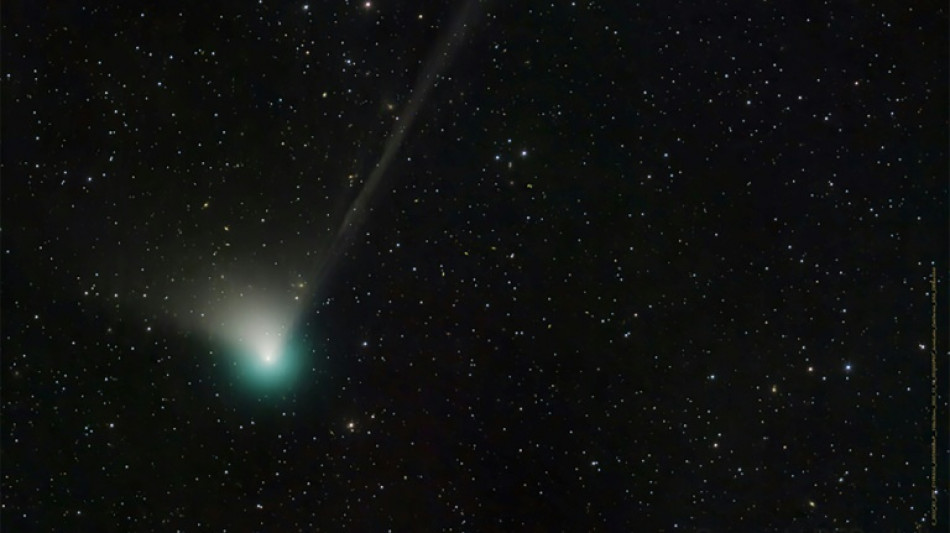
Once in 50,000-year comet may be visible to the naked eye
Once in 50,000-year comet may be visible to the naked eye / Photo: Dan Bartlett - NASA/AFP

Once in 50,000-year comet may be visible to the naked eye

A newly discovered comet could be visible to the naked eye as it shoots past Earth and the Sun in the coming weeks for the first time in 50,000 years, astronomers have said.

Text size:

The comet is called C/2022 E3 (ZTF) after the Zwicky Transient Facility, which first spotted it passing Jupiter in March last year.

After travelling from the icy reaches of our Solar System it will come closest to the Sun on January 12 and pass nearest to Earth on February 1.

It will be easy to spot with a good pair of binoculars and likely even with the naked eye, provided the sky is not too illuminated by city lights or the Moon.

The comet "will be brightest when it is closest to the Earth", Thomas Prince, a physics professor at the California Institute of Technology who works at the Zwicky Transient Facility, told AFP.

Made of ice and dust and emitting a greenish aura, the comet is estimated to have a diameter of around a kilometre, said Nicolas Biver, an astrophysicist at the Paris Observatory.

That makes it significantly smaller than NEOWISE, the last comet visible with an unaided eye, which passed Earth in March 2020, and Hale–Bopp, which swept by in 1997 with a potentially life-ending diameter of around 60 kilometres.

But the newest visit will come closer to Earth, which "may make up for the fact that it is not very big", Biver said.

While the comet will be brightest as it passes Earth in early February, a fuller moon could make spotting it difficult.

For the Northern Hemisphere, Biver suggested the last week of January, when the comet passes between the Ursa Minor and Ursa Major constellations.

The new moon during the weekend of January 21-22 offers a good chance for stargazers, he said.

"We could also get a nice surprise and the object could be twice as bright as expected," Biver added.

Prince said another opportunity to locate the comet in the sky will come on February 10, when it passes close to Mars.

- 'Rare visitor' -

The comet has spent most of its life "at least 2,500 times more distant than the Earth is from the Sun", Prince said.

Biver said the comet was believed to have come from the Oort Cloud, a theorised vast sphere surrounding the Solar System that is home to mysterious icy objects.

The last time the comet passed Earth was during the Upper Paleolithic period, when Neanderthals still roamed Earth.

Prince said the comet's next visit to the inner Solar System was expected in another 50,000 years.

But Biver said there was a possibility that after this visit the comet will be "permanently ejected from the Solar System".

Among those closely watching will be the James Webb Space Telescope. However, it will not take images, instead studying the comet's composition, Biver said.

The closer the comet is to Earth, the easier it is for telescopes to measure its composition "as the Sun boils off its outer layers", Prince said.

This "rare visitor" will give "us information about the inhabitants of our Solar system well beyond the most distant planets", he added.

I.Menon--DT