At CES, sailor-less ships head to port on AI wave / Photo: Patrick T. Fallon - AFP
Whether on pleasure yachts or deep-sea cargo ships, AI-backed navigation assistance and autonomy are helping captains set sail for sunsets or simply moor in a port scratch-free.
At the CES technology show in Las Vegas, boat builders are putting a big focus on technologies and artificial intelligence that make it easier for both the weekend yachtie and seasoned sailor to head out to sea.
"On the water, there is wind, currents, sometimes waves, the boat does not stay in place, you always have to compensate," said Johan Inden, president of the marine business at Swedish company Volvo Penta.
For more than ten years, the company's boats have helped mariners maneuver using a simple joystick that holds a ship in position or thrusts it sharply to the right or left.
Volvo Penta unveiled a prototype in 2018 that was capable of letting the boat dock by itself, but customers weren't ready to park their ships at the click of a button, Inden said.
Instead, the company developed the docking assistance system "that gives the captain a certain level of control" when mooring the boat, a moment "that remains one of the most stressful in sailing."
In general, the idea is to improve "safety, comfort, relaxation" and eventually make boating more accessible, he said.
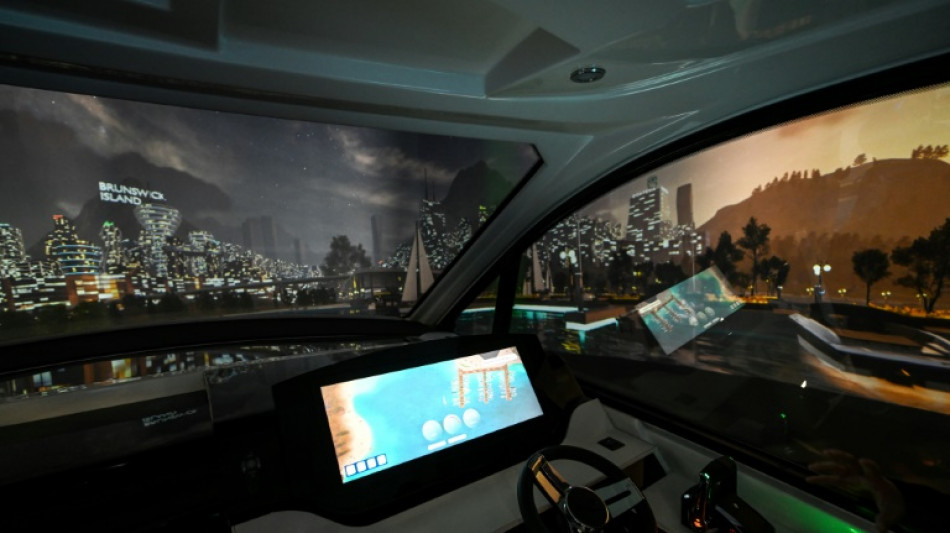
A boat prototype by US company Brunswick offers the best trajectory to enter a port, avoid collisions and finds available places to dock a boat and does the job without human intervention.
Another software program, offered by Hyundai's Avikus, can help maximize pleasure at sea.
One setting will ensure that the boat is ideally positioned for sunbathing or will find the best spot to enjoy the sunset and get there in time to see it.
The goal, according to company executive Carl Johansson, is to provide fuel savings, safety, and "peace of mind."
- 'Reduce crew' -
For merchant mariners, autonomous sailing is in test phase.
In Norway, an autonomous electric cargo ship has been transporting fertilizer from factory to port since last year, with the aim of reducing truck traffic.
While in Japan, an automated full-sized ferry has been in operation between two islands since last year, though for now with a crew on board.
If the reality of ships entirely without human sailors remains elusive, many navigation tools can provide valuable help, in ports or to calculate the best route according to weather.
A computer guided journey "provides much more reliable transportation," said John Cross of Memorial University in Canada.
HD Hyundai, which at CES unveiled a project to collect and analyze shipping data, said that its software will slow a ship's speed if the destination port is congested, thereby reducing fuel consumption.
Autonomy tools can also be useful in helping with maintenance by monitoring the condition of engines or propellers.
In the long run, the goal of companies is to "reduce the number of crew members," said John Cross. They may see it as a way to save money, but also to reduce risks as accidents on board are still frequent.
It is also a way of dealing with the ageing of professional seafarers and difficulties in recruiting.
The growth of work on autonomous navigation has recently been helped by the decision of the International Maritime Organization (IMO) to work on setting rules, said Rudy Negenborn of Delft University in the Netherlands.
It is still forbidden to operate an autonomous boat in international waters and new regulations are not expected before 2028.
The technologies also need refining to enhance safety, reduce energy consumption and determine which are the best sensors and what to do if they fail, said Negenborn.
In any case, "there will always be a human somewhere," he said. Whether it's a sailor following a computer on board or a supervisor on land managing several boats.
I.Khan--DT