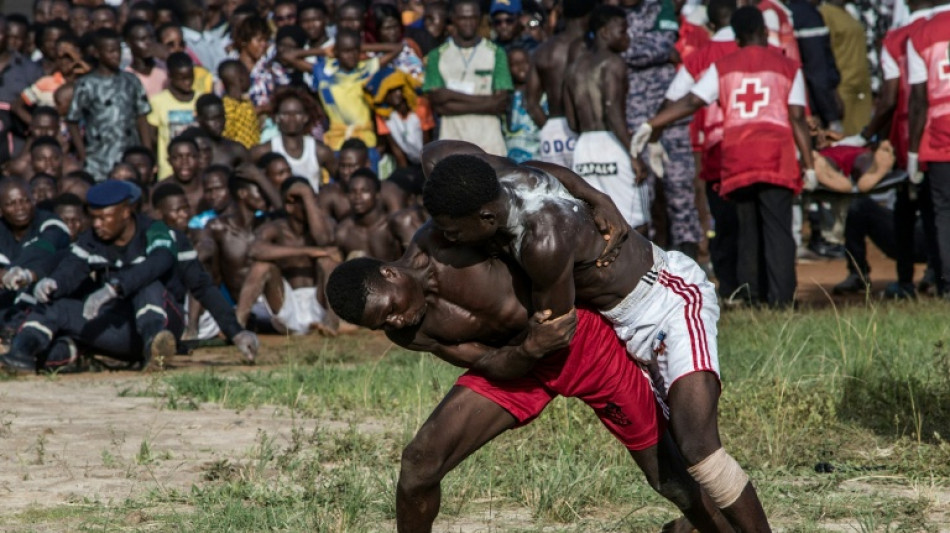
Wrestling to become a man in Togo's ancestral rite of passage / Photo: Alphonse ADZAMAVI - AFP
The bare-chested young men emerged from a forest ceremony in northern Togo chanting war songs, ready for the initiation tradition of "Evala" in which they wrestle to become men.
Every mid-July, thousands of ethnic Kabye men aged 18 to 20 take part in the ancestral rite of passage in the west African nation's Kara region, hundreds of kilometres (miles) from the capital, Lome.
And authorities hope it will soon be recognised by UNESCO as part of Togo's cultural heritage.
Ahead of wrestling, the participating "Evalo", as the young men are called, must sport three small scars near each ear, made using blades.
The next rite requires they dance with a dog until it dies of exhaustion.
They also eat the meat of the animal "for the first time" in their lives, Tchitchao canton chief Achille Samah Bidiwana told AFP.
"The dog is a strong, hardy and cunning animal. By eating its meat, the initiate takes on these qualities. In the arena, the one who floors his opponent is the winner," he said, dressed in a black-and-white ceremonial outfit with a matching traditional cap.
Then, the wrestling begins.
Each man watched his opponent's movements, often someone from another village, taking advantage of a moment of weakness to quickly grab an arm or a leg and try to bring him down.
The clashes were rough and the falls sometimes spectacular.
Injured wrestlers received first aid from the emergency teams on site -- some even had to be taken to nearby hospitals.
Around the arena, each camp cheered on its wrestlers.
"Hold tight, don't let go," one member of the crowd shouted. "Lock your legs and throw him," yelled another.
"We are great warriors!" supporters sang in the Kabye language.
"Our encouragement helps the wrestlers keep their courage right to the end of the fight," another spectator told AFP.
- Social pressures -
Although taking part in the Evala is not compulsory in Kabye tradition, young men face social pressure.
"We don't force a young Kabye to wrestle, but if he doesn't, especially if he is in good shape, he brings shame on society," said Tchaa Tidiye, a wrestling coach in the Pya canton.
According to "the standards of our grandparents, you can't have a wife before becoming an Evalo," Bidiwana, the Tchitchao canton chief, said.
"I am very proud," Nabede Kpatcha, who came to watch his son wrestle, said.
"What my parents showed me, I must pass on to my child and he will also pass it on to his children," he added.
Several high-ranking officials, including ministers and officers of the Togolese army from the Kara region, also went through the Evala.
Notable among them is Togo's former president and current leader of the Council of Ministers Faure Gnassingbe.
In power since 2005, Gnassingbe attended the matches as he does every year and addressed the wrestlers in the Kabye language.
He underwent the rite of passage like his father, Gnassingbe Eyadema, who preceded him as president.
"Faure Gnassingbe is considered one of the best wrestlers of his generation," Tidiye said.
Togo has launched the process to register the Evala on the UNESCO list of intangible cultural heritage, Culture Minister Isaac Tchiakpe told AFP.
"The Togolese government is determined to see the Evala duly recognised on the international stage," he added.
The wrestling matches have already piqued the interest of domestic and foreign tourists.
"It's a wonderful discovery," said Sandrine Plathey, who travelled from France for the occasion.
But for several years, violence by jihadist groups active in the neighbouring Sahel region has affected Togo's far north, threatening tourism to the region's lush, rolling landscapes.
I.Menon--DT