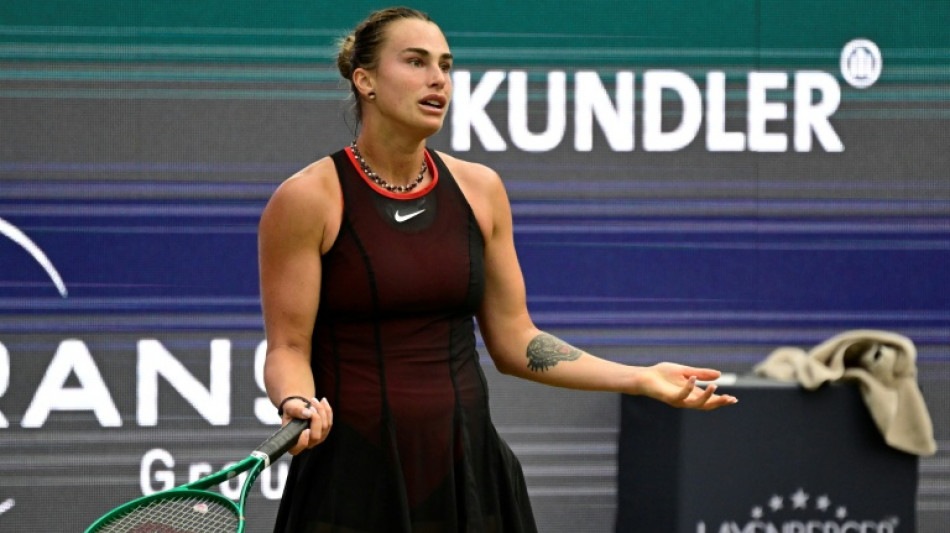
Sabalenka urges Grand Slams to 'get it done' in prize money boycott row / Photo: John MACDOUGALL - AFP
World number one Aryna Sabalenka has urged Grand Slam chiefs to solve the prize money row that prompted Wimbledon stars to limit their media duties ahead of the tournament.
Sabalenka is among a group of leading players fighting to increase the total prize money on offer at the four Grand Slam tournaments.
With Wimbledon starting on Monday, the Belarusian and her fellow players met the media at press conferences on Saturday.
But, as several stars did at the recent French Open, Sabalenka and other players again restricted their time with journalists in a prize money protest.
Wimbledon organisers have increased the total pot for this year's tournament by a record 20 percent in response to the demands of a players' group led by former WTA chief executive Larry Scott.
While Sabalenka acknowledged that was a welcome gesture, the four-time Grand Slam champion said it still wasn't enough and called for negotiations between the players and the tournament chiefs.
"It's a great start that they raised the prize money. But if you look over the last 10 years, if you compare the prize money to 2016, it's kind of like the same," she told reporters.
"I really hope we can finally get to the table and really get it done, come to a conclusion that everyone is going to be happy with.
"Hopefully we'll never have to do this again."
All England Club officials admitted they were "surprised and disappointed" by the protest, pointing out they have proposed a player council to solve the dispute.
Wimbledon's £64.2 million ($84.7 million) prize money for 2026 is around 15 percent of the tournament's overall revenue.
But that figure is short of the 16 per cent that the players want.
The Wimbledon singles champions will bank £3.6 million, an increase from the £3 million earned by 2025 champions Iga Swiatek and Jannik Sinner.
Even first round losers will receive £80,000 -- a significant rise from last year's £66,000.
- 'We don't do it for ourselves' -
Sabalenka and her fellow millionaire stars have been accused of greed by demanding more prize money.
But the 28-year-old insisted they were fighting on behalf of lower ranked players, who do not enjoy the same rewards and benefits that come with being at the top of the sport.
"Listen, we do it for the tour, we don't do it for ourselves. We do it for the rest of the players who are suffering to even hire a coach," she said.
"It's not an easy life for players who is, like, lower in the ranking. So we do it for them.
"I'm more than sure the crowd understand us. I mean, we're playing matches, we're there, we're competing, we're bringing the show.
"Now we are just limiting our media. We are just trying to really get to something that everyone is going to be happy with."
Italy's Sinner, the men's world number one, echoed Sabalenka's stance.
"I think it's getting better, even though we are not at the point where we are 100 percent happy," he said.
"Again, it's not about the money, not only about the money. It's the whole scenario we take into consideration with welfare and everything else.
"I think we talked enough about this at the moment. The Grand Slams know what we ask, then we see how it goes."
American Coco Gauff, a two-time Grand Slam winner, is also firmly behind the protest.
"I didn't have any hesitation. I think for me, we definitely welcome and appreciate the increase. It's still below what happened in 2016, below the 16 percent that we're asking for," she said.
"People have to remember there are a lot of players below the rankings. They come back from injury and are not necessarily getting that support."
D.Farook--DT