
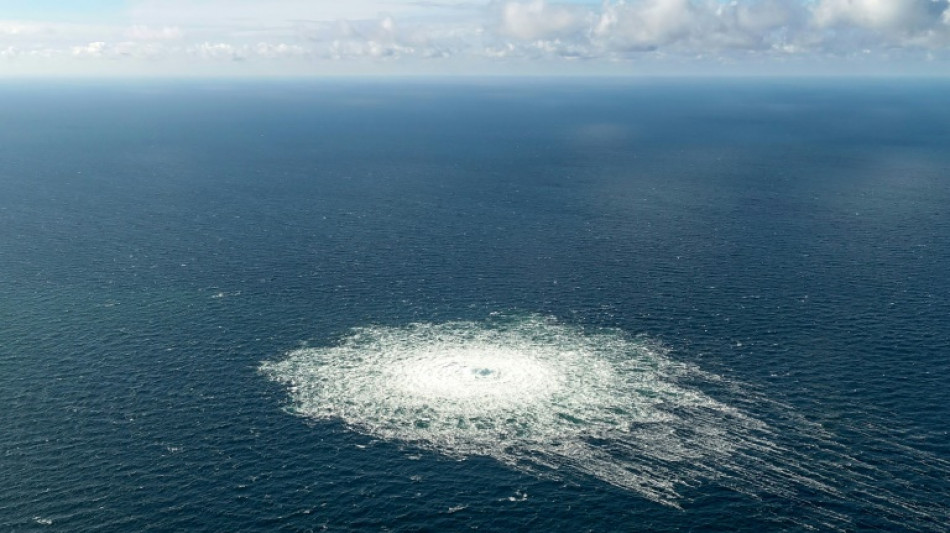
'Disturbing' Nord Stream leaks show danger of global methane emissions / Photo: Handout - DANISH DEFENCE/AFP
Planet-heating methane spewing into the atmosphere from the damaged Nord Stream pipelines only has a modest impact on climate change, say scientists, but sharply highlights the risks of fossil-fuel driven greenhouse gas emissions.
The European Union has said it believes the leaks to the strategically important pipelines, Nord Stream 1 and 2, were caused by a "deliberate act".
While not in operation the pipelines still contained gas, and Danish authorities said they will now likely continue to empty out, with leaks expected to continue for at least a week.
With only rough estimates available as to how much natural gas might bubble up through the Baltic Sea, scientists expressed concerns about climate and environmental impacts -- but stressed that the amounts of methane involved were a tiny fraction of global emissions.
"It is a real travesty, an environmental crime if it was deliberate," said Jeffrey Kargel, senior scientist at the Planetary Research Institute in Arizona, calling the leak "disturbing".
But he added: "Although the amount of gas lost from the pipeline obviously is large, it is not the climate disaster one might think."
What gas is leaking?
Natural gas is composed primarily of methane.
This is about 28 times more powerful than carbon dioxide on a century-long timescale -- although it only lingers in the atmosphere for about a decade, compared to hundreds or thousands of years for C02.
Some of the methane emitted from the pipes will be oxidised in the water into C02, said Grant Allen, professor of Atmospheric Physics at the University of Manchester.
"But given how violent the venting of natural gas appears to be, most of the gas will reach the sea surface as methane," he said.
Methane is responsible for roughly 30 percent of the global rise in temperatures to date, even though it is far less abundant in the atmosphere than CO2.
How big is the leak?
This is the subject of much uncertainty, although some experts and organisations have attempted to calculate the potential amount of gas in the pipelines.
One estimate is that there was up to 177 million cubic metres of natural gas still in Nord Stream 2, said Allen.
"This is not a small amount of gas, and represents a reckless emission of greenhouse gases into the atmosphere," he said, adding it was equivalent to the natural gas used by 124,000 UK homes in a year.
Greenpeace have used similar figures to roughly estimate that the leak emissions could be equivalent to eight months of Denmark's total greenhouse gas emissions.
Paul Balcombe, an honorary lecturer at the Department of Chemical Engineering at Imperial College London, said estimates for the gas in the pipes range from around 150 to 300 million cubic metres.
"It is unlikely that they will release all their contents," he told the Science Media Centre.
But he added if just one of the pipes did completely empty out it would be about twice as much as the worst methane leak recorded in the United States, the 2015 Aliso Canyon leak.
"It would have a very large environmental and climate impact indeed, even if it released a fraction of this," he said.
Lauri Myllyvirta from the Centre for Research on Energy and Clean Air said he has calculated an estimated potential leak of between 180 and 270 kilotons from the two pipelines.
This figure is significant but, he said, is probably only 1.5 percent of the total annual methane emissions from oil and gas operations in Russia.
The International Energy Agency estimates this was some 18 million tonnes in 2021.
How does it compare to global emissions?
The IEA has decried the enormous amount of methane that leaks from fossil fuel operations every year -- estimating the amount lost last year globally was broadly similar to all the gas used in Europe's power sector.
The leak will certainly have a "strong immediate warming effect and cause poor air quality" Piers Forster, director of the Priestley International Centre for Climate at the University of Leeds.
But ultimately its effect is small compared to the daily leaks from the world’s poorly-maintained gas networks, which see around 10 percent of global gas supply lost.
Experts said the incident further underscores the need to urgently switch from polluting fossil fuels, both to combat climate change and ensure energy security.
This year's energy crisis caused by Russia's invasion of Ukraine has already "supercharged the clean energy transition", Myllyvirta said.
Kargel, who calculated that the Nord Stream leak was roughly equivalent to 2.5 hours of global emissions, said it was a reminder of the urgent need to slash greenhouse emissions.
"The global climate is changing drastically, with huge impacts on extreme climate mounting every year, decade after decade," he said.
K.Al-Zaabi--DT



