Dubai Telegraph - Lake Urmia risks fully drying up: Iran wetlands chief

EUR -
AED 4.221739
AFN 72.42195
ALL 96.020858
AMD 433.494163
ANG 2.057799
AOA 1054.141908
ARS 1605.37418
AUD 1.624033
AWG 2.072072
AZN 1.956718
BAM 1.956216
BBD 2.312592
BDT 140.889991
BGN 1.964944
BHD 0.433904
BIF 3409.199857
BMD 1.149555
BND 1.468745
BOB 7.962695
BRL 6.016654
BSD 1.148249
BTN 105.909466
BWP 15.656401
BYN 3.420428
BYR 22531.272227
BZD 2.309292
CAD 1.573321
CDF 2603.741289
CHF 0.90665
CLF 0.026491
CLP 1046.003057
CNY 7.99659
CNH 7.915788
COP 4258.536902
CRC 539.331228
CUC 1.149555
CUP 30.4632
CVE 110.288957
CZK 24.437268
DJF 204.464414
DKK 7.472795
DOP 70.087053
DZD 152.076946
EGP 60.260464
ERN 17.243321
ETB 180.867995
FJD 2.543332
FKP 0.867843
GBP 0.863807
GEL 3.12688
GGP 0.867843
GHS 12.497715
GIP 0.867843
GMD 84.489549
GNF 10066.449332
GTQ 8.800912
GYD 240.351163
HKD 9.004042
HNL 30.397528
HRK 7.533265
HTG 150.495309
HUF 390.848437
IDR 19524.037117
ILS 3.58941
IMP 0.867843
INR 106.148671
IQD 1504.120182
IRR 1518619.243421
ISK 143.200536
JEP 0.867843
JMD 180.619234
JOD 0.815036
JPY 183.193613
KES 148.69464
KGS 100.528364
KHR 4604.080197
KMF 493.158699
KPW 1034.599226
KRW 1715.158638
KWD 0.353016
KYD 0.956804
KZT 554.468029
LAK 24640.245163
LBP 102820.787438
LKR 357.546111
LRD 210.113813
LSL 19.316712
LTL 3.394336
LVL 0.695354
LYD 7.359599
MAD 10.787196
MDL 19.978253
MGA 4780.038316
MKD 61.633189
MMK 2413.653719
MNT 4105.387442
MOP 9.260171
MRU 45.779741
MUR 53.730046
MVR 17.772551
MWK 1990.632404
MXN 20.343842
MYR 4.509126
MZN 73.460046
NAD 19.316712
NGN 1577.429825
NIO 42.251199
NOK 11.124817
NPR 169.459969
NZD 1.966194
OMR 0.442006
PAB 1.148244
PEN 3.963544
PGK 4.951162
PHP 68.643361
PKR 320.749473
PLN 4.274562
PYG 7452.780967
QAR 4.197012
RON 5.093556
RSD 117.442229
RUB 93.405395
RWF 1675.764008
SAR 4.313987
SBD 9.255824
SCR 16.567608
SDG 690.882734
SEK 10.75655
SGD 1.469594
SHP 0.862464
SLE 28.282209
SLL 24105.59984
SOS 655.042288
SRD 43.19049
STD 23793.461461
STN 24.505963
SVC 10.047139
SYP 127.054517
SZL 19.302193
THB 37.302476
TJS 11.022598
TMT 4.029189
TND 3.391437
TOP 2.767851
TRY 50.805035
TTD 7.786658
TWD 36.654125
TZS 2994.5901
UAH 50.619496
UGX 4334.922774
USD 1.149555
UYU 46.679734
UZS 13882.955262
VES 512.984476
VND 30207.423772
VUV 137.446801
WST 3.144279
XAF 656.099517
XAG 0.01419
XAU 0.000229
XCD 3.106729
XCG 2.069341
XDR 0.815977
XOF 656.099517
XPF 119.331742
YER 274.175214
ZAR 19.190724
ZMK 10347.371931
ZMW 22.36076
ZWL 370.156146
  • RBGPF

    0.1000

    82.5

    +0.12%

  • CMSD

    -0.0400

    22.95

    -0.17%

  • CMSC

    0.0000

    22.99

    0%

  • RYCEF

    -0.1500

    16.4

    -0.91%

  • NGG

    -0.0100

    90.89

    -0.01%

  • BCC

    1.7200

    71.72

    +2.4%

  • RIO

    2.0300

    89.86

    +2.26%

  • BCE

    0.6521

    25.9

    +2.52%

  • RELX

    0.3300

    34.47

    +0.96%

  • GSK

    0.3800

    53.77

    +0.71%

  • BTI

    1.0100

    60.94

    +1.66%

  • JRI

    -0.0500

    12.54

    -0.4%

  • BP

    0.2300

    42.9

    +0.54%

  • VOD

    0.1900

    14.6

    +1.3%

  • AZN

    2.1100

    192.01

    +1.1%

Lake Urmia risks fully drying up: Iran wetlands chief
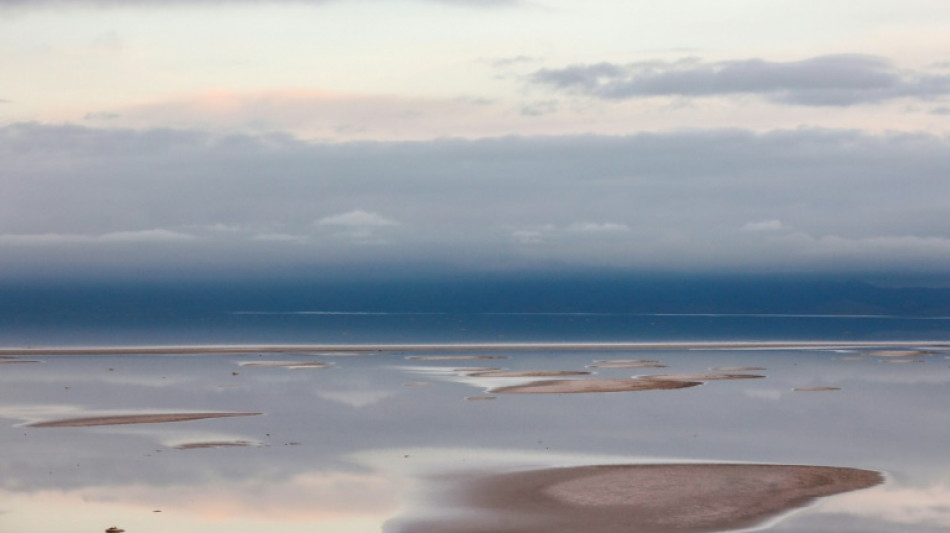
Lake Urmia risks fully drying up: Iran wetlands chief / Photo: ATTA KENARE - AFP/File

Lake Urmia risks fully drying up: Iran wetlands chief

Iran's Lake Urmia will dry out completely if rescue efforts are not prioritised over the needs of farmers in the drought gripping the region, an environment official said Tuesday.

Text size:

The warning comes just four years after a Japanese government-funded programme had raised hopes of stabilising what was once the Middle East's largest lake and turning around one of the worst ecological disasters of recent decades.

"If the water quotas are not delivered and the approved plans are not fully realised, the lake will definitely dry up and there will be no hope of its recovery," said the head of the environment department's wetlands unit, Arezoo Ashrafizadeh.

"According to the law, the energy ministry is obliged to provide the environmental water needs of Lake Urmia," she told Iran's ISNA news agency.

"But the lake has not received its water entitlement due to a decrease in rainfall among other reasons."

Ashrafizadeh said there needed to be a halt to all new dam construction and measures to "stop agricultural activities" if the lake is to be restored.

Situated in the mountains of northwestern Iran not far from the Turkish border, Lake Urmia is designated as a site of international importance under the United Nations Convention on Wetlands that was signed in the Iranian city of Ramsar in 1971.

The lake has no outlet to the sea and its former size was the result of the volume of water flowing into it matching or exceeding the volume being removed by humans or evaporating off.

The lake once covered 5,000 square kilometres (1,930 square miles). Since 1995, it has been shrinking, according to the UN Environment Programme, due to a combination of rising temperatures, reduced rainfall, dam-building and over-farming.

The drying out has threatened the habitats of shrimp, flamingos, deers and wild sheep and caused salt storms that pollute nearby cities and farms.

Ashrafizadeh said the lake "has not yet completely dried up, but its northern and southern parts have been separated and about 1,000 square kilometres (386 square miles) of the lake remain."

In 2013, Iran and the UN Development Programme launched a campaign to save the lake with funding from the Japanese government.

The plan saw some success as in 2017, the lake expanded in size to reach 2,300 square kilometres (888 square miles) before starting to shrink again in the face of a protracted drought.

In mid-July, police arrested several people for "destroying public property and disturbing the security of the population" after they demonstrated against the drying up of the lake.

It was one of spate of demonstrations in Iran this year against the drying up of rivers and lakes in drought-affected areas of the centre and west.

A largely arid country, Iran suffers from chronic dry spells that are expected to worsen with climate change.

F.El-Yamahy--DT



