
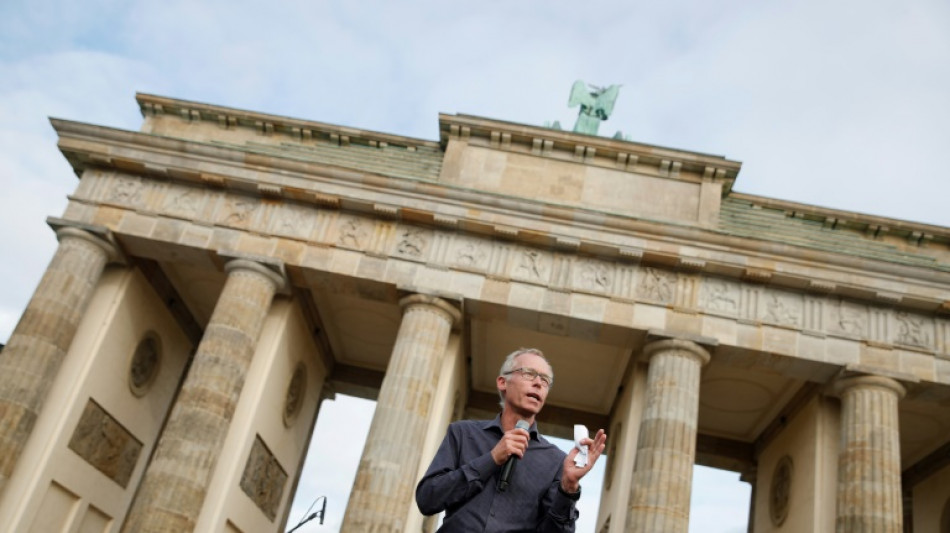
Fossil fuels causing cost-of-living crisis: climate expert / Photo: AXEL SCHMIDT - AFP/File
The cost-of-living crisis pushing millions of people towards poverty in Europe is driven by fossil fuels, according to a leading Earth systems scientist, who has warned that global heating risks causing runaway climate change.
Johan Rockstrom, director of the Potsdam Institute for Climate Impact Research and co-author of the new book Earth For All, said that spiralling inflation was in large measure a result of decades of government failures to decarbonise their economies.
"I find it very disturbing that our political leaders in Europe are unable to communicate that high living costs right now are caused by higher prices on fossil fuels," he told AFP at the book's launch on Tuesday.
"So this is fossil fuel-driven, supply-driven inflation. If 20 years ago you invested in solar (panels) or had a share in a wind farm, you're not affected today.
"The only reason why we have this crisis now is that we've had 30 years of underinvestment in preparing towards this turbulent phase which we knew would be coming," said Rockstrom.
"We've been saying since 1990 that we need to phase out the fossil fuel-driven economy towards a renewable-driven economy. And now here we are -- we're now hitting the wall."
European energy prices soared to new records last week ahead of what many analysts expect to be a challenging winter as Russia's invasion of Ukraine continues to disrupt oil and gas supplies.
The year-ahead contract for German electricity reached 995 euros ($995) per megawatt hour, while the French equivalent surged past 1,100 euros -- a more than tenfold increase in both countries from last year.
In Britain, energy regulator Ofgem said it would increase the electricity and gas price cap almost twofold from October 1 to an average £3,549 ($4,197) per year.
Rockstrom, who helped pioneer the concept of planetary boundaries -- thresholds of pollution or warming within which humanity can thrive -- said he hoped the current energy price crisis would be "communicated as another nail in the coffin" for oil, gas and coal.
"This should accelerate our transition towards renewable energy systems," he said.
- 'Giant changes required' -
Rockstrom has spent two years working on Earth For All -- a guide to help humans survive climate change -- with several of the authors of The Limits to Growth.
Written 50 years ago, that groundbreaking work warned that the development of civilisation could not go on indefinitely with no limit to resource consumption.
The new book outlines two growth trajectories this century.
The first -- "Too Little, Too Late" -- sees the economic orthodoxy of the last 40 years endure, leading to ever starker inequality as the Earth's average temperature rises by 2.5 degrees Celsius (36.5 degrees Farenheit) by 2100.
The second -- the "Great Leap" scenario -- sees unprecedented mobilisation of resources to produce five changes: eradicate poverty and inequality, empower women, transform the global food system towards more plant-based diets, and rapidly decarbonise energy.
In particular, the book says the International Monetary Fund must provide $1.0 trillion annually to poorer nations to create green jobs, and rich governments to cancel debt to low-income creditors while giving their own citizens a "universal basic dividend" to help share corporate windfalls.
Rockstrom said the tools are already available to make the Great Leap possible.
"(It) is to do with the current knowledge on all the current existing technologies and practices and policies. If we could put in place all the five turnarounds and scale them up very fast, that's the best outcome we can have."
- 'Urgency point' -
The project comes after another record-breaking summer that has seen unprecedented heatwaves and drought in Europe and China and devastating floods in Pakistan.
Rockstrom said the world had reached an "urgency point" as climate-linked disasters occur more frequently than predicted in climate models.
"Here we are -- at 1.1C (of warming now), the things that we thought would happen perhaps at 2C are happening much earlier and are hitting harder," he said.
Rockstrom was recently involved in a paper studying the "climate endgame" -- scenarios such as the complete melting of the Greenland ice sheet or heating "feedback loops", which are deemed by scientists to be extremely unlikely and, he believes, therefore understudied.
He explained the possibility of "self-amplified warming", which is when the Earth itself is triggered into producing emissions from carbon stored in forests and methane in permafrost.
"There is a risk of rolling towards a worst-case scenario, not because we are ploughing in more carbon dioxide and greenhouse gasses from (manmade) sourcing but that the Earth system itself starts emitting these greenhouse gasses."
Rockstrom said scientists needed to "open up a much broader palette of scenarios" in climate models that could incorporate the kind of low-probability, high-impact events that could lead to runaway warming.
As to whether governments were finally ready to take the kind of system-changing action needed to avoid climate meltdown, Rockstrom said that he was "actually quite pessimistic".
"If you asked me three years ago, I would have said I was optimistic -- we saw a post-Paris momentum and more policies coming into play and businesses stepping on board," he said.
"Now with the post-Covid meltdown in public trust and the rise of populism ... I cannot see that we are really ready to implement all these giant leaps.
"That's why timing is really important. We need to bring back the debate and we have to have a conversation about the urgency of action. But is it a challenge? Definitely."
W.Darwish--DT



