In US, rare earths extracted from coal mine wastewater / Photo: Pierre HARDY - AFP
In the Appalachian region stretching through the US state of West Virginia, the reddish water flowing out of retired coal mines is acidic, full of heavy metals and toxic for the environment.
But that water is also rich in rare earths, the highly coveted minerals needed for many high-tech products such as smartphones and the clean energy industry that have become a focus of geopolitical competition.
Some believe this acid mine drainage could help the United States improve its position in the increasingly vital rare earths market.
The minerals are used to manufacture powerful magnets used in electric vehicles and wind turbines, but also in drones and fighter jets.
The limited resource is one of the key challenges in the rivalry between the United States and China, which currently dominates the market, both in terms of production and refining.
Washington sees Beijing's near-monopoly as a strategic threat and wants to reduce its dependence on China by finding new producers to develop a domestic supply chain.
So far, the US only has one rare earths mine, in Mountain Pass, California, which primarily yields so-called "light" elements.
"Heavy" rare earths, which are more difficult to mine and more highly desirable, are largely sourced outside the United States.
"The US has started to make inroads on the midstream and downstream portions, but what we haven't had domestically is the front end feedstock," said Mark Gavin, the vice provost of West Virginia University (WVU).
- 'Environment cleanup' -
About 10 years ago, university researchers discovered that the wastewater from shuttered mines contained rare earths.
With public financing, they developed a pilot program to collect the runoff at a retired coal mine in Mount Storm.
The water emerging from the mine is trapped in a basin where ochre-colored deposits, typical of acid mine drainage, are visible.
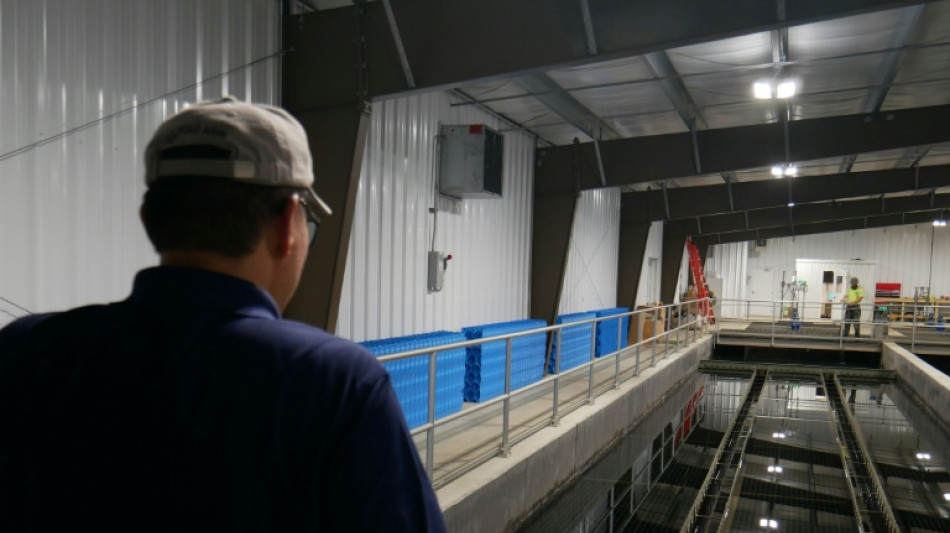
It is then piped into a small hillside plant, where it passes through three separate pools and is treated to eliminate pollutants and extract the rare earths in concentrated form.
When the water emerges on the other end to be discharged back into nature, it is nearly turquoise.
"With this operation, we achieve two purposes: one, environment cleanup, and second, recover rare earths as a valuable byproduct," said Lance Lin, director of the WVU Rare Earth Elements Initiative.
Lin said that the process is a boon for the US industry as acid mine drainage is rich in "heavy" rare earths, which are already naturally dissolved -- meaning another mine is not needed to recover them.
The potential for the Mount Storm facility is nonetheless rather limited: it can produce about four tons of rare earth oxides per year, and about 45 percent of that is "heavy" rare earths, Lin said.
That represents just a tiny fraction of US demand.
To build a more significant supply source, the university is mulling a wider rollout to more sites.
"If we produce 300 metric tons per year of rare earths, we can meet seven to eight percent" of global demand for rare earths such as terbium and dysprosium, said WVU engineer David Hoffman.
- 'Minimum supply' -
Tommee Larochelle, an engineer and specialist in the development of rare earths extraction and refining processes, questions the commercial viability of the WVU project but says it could "ensure minimum supply to the defense industry."
"If the political will and financing align, it is doable in the short term," Larochelle told AFP.
Once the rare earth concentrate has been extracted from the wastewater, the individual elements must then be separated out and processed.
The United States however only has limited processing capabilities.
The US government has been pouring money into the development of companies specializing in separation, refining and magnet production.
This year, the startup that is part of the WVU project concluded a preliminary agreement with one of these companies, REalloys, to treat rare earths extracted from acid water drainage.
"Even us partnering with this kind of partner...we're not going to solve the entire problem," said Gavin.
"But we can absolutely put into the supply chain a very meaningful amount of heavy rare earth elements that will produce the magnets that we domestically depend upon," he added.
"So, are we the solution? No. Are we part of the solution? Absolutely."
A.Al-Mehrazi--DT