
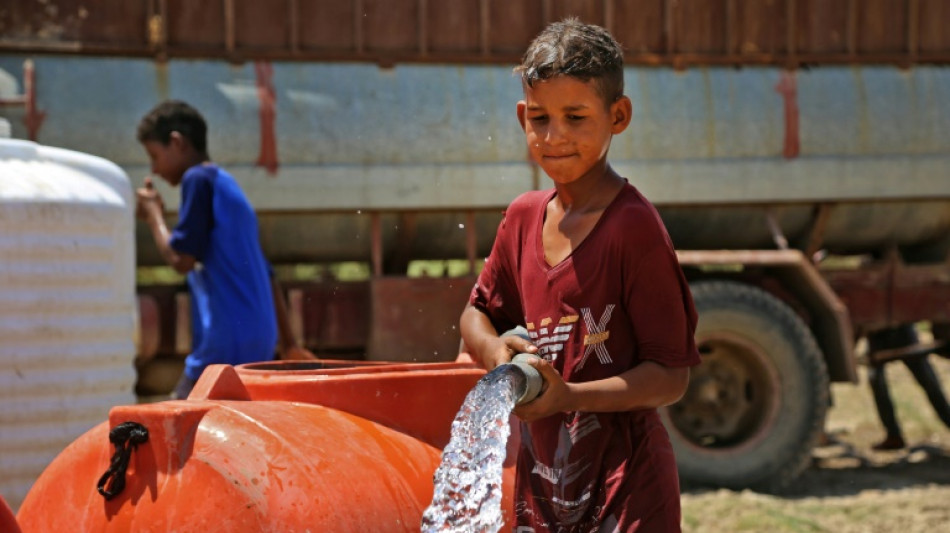
Boiling heat and no water: taps run dry in southern Iraq / Photo: Haidar INDHAR - AFP
Younes Ajil turns on the tap in his home but nothing comes out: dozens of villages are without running water in drought-hit Iraq, surviving on sporadic tanker-truck deliveries and salty wells.
For everything from drinking to bathing and washing dishes and clothes, Ajil and his eight children wait at their home in Al-Aghawat for trucked-in water from the Diwaniyah provincial authorities once or twice a week.
In burning summer temperatures that at times approach 50 degrees Celsius (122 Fahrenheit), he said he hasn't bathed for four days.
"Even if there were daily deliveries, there would not be enough" water, the 42-year-old said.
Iraq is known in Arabic as the Land of the Two Rivers, but it has seen water levels on the once mighty Tigris and Euphrates plummet.
The Euphrates, which passes through Diwaniyah province, has visibly contracted in recent months, with some of the river's weaker branches drying up.
Governor Zouheir al-Shaalan said "around a third" of his province has problems accessing water, with more than 75 villages affected.
Ajil has dug a well, but the water is salty.
"We mix that with the water from the trucks and make do," he told AFP.
- Climate migration -
Local children cry out and run towards an orange water truck as it drives up the dirt road in their village.
One person fills a tall white tank, climbing on top of it to hold the truck's hose as water gushes out, while others wait to fill smaller tanks or even cooking pots.
Children splash gleefully in a rusting old fridge that has been laid on the ground as a cramped, makeshift tub.
The UN classifies Iraq as the world's fifth most vulnerable country to climate change.
Authorities blame drought for the current water shortages, but also dams built upstream on some rivers and tributaries in neighbouring Turkey and Iran.
Ajil shares his house with his brother, Mohammed.
Like most of their neighbours, they used to make a living from farming.
But over the past two years, the drought has brought local agriculture to its knees, so they have been selling their sheep to survive.
There are around 50 houses in the village, Ajil said, but only 10 families remain.
"The rest have left," he said. "If there is no water, there is no more life."
A report published this month by the International Organization for Migration in Iraq said that "climate migration is already a reality" in the country.
More than 3,300 families across 10 provinces in the country's centre and south were displaced due to "climate factors" as of March this year, the report said, blaming water scarcity, high salinity and poor water quality.
- 'Farming is our lives' -
Hassan Naim, who manages Diwaniyah's water resources, said around 20 treatment plants were at a standstill.
Before, "some rivers ran dry, but only for a matter of days", he said.
The present crisis has been going on for more than two months.
Naim acknowledged that authorities were distributing a "very low" amount of water compared to what was needed, but cautioned against using high-salinity well-water.
Diwaniyah Governor Shaalan said that to end the shortages, the province needed to receive double the current water flows of 85-90 cubic metres (3,000-3,200 cubic feet) per second along the Euphrates.
"Diwaniyah has no border crossings, oilfields, religious sanctuaries or tourism" to generate income, he said, urging authorities in Baghdad to exclude the province from the federal government's water rationing plan.
"Farming is our lives," he said.
Hundreds of angry Diwaniyah residents have twice taken to the streets to protest the situation.
Al-Aghawat resident Razzak Issa believes a deal with Turkey, the source of the Euphrates, is needed to increase water supplies.
"Yes, we can ration usage, but it's hot. How am I supposed to ration? I don't bathe? I don't wash my clothes? I don't bathe my children? It's impossible," he said.
He too mixes salty water from his well with the trucked-in water from the authorities.
"Where can we go?" he said. "Everywhere in Iraq is "torture".
Y.I.Hashem--DT



