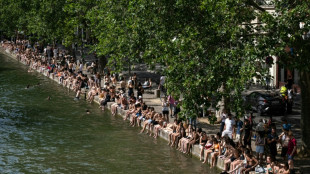
June heatwave cost UK economy more than £1bn: study / Photo: JUSTIN TALLIS - AFP
Britain's record-breaking June heatwave resulted in some 24 million lost hours of work, costing the economy £1.15 billion ($1.5 billion), according to an estimate released Thursday by the London School of Economics (LSE).
The UK, France and other European countries saw an exceptional spell of heat in June which disrupted transport, schools and hospitals, raising concerns about health and poorly-adapted infrastructure.
"Those working in jobs more highly exposed to heat and that are physically demanding, in sectors such as construction and agriculture, reduced their hours by more than those working in low-exposure and physically undemanding jobs such as academia," the study found.
On average, the reported reduction in hours worked across the week of June 22 was 0.47 hours, according to the study by the Grantham Research Institute at LSE and the Euro-Mediterranean Center on Climate Change (CMCC), which surveyed a sample of 1,950 adults across the UK.
The study showed that 3.6 percent of respondents -- equivalent to some 1.25 million workers in the population -- did not work at all that week because of the heat.
Researchers examined the perceived impacts of the heatwave on "working hours, ability to sleep and any changes to how they travelled to work," according to an LSE press release.
A majority -- 87 percent -- of respondents reported at least one health-related impact during the sweltering week, including disrupted sleep, tiredness at work as well as dizziness, fainting and a faster heartbeat.
"Our findings point to a country that remains insufficiently adapted to the changing climate," said Elizabeth Robinson, director of the Grantham Institute.
"The government cannot continue to ignore extreme heat," said Robinson, urging it to "act now".
England chalked up its warmest June on record this year, with scientists warning that extreme weather events are becoming more frequent and intense as a result of climate change.
Y.Al-Shehhi--DT