Thousands without power in US Pacific islands after super typhoon / Photo: Yuichi YAMAZAKI - AFP
Tens of thousands of people were without power Tuesday on Guam and the Northern Marianas after a super typhoon tore through the US Pacific territories, with no casualties reported.
The small island of Rota was the worst affected after a direct hit from Super Typhoon Bavi with winds up to 180 miles (290 kilometers) per hour on Monday, bringing down trees and power lines and knocking out water supplies.
"Many homes have suffered severe damage, with countless roofs completely torn off... Across the island, there is no electricity, no running water, and no mobile network service," said Rota resident Masum Dhali, 24.
"Numerous water pipelines have been broken, and many power poles have fallen, leaving the entire island without essential services," Dhali told AFP via Facebook.
"As of right now, still no water and electricity," Lou Rosario, a spokeswoman for the Municipal Operations Center on Rota, confirmed on Tuesday.
The Rota mayor's office later issued the all-clear to residents but told people to be careful of live fallen power lines, unstable buildings, floods, and debris on roads.
Local media showed a long line of cars on Rota -- home to some 1,500 people -- queueing to get drinking water as temperatures hit a hot and humid 85F (29C).
Saipan and Tinian, the two main islands of the Northern Marianas home to around 40,000 people, also lost power as did parts of nearby Guam, a separate US territory home to major military bases.
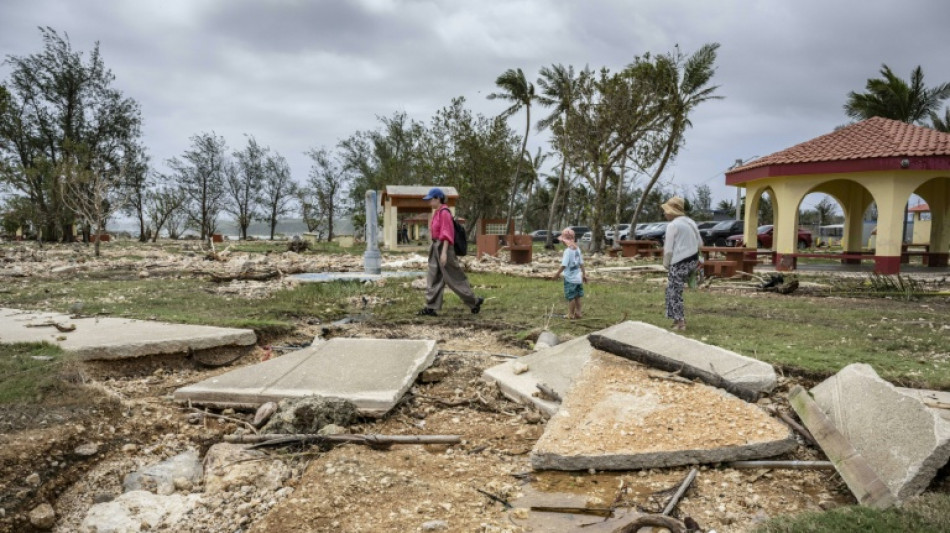
On Guam, less than 50 miles (80 kilometers) from Rota, fallen trees, bits of streetlamps and rocks were strewn over the roads and AFP saw at least one car flipped on its side.
With the exception of Rota, the damage in the region of around 210,000 people was less severe than after Sinkalu, a super typhoon that hit in April.
- 'Nowhere else to go' -
Guam resident Marie and her partner, who were clearing up the debris with an excavator, had to move out of their house after Sinlaku and were living in a van when Bavi struck.
"All of our stuff (in the van) got wet from this typhoon now, so we ended up coming here to our car because we have nowhere else to go," 37-year-old Marie told AFP.
Handyman Bob Benavente said at a seaside park where rocks had been washed ashore by the storm surge that some rainwater leaked into his house but that he and his neighbors had not suffered major damage.
"Everybody goes out and gets gas, water, all the supplies (before storms arrive)... Everyone's used to it here. It's part of the island lifestyle," the 61-year-old told AFP.
Oceans experienced their hottest June on record and could set fresh highs in the months ahead, the European Union's Copernicus Marine Service said last week.
Warmer oceans help tropical storms to intensify and add more moisture, which can fall as heavy rain.
Adding to the mix is the return this year of El Nino, a natural climate phenomenon that warms Pacific surface temperatures and typically occurs every two to seven years.
Its effects can include drought across parts of the Amazon, Indonesia and Australia, disrupted monsoons in India, and more tropical storms and typhoons in the Pacific.
Charles "Chip" Guard, 80, a meteorologist who for years worked for the National Weather Service in Guam, remembers 11 super typhoons in the Pacific in 1997.
"That was very strong El Nino year. This is a strong El Nino year, but you know the season's only just started and we already had a couple," Guard told AFP.
F.El-Yamahy--DT