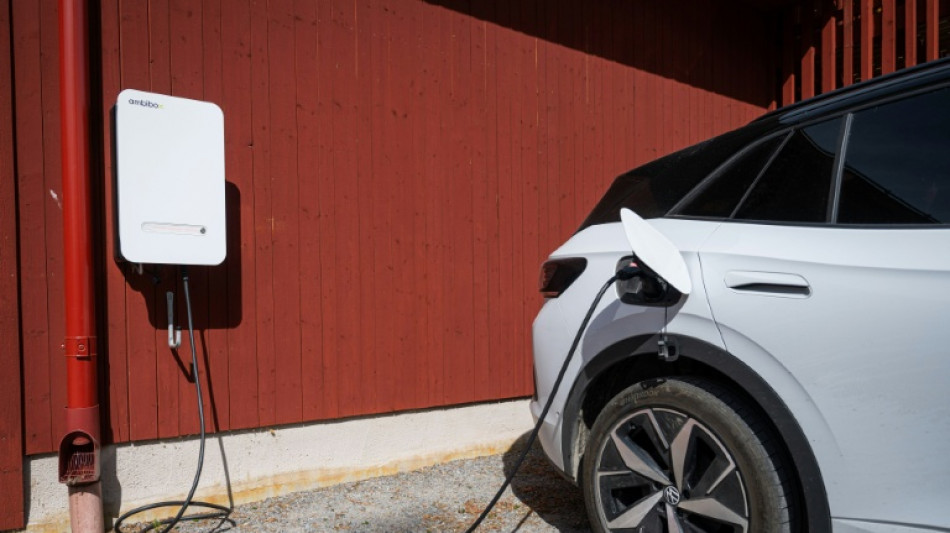
'Battery on wheels': Sweden powers homes with EVs / Photo: Jonathan NACKSTRAND - AFP
When they get home, the residents of a small housing association on the outskirts of Hudiksvall, Sweden, plug in their electric vehicles to charge them or, intriguingly, power their homes.
The two-way energy exchange enables the eight families living there to save a lot on electricity bills, resident Filip Kiltorp, a 33-year-old salesman, told AFP.
"We use the cars to power our homes when our energy demand is high," Kiltorp said, standing next to his electric vehicle.
The cars are connected to charging points by the garages for the flats, which are in traditional red buildings bordered by birch trees and a large golf course.
Electric vehicles, when not in use, often have surplus energy stored in their batteries.
But having a bidirectional charger means this stored energy can be fed back into the grid to power the flats' electrical appliances, lighting and other systems.
The software controlling the system ensures that the car batteries charge up in off-peak hours, when demand for electricity in the flats is low.
And it switches the flow so the batteries feed electricity back into the local power grid during peak usage hours, when electricity from the network is most expensive, and during power outages.
This helps stabilise the grid, explained Klas Boman, the driving force behind the project.
- 'Source of inspiration' -
It also lowers the occupants' electricity bills.
"Living here is undeniably cheaper," Kiltorp said.
"Electricity costs are a recurring topic of discussion at the office or among friends. We use the same amount of electricity as other homeowners but our bill is much lower," Kiltorp continued.
The flats are powered by other, renewable energy sources too, making them "almost self-sufficient", Kiltorp said.
No longer simple modes of transport, the cars now also serve as mobile energy storage units.
In addition, the eight flats have a shared heat pump, which helps manage heating costs.
And they have solar panels on the roofs, combined with stationary storage units that hold any surplus power generated by the solar panels.
The pilot project is a joint enterprise by housing association BRF Stenberg, carmaker Volkswagen and Swedish utility company Vattenfall.
It aims to demonstrate that V2G (Vehicle to Grid) technology can work on the scale of a residential complex.
"We're trying to be a source of inspiration for others," said Boman, who used to work in the vehicle industry.
In Sweden, the technology is also being tested in larger buildings, universities and start-ups.
Gavle University in central Sweden staged a power cut in the middle of a speech there by the higher education minister to demonstrate how its bidirectional chargers worked.
They plugged an electric car in and this kept the premises working for several hours.
"I call this a battery on wheels," Nicholas Etherden, a lecturer and researcher in energy systems at the university, told AFP.
"Cars drive about five percent of the time. Ninety-five percent of the time they are standing still in a car park somewhere," he explained.
"If we connect them to the grid, we have a resource that will, at any given time, provide more electricity than the amount people draw from the grid at the highest peak times."
- 'Enormous potential' -
On average, a vehicle battery can cover a household's needs for between five and seven days before running down.
"So we have enormous potential," the researcher said.
Wider adoption of the model still faces several obstacles.
It requires a large share of the vehicle fleet to be electric, which is far from the case in Sweden, unlike in neighbouring Norway and Denmark.
Bureaucracy and a conservative automotive sector are also slowing down large-scale adoption of the technology, even though it has been available for a long time, according to professor Lina Bertling Tjernberg.
The next major step to accelerate its development is to equip every electric vehicle with a bidirectional charging system, said Bertling Tjernberg, who is professor of power grid technologies at the Royal Institute of Technology in Stockholm.
She lamented that incentives to promote the technology were always changing.
Potential wear on the vehicles batteries is also a concern for some.
Bertling Tjernberg said this aspect needed more research although experience suggested batteries were lasting longer than expected.
Etherden, for his part, is convinced this isn't an issue, given the evidence garnered from the past 10-20 years of using electric vehicles.
"The battery will last longer than the car," he said, adding that powering an average home used the same amount of energy as accelerating from zero to five kilometres (zero to three miles) per hour.
"It's like driving behind a donkey. It's a very careful use of the battery," he said with a smile.
C.Masood--DT