Dubai Telegraph - Hong Kong's 'hero trees' lose their glory as climate warms

EUR -
AED 4.206023
AFN 72.72297
ALL 93.511654
AMD 421.701583
ANG 2.050504
AOA 1050.793343
ARS 1645.459316
AUD 1.634729
AWG 2.061495
AZN 1.945989
BAM 1.929992
BBD 2.307839
BDT 140.660272
BGN 1.936523
BHD 0.431888
BIF 3425.517525
BMD 1.145275
BND 1.46797
BOB 7.946734
BRL 5.830367
BSD 1.145877
BTN 108.297806
BWP 15.353685
BYN 3.172378
BYR 22447.39
BZD 2.304582
CAD 1.620095
CDF 2657.038139
CHF 0.92276
CLF 0.025775
CLP 1014.438637
CNY 7.739139
CNH 7.775198
COP 3934.019625
CRC 521.920702
CUC 1.145275
CUP 30.349788
CVE 109.20206
CZK 23.824068
DJF 203.53812
DKK 7.371151
DOP 67.11305
DZD 152.182966
EGP 57.158611
ERN 17.179125
ETB 181.382953
FJD 2.558201
FKP 0.854908
GBP 0.867886
GEL 3.029251
GGP 0.854908
GHS 12.938973
GIP 0.854908
GMD 83.604714
GNF 10052.650185
GTQ 8.734279
GYD 239.694722
HKD 8.975829
HNL 30.575632
HRK 7.534073
HTG 149.648846
HUF 344.326519
IDR 20327.027865
ILS 3.367281
IMP 0.854908
INR 108.01031
IQD 1500.31025
IRR 1574753.124934
ISK 142.392076
JEP 0.854908
JMD 181.226578
JOD 0.812022
JPY 183.545206
KES 148.336222
KGS 100.154026
KHR 4595.407995
KMF 486.741659
KPW 1030.747901
KRW 1731.501185
KWD 0.352857
KYD 0.95493
KZT 558.802625
LAK 25230.408025
LBP 102559.376312
LKR 383.87998
LRD 208.611647
LSL 18.547566
LTL 3.381699
LVL 0.692766
LYD 7.301151
MAD 10.588087
MDL 19.995612
MGA 4810.154941
MKD 60.798799
MMK 2405.015416
MNT 4099.376896
MOP 9.24517
MRU 45.902674
MUR 53.977086
MVR 17.706231
MWK 1988.197695
MXN 19.881699
MYR 4.655319
MZN 73.185483
NAD 18.55565
NGN 1556.565759
NIO 41.928632
NOK 11.163774
NPR 173.275391
NZD 1.99251
OMR 0.440356
PAB 1.145877
PEN 3.908263
PGK 5.025181
PHP 69.143698
PKR 318.727956
PLN 4.177585
PYG 6992.494033
QAR 4.169376
RON 5.161796
RSD 115.754152
RUB 83.572488
RWF 1704.1692
SAR 4.296951
SBD 9.232547
SCR 16.165698
SDG 687.736863
SEK 10.992475
SGD 1.468277
SHP 0.855063
SLE 28.34589
SLL 24015.848309
SOS 654.533283
SRD 42.755436
STD 23704.880199
STN 24.508885
SVC 10.026016
SYP 126.589648
SZL 18.549882
THB 37.26095
TJS 10.622157
TMT 4.019915
TND 3.334755
TOP 2.757548
TRY 53.183565
TTD 7.783911
TWD 36.143164
TZS 3006.350277
UAH 51.3185
UGX 4239.310523
USD 1.145275
UYU 46.261776
UZS 13749.026212
VES 682.625584
VND 30150.50965
VUV 136.275014
WST 3.137769
XAF 647.301074
XAG 0.017743
XAU 0.000274
XCD 3.095164
XCG 2.065166
XDR 0.805927
XOF 647.08058
XPF 119.331742
YER 273.291276
ZAR 18.855619
ZMK 10308.844751
ZMW 20.253168
ZWL 368.778083
  • CMSC

    0.0500

    22.37

    +0.22%

  • NGG

    -1.2400

    79.44

    -1.56%

  • RIO

    -2.5900

    100.08

    -2.59%

  • CMSD

    0.0000

    22.29

    0%

  • GSK

    -1.4800

    50.67

    -2.92%

  • BTI

    -0.5800

    58.91

    -0.98%

  • BP

    -1.0400

    39.1

    -2.66%

  • BCC

    3.8500

    74.66

    +5.16%

  • BCE

    0.0000

    23.28

    0%

  • RYCEF

    -0.0300

    18.4

    -0.16%

  • VOD

    -0.2300

    14.3

    -1.61%

  • JRI

    0.0500

    12.67

    +0.39%

  • RELX

    -0.8300

    31.18

    -2.66%

  • RBGPF

    -0.5300

    60.61

    -0.87%

  • AZN

    -2.9600

    174.93

    -1.69%

Hong Kong's 'hero trees' lose their glory as climate warms
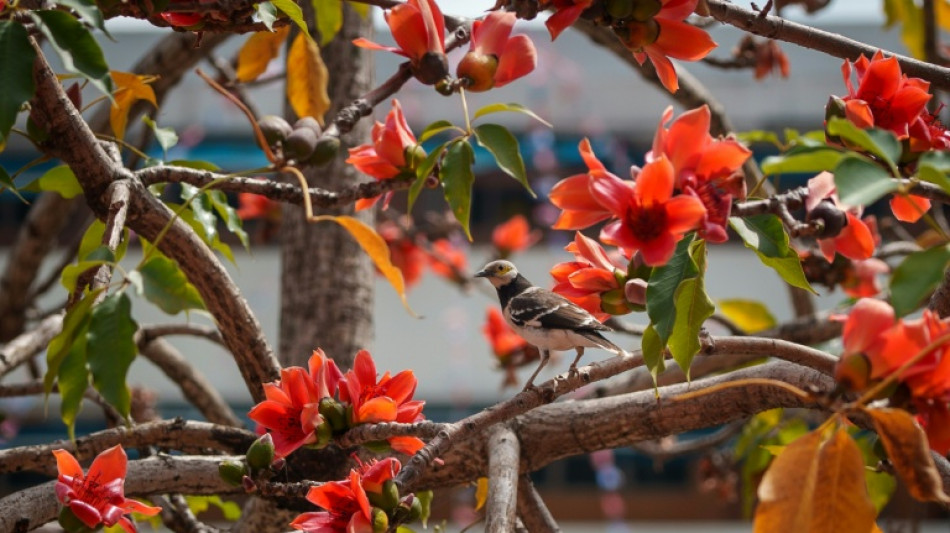
Hong Kong's 'hero trees' lose their glory as climate warms / Photo: Yan Zhao - AFP

Hong Kong's 'hero trees' lose their glory as climate warms

Hong Kong's beloved kapok trees are not blooming the way they used to, drawing concern from conservationists who see it as a sign that nature is falling out of sync as the climate warms.

Text size:

Locally known as "hero trees" for their majestic appearance, kapoks attract large numbers of photographers every spring when their bright red flowers bloom on otherwise bare branches.

But that contrast has been fading in recent years as leaves that should have been shed during winter stay put as the seasons change, worrying researchers.

"The kapok trees we see now very often have both flowers and leaves at the same time," said Lam Chiu-ying, former director of the Hong Kong Observatory.

"In some places, half the tree is covered in green leaves and the other half in red flowers."

The kapok, also known as the red silk-cotton tree, is native to tropical and subtropical Asia, including southern China.

The shift in their springtime appearance has "become increasingly common" over the past decade due to warming winters caused by climate change, Lam told AFP.

Hong Kong has just recorded its warmest winter on record, with the mean temperature from December to February hitting 19.3C, two degrees higher than normal, according to the observatory.

Angie Ng, an ecologist and conservation manager at local NGO The Conservancy Association, said the trees seemed to be blooming about two weeks earlier than usual this year, likely due to climate factors like temperature and moisture.

The trees have to divert resources to maintain both old leaves and new flowers, which may result in fewer blooms, she said.

The disruption could have knock-on effects on wildlife, as flowers provide nectar for birds and pollen for bees.

"Ecological processes function like an intricate web," Ng says.

"When the timing of animals and plants does not align properly, it can trigger ripple effects that impact not only animals dependent on those plants but also the broader ecological chains."

A.Padmanabhan--DT



