Dubai Telegraph - Europe heat sparks harmful ozone pollution, 'extreme' fire risk

EUR -
AED 4.228093
AFN 74.824423
ALL 93.226638
AMD 421.295497
AOA 1056.750053
ARS 1719.783145
AUD 1.644777
AWG 2.072059
AZN 1.954867
BAM 1.953753
BBD 2.31814
BDT 142.119343
BHD 0.434017
BIF 3405.124673
BMD 1.151144
BND 1.476057
BOB 14.012343
BRL 5.865765
BSD 1.150924
BTN 109.673926
BWP 15.653712
BYN 3.364455
BYR 22562.416614
BZD 2.314813
CAD 1.616304
CDF 2618.852233
CHF 0.933301
CLF 0.02702
CLP 1066.914398
CNY 7.771716
CNH 7.778399
COP 3730.23513
CRC 522.818071
CUC 1.151144
CUP 30.505308
CVE 110.140493
CZK 24.213129
DJF 204.950986
DKK 7.475493
DOP 66.765975
DZD 153.104429
EGP 57.696125
ERN 17.267156
ETB 185.767622
FJD 2.553119
FKP 0.853856
GBP 0.856825
GEL 3.010237
GGP 0.853856
GHS 13.479919
GIP 0.853856
GMD 84.603481
GNF 10106.575156
GTQ 8.781264
GYD 241.170515
HKD 9.027603
HNL 30.849796
HRK 7.532745
HTG 150.482504
HUF 364.513686
IDR 20690.65695
ILS 3.503661
IMP 0.853856
INR 109.668137
IQD 1507.728353
IRR 1582966.487118
ISK 142.017091
JEP 0.853856
JMD 182.318652
JOD 0.816153
JPY 180.375011
KES 149.016002
KGS 100.668118
KHR 4650.863699
KMF 491.538751
KRW 1645.669283
KWD 0.356198
KYD 0.959141
KZT 545.964678
LAK 26031.251717
LBP 103070.628234
LKR 386.433233
LRD 207.750565
LSL 18.981655
LTL 3.399028
LVL 0.696315
LYD 7.335898
MAD 10.731548
MDL 20.095807
MGA 4902.585703
MKD 61.452134
MMK 2417.037031
MNT 4136.667777
MOP 9.296933
MRU 46.095893
MUR 54.034696
MVR 17.796958
MWK 1995.72662
MXN 19.936307
MYR 4.714741
MZN 73.569574
NAD 18.981655
NGN 1569.077604
NIO 42.352124
NOK 10.98318
NPR 175.479443
NZD 1.96175
OMR 0.442596
PAB 1.150914
PEN 3.887206
PGK 5.07939
PHP 70.096015
PKR 319.591151
PLN 4.308978
PYG 6865.388212
QAR 4.195748
RON 5.247141
RSD 117.384436
RUB 92.258613
RWF 1687.835995
SAR 4.308189
SBD 9.302513
SCR 15.481419
SDG 690.686581
SEK 11.000882
SGD 1.476509
SLE 28.43061
SOS 657.770717
SRD 43.520133
STD 23826.35054
STN 24.472866
SVC 10.070616
SZL 18.984951
THB 38.483442
TJS 10.628923
TMT 4.040514
TND 3.377355
TRY 54.718698
TTD 7.804313
TWD 37.363845
TZS 3045.080179
UAH 51.627784
UGX 4307.243185
USD 1.151144
UYU 46.28888
UZS 13799.700007
VES 858.40372
VND 30260.114568
VUV 137.043837
WST 3.147792
XAF 655.233376
XAG 0.020079
XAU 0.000285
XCD 3.111023
XCG 2.0743
XDR 0.813664
XOF 655.233376
XPF 119.331742
YER 274.321302
ZAR 19.010281
ZMK 10361.675417
ZMW 21.629831
ZWL 370.667803
  • AZN

    -13.8300

    155.81

    -8.88%

  • BCE

    0.0200

    21.7

    +0.09%

  • BTI

    -0.8900

    59.76

    -1.49%

  • GSK

    -0.5600

    51.13

    -1.1%

  • BCC

    4.0100

    80.39

    +4.99%

  • BP

    -0.9100

    44.31

    -2.05%

  • NGG

    -0.3560

    79.614

    -0.45%

  • RYCEF

    0.8000

    20.3

    +3.94%

  • CMSD

    0.0190

    22.129

    +0.09%

  • RBGPF

    -3.2100

    66

    -4.86%

  • RIO

    -1.5400

    95.31

    -1.62%

  • VOD

    -0.1650

    15.615

    -1.06%

  • JRI

    -0.1350

    12.825

    -1.05%

  • CMSC

    0.0050

    21.845

    +0.02%

  • RELX

    0.5850

    36.005

    +1.62%

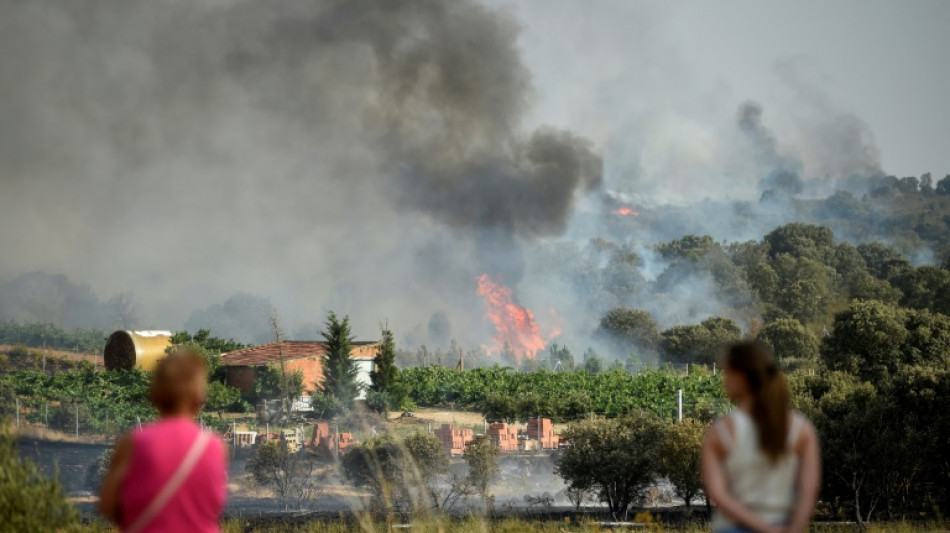
Europe heat sparks harmful ozone pollution, 'extreme' fire risk
Europe heat sparks harmful ozone pollution, 'extreme' fire risk / Photo: MIGUEL RIOPA - AFP/File

Europe heat sparks harmful ozone pollution, 'extreme' fire risk

Europe's searing heatwave is generating very high levels of harmful ozone pollution, the region's atmospheric monitoring service warned Tuesday, adding that large areas of western Europe also face "extreme" danger of wildfires.

Text size:

Record temperatures, which scientists say are driven by climate change, are predicted in France and Britain Tuesday as suffocating heat that has gripped southwest Europe and sparked ferocious wildfires moves northwards.

"Tinder dry conditions and extreme heat are exacerbating the risk of wildfires," according to a statement from the Copernicus monitoring service.

The organisation's emergency management service has warned that a large proportion of western Europe is in "extreme fire danger" with some areas of "very extreme fire danger".

The heatwave is also causing high levels of ground-level ozone, Copernicus said.

Unlike the protective layer in the upper atmosphere, this is a major greenhouse gas and component of urban smog that harms human health and inhibits photosynthesis in plants.

"The potential impacts of very high ozone pollution on human health can be considerable both in terms of respiratory and cardio-vascular illness," said Mark Parrington, Senior Scientist from the Copernicus Atmosphere Monitoring Service.

Ozone is formed as emissions from fossil fuels and other man-made pollutants react in the presence of sunlight and Copernicus said cutting emissions of these pollutants is "crucial".

Scientists have already detected "extremely high surface ozone pollution" across western and southern Europe, particularly over the Iberian Peninsula and parts of northern Italy.

Daily maximum levels of surface ozone, which normally peaks during the middle of the day, reached unhealthy levels in Portugal, Spain and Italy, according to Copernicus.

Scientists now warn that, while the situation is likely to ease across the Iberian Peninsula, very high surface ozone levels are now being seen in areas of northern and western parts of the continent as temperatures rise.

The ozone levels in these regions are forecast to peak in the next few days, before easing.

Copernicus also predicted no relief from the wildfires that have engulfed swathes of forests across parts of southern Europe.

- One million ozone pollution deaths -

In southwest France, two massive fires have created apocalyptic scenes of destruction, despite much of the country's entire firefighting capacity being deployed.

Copernicus said total carbon emissions from the wildfires in Spain so far in July are the highest seen for the June-July period since 2003.

Parrington said high surface ozone can lead to sore throats, coughing, headaches and an increased risk of asthma attacks.

The Clean Air Alliance estimates that ozone pollution causes approximately one million additional deaths per year.

Ozone is also a key concern for agricultural regions and food security.

In January, researchers estimated that persistently high levels of ozone pollution in Asia are costing China, Japan and South Korea an estimated $63 billion annually in lost rice, wheat and maize crops.

T.Prasad--DT



