
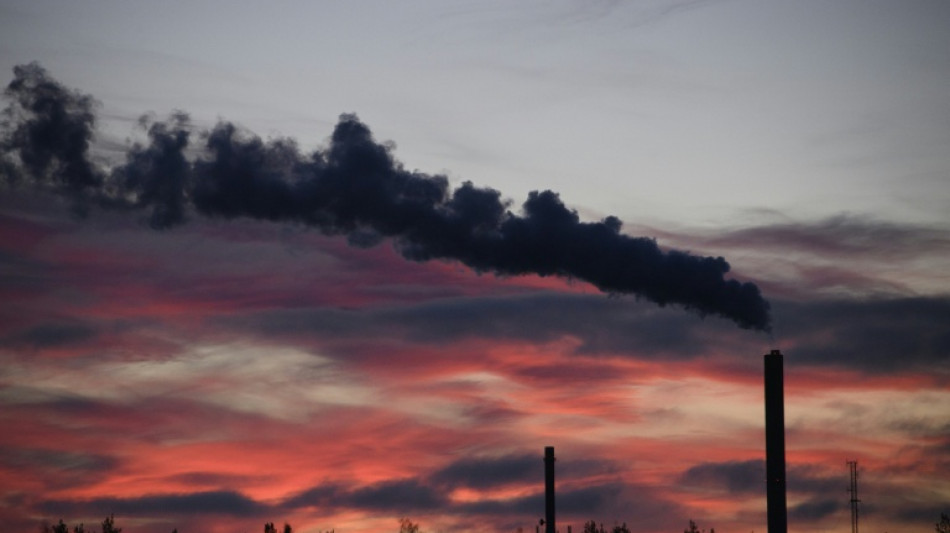
World's fossil fuel emissions to hit new record in 2025: study / Photo: Olivier MORIN - AFP/File
Global fossil fuel emissions are set to hit a new high in 2025, according to research published Thursday that also warns curbing warming under 1.5C would now be essentially "impossible".
The annual Global Carbon Budget report looks at humanity's emissions of planet-heating CO2 from burning hydrocarbons, cement production and land use -- like deforestation -- and relates the figures to the warming thresholds outlined in the 2015 Paris Agreement.
An international team of scientists found that CO2 emissions from fossil fuels will be 1.1 percent higher in 2025 than a year ago, with the huge rollout of renewable technologies across the world not yet enough to compensate for growing energy demand.
With emissions from oil, gas and coal all set to rise, the overall figure is due to reach a record of 38.1 billion tonnes of CO2.
Released as nations meet for COP30 climate talks in the Brazilian Amazon, the new study calculated a remaining allowance of 170 billion tonnes of CO2 to limit warming to 1.5C from pre-industrial levels -- the goal outlined in the Paris Agreement.
"This equates to four years of emissions at the current rate before the budget for 1.5C is exhausted, so that is impossible, essentially," said Pierre Friedlingstein of Britain's Exeter University, who led the research.
The failure to cut planet-heating emissions is overshadowing the COP30 in the rainforest city of Belem -- the conference taking place this week without the presence of the United States, the world's second largest polluter.
Despite indications that 2025 will be one of the hottest years ever recorded, nations' future climate plans have also fallen far short.
"Collectively, the world is not delivering," Glen Peters, at the CICERO Center for International Climate Research, told AFP.
"Everyone needs to do their bit, and all of them need to do more."
- Not yet peaked -
Peters said fossil emissions in China were largely "flat" this year, particularly from highly polluting coal, which could indicate that renewables will start to take a greater share of energy demand.
But he said policy uncertainty in the world's biggest carbon polluter meant it was too early to declare it had reached a peak.
"The balance is shifting towards where you would start to expect emissions to go down, but it will take some time," he said.
In the US, coal emissions rose 7.5 percent, as higher gas prices saw power generation switched to the more polluting fuel.
Overall, both the US and EU bucked recent downward trends with increased emissions, partly linked to cooler winter months spurring demand for heating.
In India, an early monsoon and strong renewables growth helped drive a smaller CO2 rise than in recent years.
The study, published in the journal Earth System Science Data, found that 35 countries had now managed to reduce their emissions while also growing their economies -- twice as many as a decade ago.
Humanity's total emissions including from land were projected to reach 42.2 billion tonnes this year -- slightly lower than last year, although this was subject to wide uncertainty.
Researchers said a reduction in deforestation and damaging fires in South America -- partly linked to the end of very dry 2023-2024 El Nino conditions -- had played a role in reducing net land use emissions.
H.El-Hassany--DT



