Dubai Telegraph - Treat carbon storage like 'scarce resource': scientists

EUR -
AED 4.218957
AFN 74.661225
ALL 91.582971
AMD 417.457719
ANG 2.056463
AOA 1054.440663
ARS 1743.614232
AUD 1.610725
AWG 2.06753
AZN 1.957227
BAM 1.958584
BBD 2.314189
BDT 141.100567
BGN 1.933647
BHD 0.43308
BIF 3445.883141
BMD 1.148628
BND 1.468274
BOB 11.289342
BRL 5.906291
BSD 1.149053
BTN 110.098541
BWP 15.582625
BYN 3.475741
BYR 22513.103189
BZD 2.310945
CAD 1.607792
CDF 2654.479062
CHF 0.944284
CLF 0.027911
CLP 1102.062801
CNY 7.693107
CNH 7.700293
COP 3657.609688
CRC 514.039631
CUC 1.148628
CUP 30.438634
CVE 110.55587
CZK 24.347696
DJF 204.134569
DKK 7.475389
DOP 67.81758
DZD 153.643935
EGP 60.011386
ERN 17.229416
ETB 187.686889
FJD 2.545249
FKP 0.859109
GBP 0.857505
GEL 2.990867
GGP 0.859109
GHS 13.237162
GIP 0.859109
GMD 84.42856
GNF 10101.666796
GTQ 8.768617
GYD 240.39904
HKD 9.011042
HNL 30.845651
HRK 7.534658
HTG 150.176082
HUF 364.287725
IDR 20459.4717
ILS 3.487958
IMP 0.859109
INR 110.252582
IQD 1505.265866
IRR 1578903.655694
ISK 139.202636
JEP 0.859109
JMD 181.437904
JOD 0.814422
JPY 180.197158
KES 148.759217
KGS 100.447935
KHR 4656.761237
KMF 491.613064
KPW 1033.765308
KRW 1592.044397
KWD 0.353962
KYD 0.95759
KZT 513.710212
LAK 25757.976881
LBP 102859.612165
LKR 380.330553
LRD 198.788625
LSL 18.680779
LTL 3.391599
LVL 0.694794
LYD 7.294223
MAD 10.886907
MDL 20.194321
MGA 4981.210628
MKD 61.619198
MMK 2411.949927
MNT 4132.823691
MOP 9.2846
MRU 46.225512
MUR 54.640655
MVR 17.746733
MWK 1992.492937
MXN 19.78965
MYR 4.690656
MZN 73.40923
NAD 18.680942
NGN 1529.662418
NIO 42.280099
NOK 10.809019
NPR 176.162473
NZD 2.008793
OMR 0.442789
PAB 1.149063
PEN 3.877412
PGK 5.114426
PHP 72.2606
PKR 318.484727
PLN 4.363465
PYG 6811.860614
QAR 4.19998
RON 5.263476
RSD 117.119869
RUB 96.935341
RWF 1687.950767
SAR 4.280492
SBD 9.18961
SCR 16.157873
SDG 690.903792
SEK 11.290555
SGD 1.465768
SHP 0.858627
SLE 28.314099
SLL 24086.139517
SOS 656.64482
SRD 43.585257
STD 23774.274604
STN 24.535303
SVC 10.054598
SYP 14934.457826
SZL 18.674871
THB 38.295672
TJS 10.59989
TMT 4.031683
TND 3.380004
TOP 2.76562
TRY 56.015171
TTD 7.800223
TWD 36.503811
TZS 3043.85889
UAH 51.337638
UGX 4532.442628
USD 1.148628
UYU 46.207089
UZS 13604.57507
VES 973.444877
VND 29889.590367
VUV 135.812798
WST 3.158992
XAF 655.957
XAG 0.01734
XAU 0.000262
XCD 3.104224
XCG 2.070844
XDR 0.812139
XOF 655.957
XPF 119.331742
YER 271.708303
ZAR 18.687948
ZMK 10339.031894
ZMW 22.584693
ZWL 369.857655
SSP 6551.981415
MXV 2.243593
  • JRI

    -0.0600

    11.55

    -0.52%

  • CMSC

    0.0400

    20.71

    +0.19%

  • GSK

    -0.8400

    50.22

    -1.67%

  • RIO

    -0.6700

    97.37

    -0.69%

  • AZN

    -0.0600

    166.08

    -0.04%

  • NGG

    -0.8000

    76.8

    -1.04%

  • BCC

    0.1600

    75.69

    +0.21%

  • CMSD

    0.0000

    20.45

    0%

  • RBGPF

    -1.6900

    68.3

    -2.47%

  • BTI

    -0.1900

    55.83

    -0.34%

  • RYCEF

    0.7100

    20

    +3.55%

  • BCE

    -0.2200

    22.06

    -1%

  • BP

    -0.8400

    44.58

    -1.88%

  • VOD

    -0.5700

    16.95

    -3.36%

  • RELX

    -0.9700

    33.41

    -2.9%

Treat carbon storage like 'scarce resource': scientists
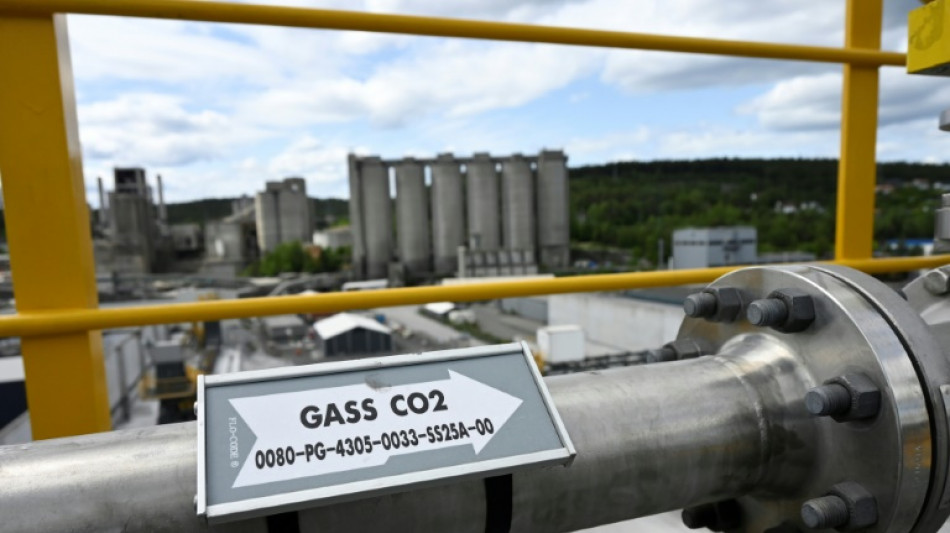
Treat carbon storage like 'scarce resource': scientists / Photo: Jonathan KLEIN - AFP

Treat carbon storage like 'scarce resource': scientists

The amount of carbon dioxide that can be stored underground is vastly overestimated, new research said Wednesday, challenging assumptions about the "limitless" potential this approach holds to reducing global warming.

Text size:

Carbon capture and storage (CCS) is complex and costly, and critics say it cannot meet the urgent need to slash planet-heating emissions and meet the world's climate targets.

One approach works by avoiding emissions at a polluting source -- such as a factory smokestack. Another, known as direct air capture, pulls CO2 from the atmosphere.

But both require the CO2 captured to be injected into rock and locked away underground for centuries or millennia in deep geologic formations.

At present, carbon capture plays a vanishingly small part in addressing the climate crisis. But scientists and policymakers consider it a necessary tool to help bring future warming down to safer levels.

However, in a new paper published in the prestigious journal Nature, a team of international scientists has sharply revised down the global capacity for safely and practically storing carbon underground.

They estimated a global storage limit of around 1,460 billion tonnes of CO2 -- nearly 10 times below scientific and industry assumptions.

This "reality check" should better inform decision-makers considering carbon capture in their long-term climate policies, the study's senior author, Joeri Rogelj, told AFP.

"This is a study that helps us understand -- and actually really corrects -- the working assumption of how much carbon, or CCS capacity, would be available if one takes a practical and a prudent approach," said Rogelj, an expert in carbon capture from Imperial College London.

- 'Scarce resource' -

To reach this revised figure, the team -- led by the International Institute for Applied Systems Analysis -- took existing assumptions about carbon storage and ruled out locations deemed risky or economically unviable.

This included, for example, injecting CO2 below major civilian centres, into zones of known seismic activity, or many hundreds of metres beneath the oceans.

The findings underscored that carbon storage should be treated as "a scarce resource that needs to be deployed strategically to maximise climate benefits rather than... a limitless commodity", the study said.

This storage limit could be breached by 2200, the authors said, noting they could not account for possible advances in carbon capture, or other technologies, in future.

Fully exhausting this capacity could lower global temperatures by 0.7C -- but that should be reserved for future generations who may need it most, the authors said.

The IPCC, the UN's expert scientific panel on climate change, says carbon capture is one option for reducing emissions, including in heavy polluting sectors like cement and steel.

But it remains infinitesimal: Rogelj said the amount of carbon captured every year at present amounted to approximately one-thousandth of global annual CO2 emissions.

T.Jamil--DT



