
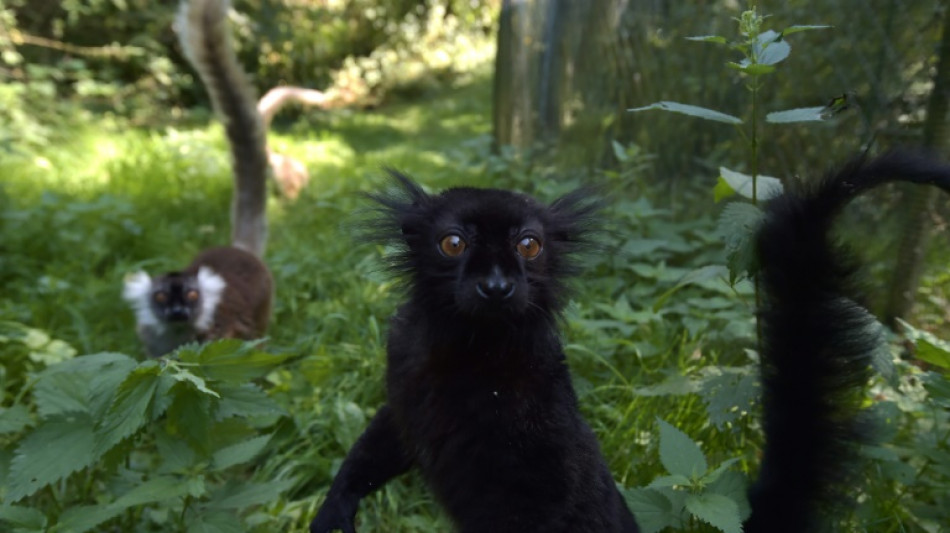
Alpha males are rare among our fellow primates: scientists / Photo: PATRICK HERTZOG - AFP/File
New research on Monday contradicted the commonly held idea that males dominate females among primates, revealing far more nuanced power dynamics in the relationships of our close relatives.
"For a long time we have had a completely binary view of this issue: we thought that a species was either dominated by males or females -- and that this was a fixed trait," Elise Huchard, a primatologist at the University of Montpellier in France, told AFP.
"Recently, this idea has been challenged by studies showing that the truth is much more complicated," said the lead author of a new study published in the journal PNAS.
The French-German team of researchers combed through scientific literature for interactions between male and female primates that revealed their hierarchical relationships.
These included aggression, threats and signs of dominant or submissive behaviour, such as when one primate spontaneously moved out of the way of another.
Over five years, the team gathered data from 253 populations across 121 primate species, including a range of monkeys, lemurs, tarsiers and lorises.
They found that confrontations between members of the opposite sex were much more frequent than had been previously thought. On average, more than half of these interactions within a group involved a male and a female.
Males clearly dominating females, which was defined as winning more than 90 percent of these confrontations, was only observed in 17 percent of the populations. Among this minority were baboons and chimpanzees, which are the closest living relatives to humans.
Clear female domination was recorded in 13 percent of the primate populations, including lemurs and bonobos.
This meant that for 70 percent of the primates, either males or females could be at the top of the pecking order.
- Battle of the sexes -
When male domination was particularly pronounced, it was usually in a species where males have a clear physical advantage, such as bigger bodies or teeth.
It was also more common among ground-bound species, in which females are less able to run and hide compared to their relatives living in the trees.
Females, meanwhile, tended to dominate over societies when they exerted control over reproduction.
For example, the genitals of female baboons swell when they are ovulating. Males jealously guard females during these few days of their menstrual cycle, making sure that other competitors cannot mate with them.
However in bonobos, this sexual swelling is less obvious.
"Males never know when they are ovulating or not. As a result, (the female bonobos) can mate with whoever they want, whenever they want, much more easily," Huchard said.
Female dominance is also more common when females compete with each other, and when males provide more care for the young.
In these species, females are often solitary or only live in male-female pairs. This means that monogamy is closely linked to female dominance.
Can these results be extrapolated to our own species? There are a great many differences between humans and our fellow primates, Huchard emphasised.
But we would broadly fall into the middle category in which neither males nor females always have strict dominance over the other.
"These results corroborate quite well with what we know about male-female relationships among hunter-gatherers, which were more egalitarian than in the agricultural societies that emerged later" in human history, Huchard said.
Y.Sharma--DT



