
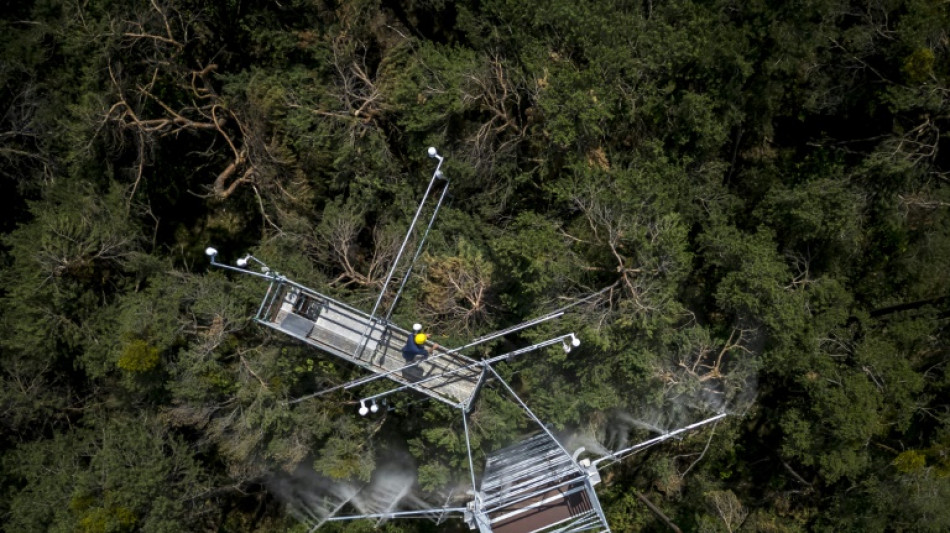
Facing climate change, Swiss trees get mist before they're missed / Photo: Fabrice COFFRINI - AFP
In a Swiss pine forest, the treetops are being sprayed with mist in a bid to discover the effect that drier or wetter air has on their ability to survive.
Eighteen scaffolding towers have been erected between the trees in the Pfynwald in Switzerland's southern Wallis region. High-pressure nozzles mounted on the towers spray vapour over the canopy of some 60 Scots pines, standing 15 metres (49 feet) tall.
The study is a unique experiment designed to separate out and analyse the different effects of soil drought and air dryness in a natural forest ecosystem.
"The goal is not to spray forests to save them, but to understand why a lack of water in the atmosphere has such a significant impact on forests," project director Charlotte Grossiord told AFP.
The trial is being conducted by the Swiss Federal Institute for Forest, Snow and Landscape Research (WSL) and the Swiss Federal Institute of Technology in Lausanne (EPFL).
The vapour studies aim to measure the rate of dieback in trees, where the leaves and branches start to wither away. It should help experts anticipate when similar forests will be affected, said Giovanni Bortolami, one of the researchers.
The objective is to develop forestry strategies and influence the choice of tree species to plant in future, as Switzerland experiences increasingly dry summers.
By 2060, there will be 25 percent less rain in the summer and droughts will generally last longer, the environment ministry has said.
Another goal is to better understand tree mortality, given that trees "allow us to estimate the concentration of carbon dioxide in the atmosphere", with CO2 being the main climate-warming greenhouse gas, said Grossiord, a professor of plant ecology.
- Thirsty air -
The Pfynwald is one of the biggest continuous Scots pine forests in Europe. It counts roughly a thousand trees, all around a century old.
At 615 metres (2,017 feet) above sea level, and surrounded by towering Alpine mountains in the Rhone river valley, the forest is one of the hottest and driest places in Switzerland -- ideal conditions for the researchers.
They have been working in the Pfynwald since 2003, studying the dieback of Scots pines due to soil dryness.
Some parts of the forest are irrigated, while in others, translucent plastic prevents rainwater from reaching the soil.
The mist-creating sprays were introduced last year to study the effects of air dryness, as climate change is resulting in another worrying environmental parameter: thirsty air.
At equal humidity, warm air is more "thirsty" than cold air. This "thirst" is called vapour pressure deficit (VPD).
VPD is a major factor in determining how much water trees will evaporate through their leaves. With global warming, VPD is increasing, which can cause water stress in vegetation.
"Imagine a glass of water in a desert and a glass of water in a rainforest. The temperature is the same. The glass of water empties very quickly in the desert, but not in the rainforest," said Bortolami.
It's "exactly the same for trees", which evaporate much more water if the air is drier and therefore "consume water from the soil more quickly", the plant ecophysiology researcher explained.
- Surprising results -
The nozzles diffuse water vapour onto part of the canopy during the day to reduce air "thirst" by about 20 to 30 percent.
The researchers then compare the data with the trees that did not get the water vapour spray.
Cables on the forest floor are hooked up to sensors on the tree trunks, which continuously measure their diameter and sap flow -- an indicator of water stress. The researchers take other monthly measurements on site.
The study will continue until 2028.
The initial results show that a lack of water in the soil speeds up the dieback of foliage -- an expected outcome for the researchers.
"However, we observed that a dry atmosphere will slow down the dieback process rather than speed it up. That's what really surprised us," said Grossiord.
The measurements revealed that with less moisture in the atmosphere, trees close their pores to conserve water.
But these acclimatisation mechanisms can only help a tree so much. In the Pfynwald, as in other dry Alpine valleys, Scots pines are dying out while young oak trees, some only waist high, are taking their place.
A.Krishnakumar--DT



